

Beyond the Ten Positions: Reading the Hidden Dimensions of the Celtic Cross Spread
What happens between the ten cards of the Celtic Cross once each position has been interpreted? The suit that never appeared, elements that weaken one another along the vertical axis, recurring shapes in the images, the card left at the bottom of the deck, and the quintessence card. One example—a new job offer—guides us through it all.
A spread about a job offer lies on the table. In the near-future position is the Four of Swords, a card that asks for room to breathe and think. In the position indicating direction is the Three of Wands, opening up the horizon. We could read the two cards and say, “First, pause; then move forward.” That is a good beginning, but it leaves a more interesting question: what needs to become clear during that pause for the next step to be right for the querent?
The ten positions of the Celtic Cross give a reading its structure. Once we understand what each card says in its position, we can also look at what is happening between them: a suit that never appeared, elements that weaken one another, recurring shapes in the images, and even a card left outside the spread. This perspective does not add positions to the Cross. It tests whether the story we have drawn from the positions still holds when viewed from another angle. You can find the spread’s layout and the meaning of each position in our guide to the Celtic Cross Tarot Spread; here, we will begin with all ten cards already on the table.
Ten Cards, Two Possible Readings
Suppose a querent wants to understand how to approach an offer to move into a new role over the next three months. Here is their spread, in the order of positions used at AGAT:
1. The current situation. Six of Pentacles
2. What crosses it: the challenge. Ace of Wands
3. The root. Four of Pentacles
4. The past. Eight of Wands
5. Awareness and potential. Ace of Swords
6. The near future. Four of Swords
7. The querent’s stance. Queen of Pentacles
8. The environment. Knight of Swords
9. Hopes and fears. Nine of Swords
10. The possible direction: the outcome. Three of Wands
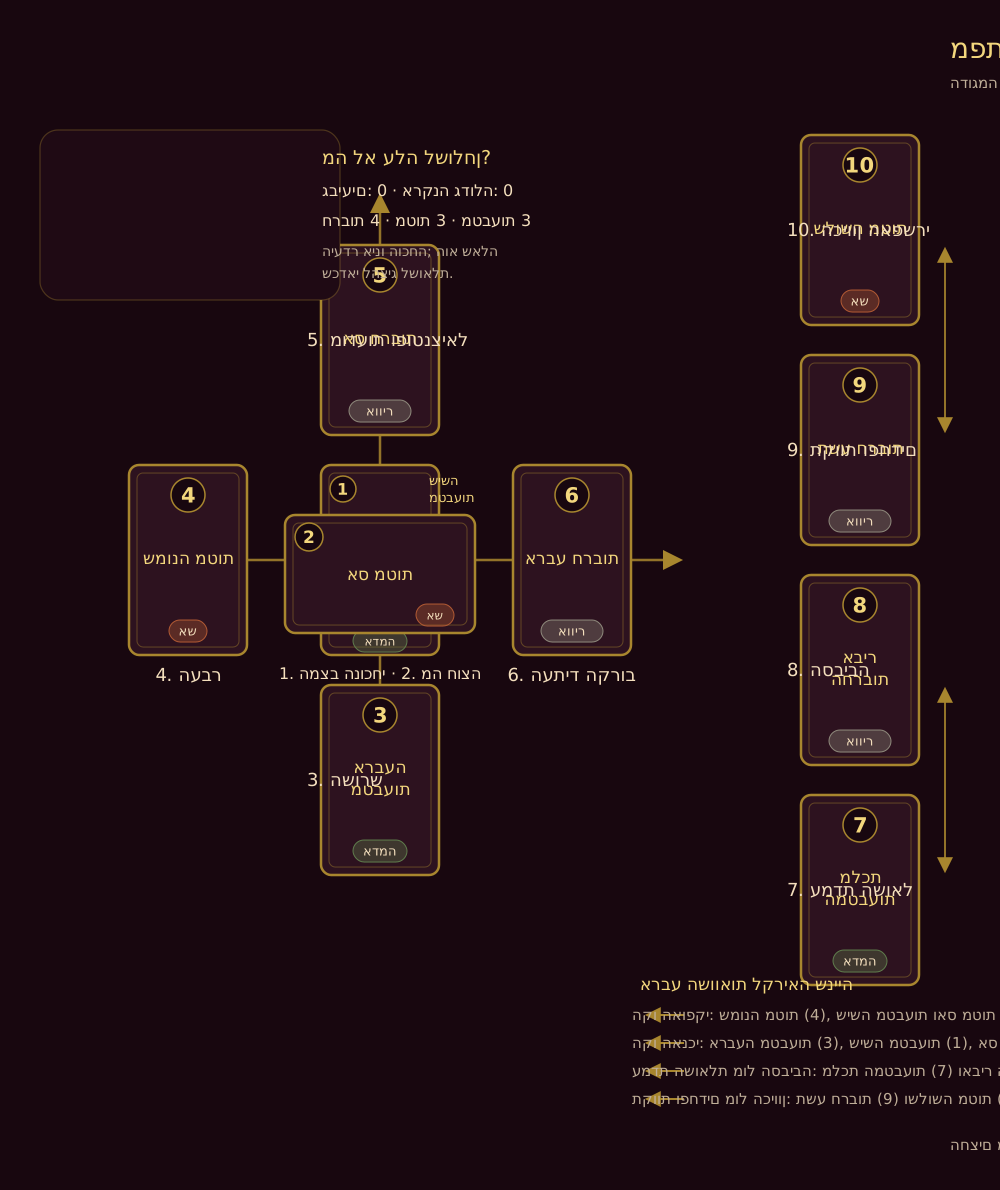
The diagram below shows the ten cards in their positions, the element associated with each, and the comparisons we will make later.
This is a fictional example created for this article. On a first reading, the Eight of Wands in the past and the Ace of Wands crossing the center might tell the story of an offer that arrived quickly and sparked a desire to begin. The Six of Pentacles at the center asks whether rewards and responsibilities are shared fairly. The Queen of Pentacles wants to know what can be relied on; the Knight of Swords in the environment pushes for a decision. The Four of Swords before the Three of Wands suggests that a brief pause does not mean movement has come to an end.
From here, we might arrive at one of two headlines: “A good opportunity—best to accept quickly” or “There is room for growth here, but first the terms need to be clarified.” Both sound plausible when we look at some of the cards. Reading beyond the positions will help us test which one accounts for the entire spread.
What Never Made It onto the Table?
There are four Swords cards here, three Wands cards, three Pentacles cards, and not a single Cup. There are no Major Arcana cards, either. This does not mean the querent feels nothing, nor does it mean the decision is minor or meaningless. A spread is a sample of ten cards from a deck; a card’s absence is not proof that something is absent from a person’s life.
But that absence offers a useful question. The Pentacles cards speak of terms, resources, and stability; the Swords fill the reading with thought, information, and worry; the Wands propel it forward. Where is the querent’s relationship with the people they would work with? Are they talking about pay and advancement while a sense of belonging on the team or a feeling of trust has yet to enter the conversation? Perhaps they are, or perhaps this issue is not central for them at all. The way to find out is to ask.
Mary K. Greer and Parsifal the Scribe suggest scanning a spread both for what recurs and for what does not appear. Here, the observation is not a verdict on the querent’s feelings. It opens up a subject that a reading focused on employment terms might miss. We discuss counting the elements in a full spread, with a separate example, in our guide How Do You Read a Full Tarot Spread?.
When the Root and the Aspiration Pull in Different Directions
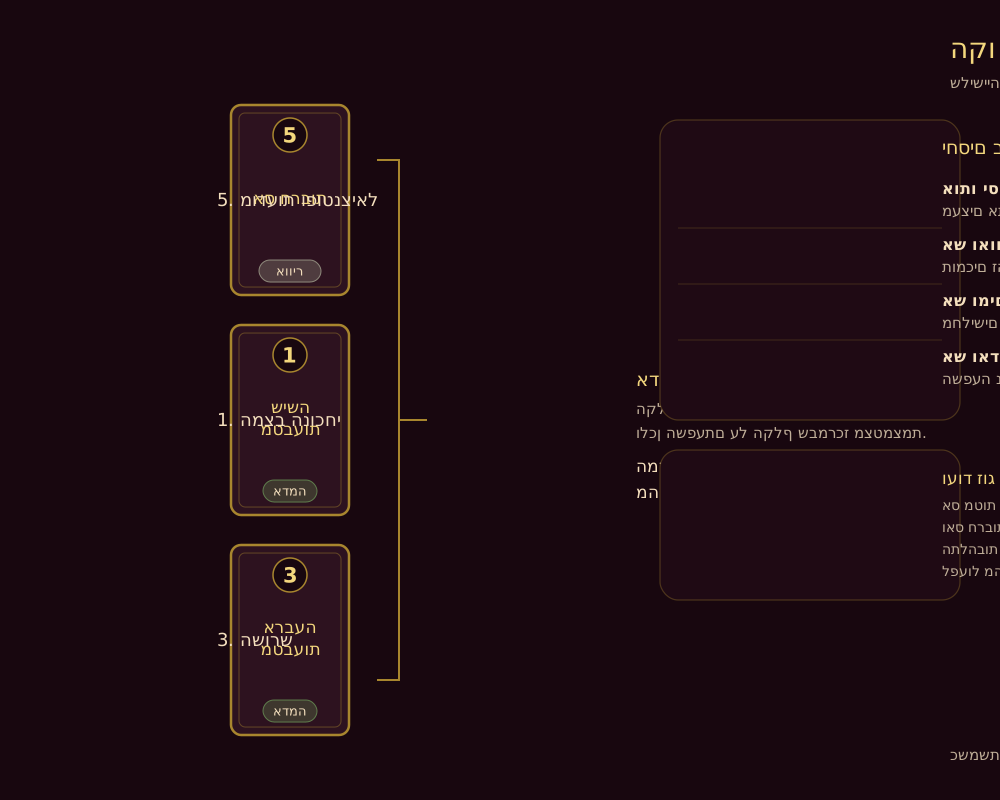
Along the vertical axis of AGAT’s version are the Four of Pentacles at the root, the Six of Pentacles at the center, and the Ace of Swords in the awareness-and-potential position. The Four of Pentacles may describe a need to protect what has already been built. The Ace of Swords calls for clarity and a decision. It is easy to look at them and say that one pulls toward security and the other toward change. But what happens to the card between them?
An approach known as elemental dignities also examines the relationships between the cards’ elements. Pentacles correspond to Earth, Swords to Air, Wands to Fire, and Cups to Water. Benebell Wen describes how proximity between cards can strengthen or weaken the way an element expresses itself in a reading:
The same element. Amplifies the quality, even when it becomes burdensome.
Fire and Air; Water and Earth. The elements support one another.
Fire and Water; Air and Earth. The elements weaken one another.
Fire and Earth; Air and Water. Their influence is relatively neutral.
In our trio, the two outer cards—the Earth-associated Four of Pentacles and the Air-associated Ace of Swords—are opposed under this system. The explanation of three-card readings states that when the outer cards oppose one another, their influence on the central card diminishes, leaving it to stand on its own. So we return to the Six of Pentacles and ask simply: what would a fair exchange look like in this role? Neither the need to hold on to what already exists nor the desire to make a swift decision can answer that question alone.
The relationship between the Ace of Wands in the challenge position and the Ace of Swords above the center adds a different tension. Fire and Air can support one another: enthusiasm finds clear expression, and a direct conversation can give momentum to action. Pressure to act quickly may also intensify in this way. The elements do not give the job offer a score; they help us see where the energy in the reading builds and where it is held back.
When using the three-card rule, it is important to decide first which three positions will be read together and to apply the same rule throughout the reading. The Major Arcana does not belong to any of the four suits; if you assign elements to those cards through astrological correspondences, it is best to choose one system and stay with it.
What Do the Images Tell Us Before We Interpret the Cards?
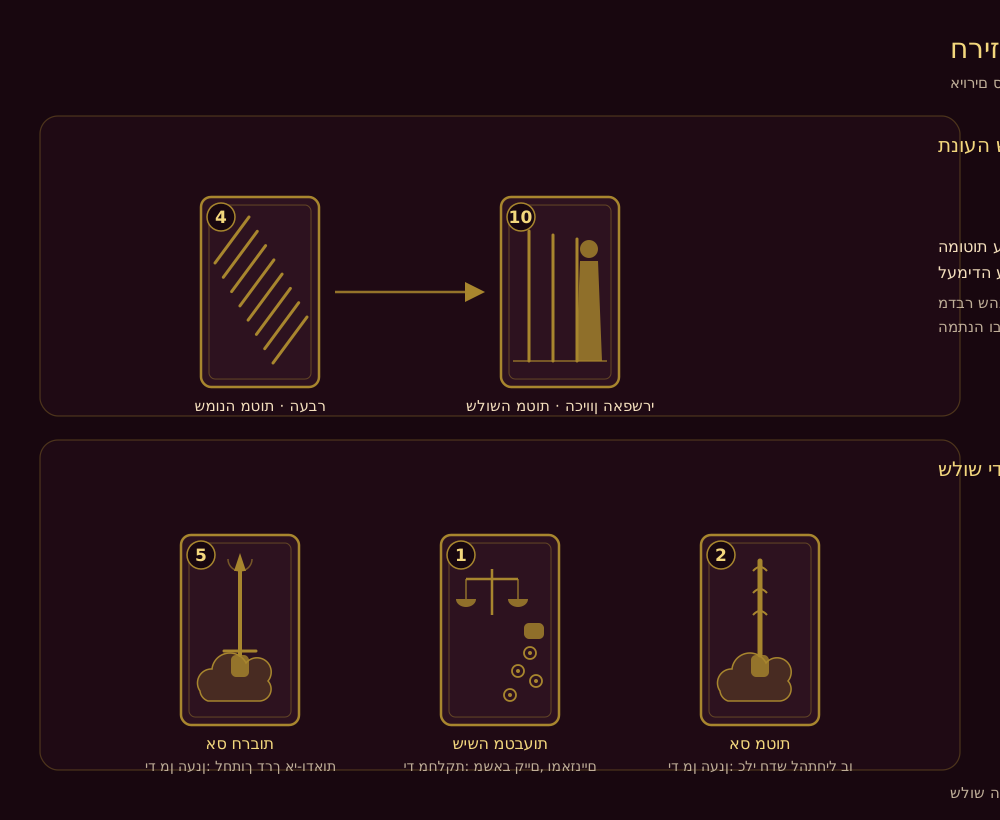
In the Rider–Waite–Smith deck, an outstretched hand appears in the Six of Pentacles: someone distributes coins while holding a set of scales. Other hands appear in the Ace of Wands and the Ace of Swords, emerging from a cloud and holding a new implement. These three hands do not all say the same thing. One distributes an existing resource; the other two offer possibilities for beginning and cutting through uncertainty. Read together, they raise a concrete question: what exactly has the querent been offered, and what has already been agreed upon in return?
There is also a shift in the lines. In the Eight of Wands, the wands move diagonally through the sky; in the Three of Wands, they stand on the ground beside a figure looking into the distance. We can see a transition from something that arrived quickly to something that requires standing still, waiting, and assessing what lies ahead. This reading grows out of shapes and movement in the images, before we ever open a list of keywords.
Camelia Elias describes a way of reading that follows lines, folds, colors, and the direction of bodies, and shares Enrique Enriquez’s suggestion to begin simply by looking. She works within the Marseille tradition; here, we have applied the principle of observation to the Rider–Waite–Smith illustrations. In another deck, the details may differ, so the visual connections we notice will differ as well. In our guide to the Celtic Cross, we discuss the figures’ gazes along the horizontal and vertical axes; here, we have added shapes and gestures that recur across cards that are not adjacent.
A Card Outside the Spread: What Remains at the Bottom of the Deck?
Suppose that after laying out the ten cards, without shuffling again, we turn over the remaining deck and find the Two of Cups at the bottom. This card does not occupy an eleventh position, and we do not use it to fix something we disliked in the spread. We can give it a role defined in advance: to suggest a question about a layer that has not yet found a place in the reading.
The Two of Cups at the bottom does not prove that a secret relationship exists or that a coworker is hiding feelings. In this case, it may bring us back to the absence of Cups among the ten cards: alongside pay and terms, does the querent want to know who they will work with and what kind of partnership might develop there? If that question resonates with them, the bottom card has helped put into words something that did not emerge in the first reading. If not, there is no reason to force it into the story.
Brigit Esselmont describes checking the card at the bottom of the deck after laying out the spread as a clue to a hidden influence. Other readers use it as a foundation card, a summary, or a way to examine their initial assumption. So if we choose to read it as a “shadow card,” it helps to clarify beforehand what we mean by shadow: here, it means a possibility that has not yet been voiced, not necessarily something dark or repressed.
The Quintessence Card: A Summary Drawn from the Numbers
The quintessence card is not drawn from the deck. It is calculated from the cards already on the table, and the resulting number is linked to a Major Arcana card. There are several ways to calculate it. In this example, we will choose one method and stay with it: an Ace equals 1, numbered cards retain their printed values, and unnumbered court cards are excluded from the total. If the total is greater than 22, its digits are added together until the result falls between 1 and 22; in this method, 22 is The Fool. Other methods assign values to court cards as well, or reduce the total differently, and may therefore produce a different card.
Here is our calculation in full: 6 + 1 + 4 + 8 + 1 + 4 + 9 + 3 = 36, and 3 + 6 = 9. The Queen of Pentacles and the Knight of Swords were excluded under our chosen rule, and the Two of Cups at the bottom of the deck is not part of the ten positions, so it does not enter the calculation. The number 9 points to The Hermit.
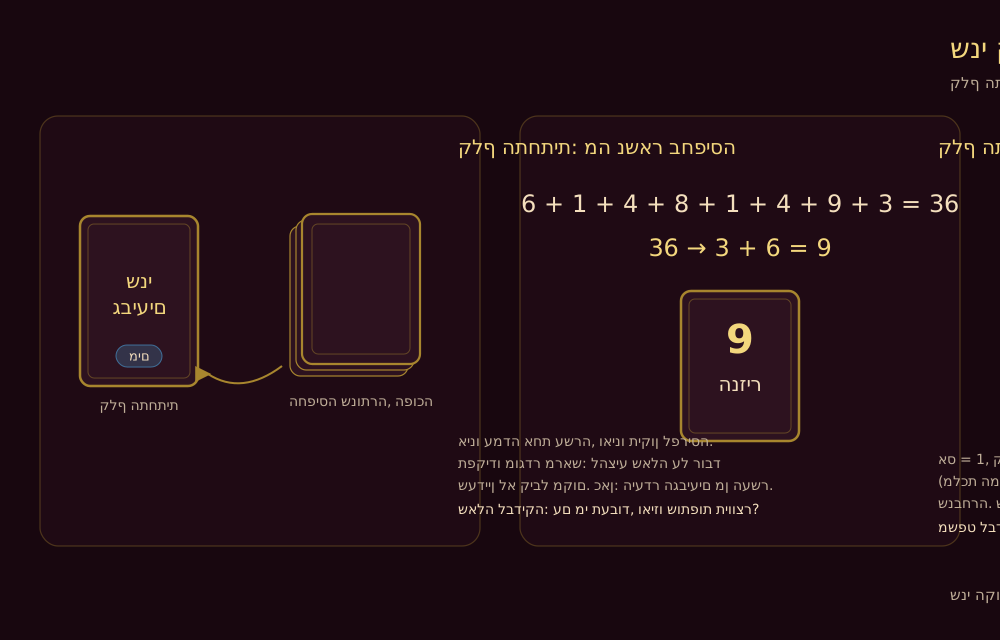
The Hermit did not physically appear in the spread. Nor does it retroactively change the fact that the spread contains no Major Arcana cards. As a quintessence card, it offers a summary question to consider: before responding to outside pressure, does the querent need time of their own to understand what is truly right for them? This echoes the Four of Swords in the near future. If the calculated card suggested a story entirely at odds with the rest of the spread, we would examine the calculation and the interpretation rather than pretend it had the final say.
Returning to the Question with Fewer Assumptions
We can now test the two headlines we began with. “Best to accept quickly” fits the Eight of Wands and the Ace of Wands, but struggles to explain the Four of Swords, the question of fairness at the center, and the tension between the Queen of Pentacles and the Knight of Swords. “There is an opening for growth here, but the terms and the relationships with the people involved need to be clarified before deciding” makes room for all of these, as well as the Three of Wands at the end.
This is still one possible reading, not knowledge of what will happen in the workplace. It leads to questions that can actually be asked: what does the written offer include? Who will be involved in the day-to-day work? How much time is available to respond? We discuss how to formulate a focused follow-up question in our guide How Do You Ask a Tarot Question?.
These additions beyond the positions do not replace the ten cards. They help us check whether our answer is attentive to what stands out in the spread, what is absent from it, and what the querent still needs to clarify outside it. If you would like to try this with a spread of your own, AGAT’s Celtic Cross spread is available here.
Sources and Research Note
Repetition, absence, and looking at the spread as a whole: Mary K. Greer, "Integrating Card Meanings in a Tarot Reading" · Parsifal the Scribe, "A Compendium of Tarot Reading Techniques". Scanning a spread for what recurs and what is missing before interpreting the individual cards.
Elemental relationships and three-card readings: Benebell Wen, "Elemental Dignities and Affinities" · Tarot Elements, "The Elemental Dignities Dictionary" · Angelorum, "How to Use Elemental Dignities in Tarot". The chart in this article summarizes the commonly accepted relationships; the three-card rule, in which opposing outer cards leave the center to stand on its own, appears in the latter two sources.
Observing images and visual connections: Camelia Elias, "The Cartomancer: The Art of Curiosity" · Tarot Heritage, review of "Marseille Tarot: Towards the Art of Reading". Reading that begins with looking, and Enrique Enriquez’s “visual rhyming” method, described in the review. Both sources concern Marseille tarot; the application to Rider–Waite–Smith is our own.
The card at the bottom of the deck: Brigit Esselmont, "Getting to the Bottom of Your Tarot Reading". Reading the bottom card as a clue to a hidden influence; its precise meaning varies among readers.
Calculating the quintessence card and its variations: Tarot Heritage, "The Quintessence Spread" · Parsifal's Wheel, "The Visual Quintessence: Six Ways to Summarize". Different calculation methods, including differences in the values assigned to court cards; this article chose one method and stated that choice explicitly.