An Introduction to Tarot—From an Italian Card Game to a Language of Symbols, Kabbalah, and Synchronicity
How did a deck of cards born in 15th-century Europe become a rich system of archetypes, mythology, Kabbalah, astrology, and personal readings? A journey from early tarot through the Golden Dawn and Rider–Waite–Smith to Crowley, Jung, and the idea of synchronicity.
A Deck of 78 Cards—and Centuries of History
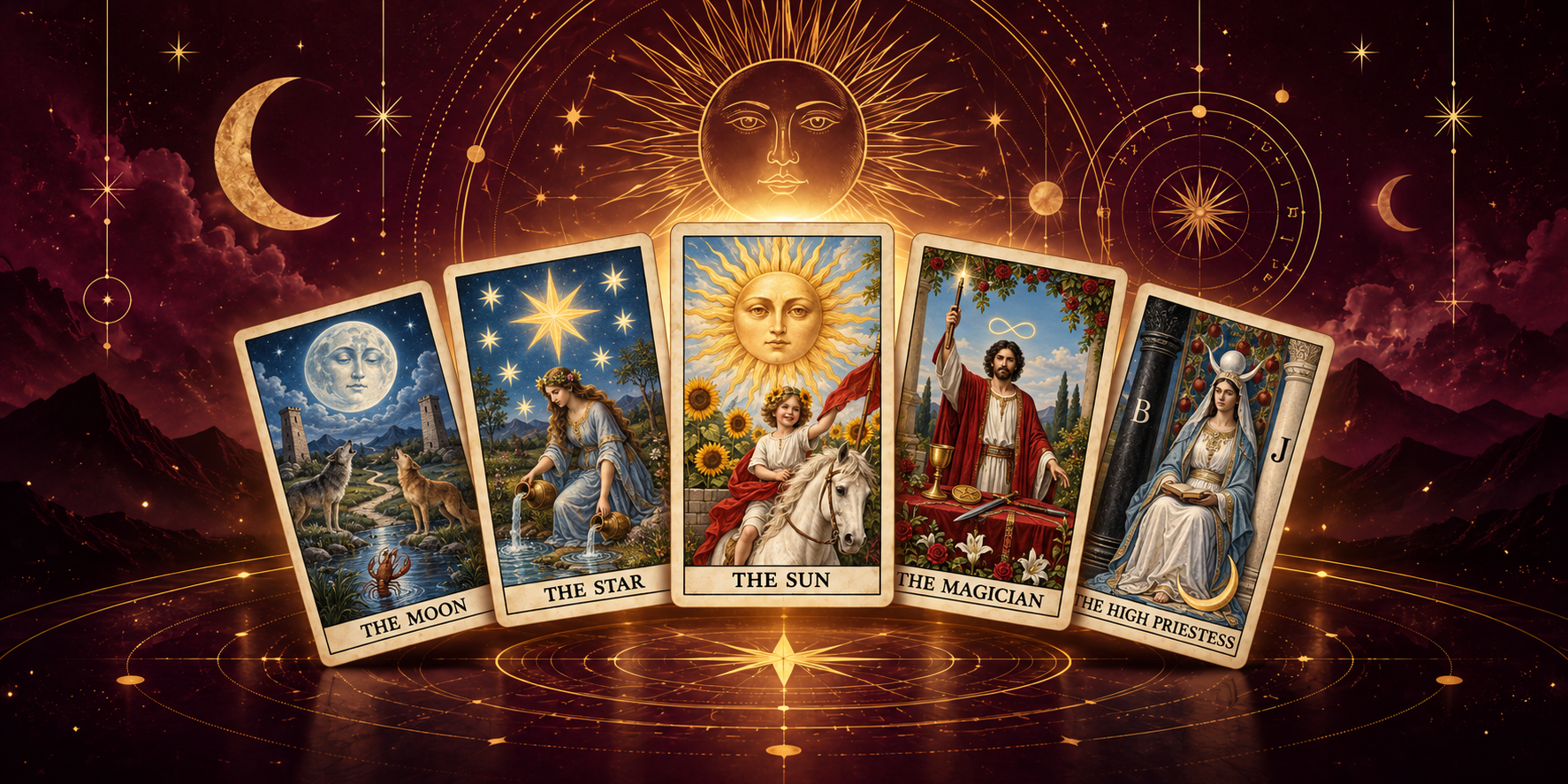
When we open a tarot deck today, it is easy to imagine that the system we know—22 Major Arcana cards and 56 Minor Arcana cards—has always existed as one complete spiritual system. In reality, its history is far more complex and interesting.
The earliest historical evidence of tarot comes from northern Italy in the 15th century, primarily the area between Milan, Venice, Florence, and Urbino. Decks such as the Visconti–Sforza were created as luxury objects, hand-painted and sometimes gilded, for aristocratic families. They were used first and foremost to play cards—not as an ancient system brought from Egypt, a secret book written in biblical times, or a prophetic tool passed down from antiquity.
This matters because the tarot we read today is the result of layers added over hundreds of years. The Italian game provided the structure. Later esoteric traditions added Kabbalah, astrology, alchemy, and mythology. Artists changed the visual language. Readers and psychologists introduced a vocabulary of archetypes, the subconscious, and synchronicity.
Tarot, then, is more than a deck of cards—it is an evolving tradition.
What Did the Early Decks Contain?
The deck was based on four suits already familiar from Italian card games: Cups, Swords, Wands, and Pentacles. Each suit contained numbered cards and court cards, together forming the 56 cards we now call the Minor Arcana.
Added to these were triumph cards, known as trionfi or trumps—figures and images that held a higher rank within the game. Over time, the structure settled into 21 trump cards plus The Fool, together forming the group we now know as the 22 cards of the Major Arcana.
Even in the earliest decks, we find figures that remain familiar today: The Emperor, The Hierophant, The Lovers, The Chariot, Wheel of Fortune, Death, The Sun, The Moon, and The World. But their meanings did not yet form the full psychological and spiritual system we associate with them today.
They were cultural images of Christian Europe during the Renaissance—religion, morality, society, fate, death, power, love, and status.
When Did Tarot Become a Spiritual Tool and a Tool for Readings?
The major shift came much later. In the 18th and 19th centuries, European writers and occultists began to see tarot not merely as a game, but as a system of hidden wisdom.
Antoine Court de Gébelin, for example, claimed in the 18th century that tarot was connected to ancient Egyptian wisdom. This claim had a profound influence on Europe’s esoteric imagination, but modern historical scholarship does not regard it as a reliable account of the deck’s origins.
He was followed by readers and writers who developed more systematic methods of divination—reading cards to explore questions, make predictions, and seek guidance. During the 19th century, the connections between tarot and Kabbalah, astrology, alchemy, Hermeticism, and Western magical systems also grew stronger.
This is where, in the eyes of occultists, tarot began to transform from a game of images into a “map of the universe.”
22 Cards and 22 Hebrew Letters
One of the most influential correspondences arose from the fact that the Major Arcana contains 22 cards, and the Hebrew alphabet contains 22 letters.
Western occultists began associating the 22 Major Arcana cards with the 22 Hebrew letters and the 22 paths on the Kabbalistic Tree of Life. Later, astrological associations, elements, colors, symbols, and mythological systems were also assigned to each path.
It is important to be precise: this connection was not part of tarot’s historical origins in the 15th century, nor is it a traditional Jewish method of card reading. It developed within Hermetic Qabalah, in which European occultists took concepts from Jewish Kabbalah and combined them with astrology, alchemy, mystical Christianity, ceremonial magic, and other traditions.
This distinction allows us to appreciate the richness of the Hebrew and Kabbalistic connections without mistakenly claiming that tarot itself originated within Judaism.
The Golden Dawn—Where the Systems Came Together
One of the most influential organizations in modern tarot was the Hermetic Order of the Golden Dawn. It was founded in London in 1888, amid the enormous wave of interest in occultism, Spiritualism, mysticism, Kabbalah, ancient Egypt, and secret traditions that characterized late-19th-century Victorian Britain.
It is important to understand what the Golden Dawn was: not a church, not a Jewish or Christian denomination, and not a fortune-telling club. It was an esoteric initiatory order—a kind of secret school with a graded curriculum in the Western magical tradition. Members progressed through grades, initiation rituals, and structured study. As they advanced, they encountered further layers of Hermetic Qabalah, astrology, alchemy, tarot, Egyptian symbolism, geomancy, ceremonial magic, and meditative and imaginative practices.
Who Founded the Golden Dawn?
The three principal founders were William Wynn Westcott, Samuel Liddell MacGregor Mathers, and William Robert Woodman. All three came from the world of Freemasonry and were also connected to the Societas Rosicruciana in Anglia—SRIA, an English Rosicrucian society for Freemasons interested in Kabbalah, Hermeticism, Rosicrucianism, and esoteric symbolism.
Westcott was a physician and coroner in London, a skilled organizer with a deep interest in Kabbalah and secret traditions. Mathers was the order’s ritual architect and system builder: he created many of its rituals, developed its framework of correspondences, and was largely responsible for turning scattered esoteric material into a system that could be studied and practiced. Woodman was a physician and a senior member of the SRIA, giving the new order connections and standing within the Rosicrucian and Masonic worlds of the time.
The founding story itself also has an almost mythological layer. Westcott claimed to have obtained the Cipher Manuscripts, which contained outlines for rituals and grades, and that through them he had established contact with a German adept named Anna Sprengel, who authorized the founding of a temple in England. Later scholars questioned parts of this story and the authenticity of that chain of authority. What is clearer historically is that Westcott and Mathers were the ones who actually built the system we know as the Golden Dawn.
Where Did They Operate?
The first and central temple, Isis-Urania, was founded in London in 1888. Temples were also established in Weston-super-Mare and Bradford that same year. In 1893, the Amen-Ra temple was founded in Edinburgh, and Mathers established the Ahathoor temple in Paris. Branches and successor groups later appeared outside Britain as well.
Late-19th-century London was especially fertile ground for such a movement. Theosophists, Spiritualists, Freemasons, Rosicrucians, psychical researchers, artists, poets, and scholars of religion were all active in the same city during those years. Libraries and museums—especially the British Museum—gave members of the order access to Egyptian, Kabbalistic, Greek, and Hermetic texts, images, and materials that fed into their symbolic language.
Why Did They Come Together?
Their goal was to create a path of study and initiation into the Western esoteric tradition. Rather than leaving Kabbalah, astrology, alchemy, tarot, and magic as separate fields, the Golden Dawn sought to bring them together into a single map.
The order’s early stages focused primarily on study, symbolism, and initiation rituals. Later, particularly within the inner order known as R.R. et A.C.—Ordo Rosae Rubeae et Aureae Crucis, greater emphasis was placed on practical magical and mystical work. This fostered an understanding of esoteric knowledge not simply as reading material, but as a path of gradual training and transformation of consciousness.
The organizational structure was part of this as well. They adopted a model of grades, rituals, passwords, and magical names from the Freemasons and Rosicrucians, but introduced one significant innovation: women could join and undergo initiation alongside men. Prominent women members included Florence Farr, Annie Horniman, and Moina Mathers, and later Pamela Colman Smith. Other well-known members included W. B. Yeats and Arthur Edward Waite.
Who Else Was Active at the Time?
The Golden Dawn did not operate in a vacuum. It was part of what is sometimes called the late-19th-century occult revival.
Its most important counterpart was the Theosophical Society, founded in 1875 around Helena Blavatsky and Henry Steel Olcott. Theosophy also explored hidden wisdom, reincarnation, mysticism, and comparative religion, but increasingly turned toward Indian and Buddhist traditions. The Golden Dawn, by contrast, sought to build a more Western path based on Hermeticism, Rosicrucianism, Kabbalah, astrology, and ceremonial magic.
Alongside them was Anna Kingsford and Edward Maitland’s Hermetic Society, which brought together esoteric Christianity, Kabbalah, Gnosticism, Neoplatonism, and mythology. In the fraternal world, the Freemasons and the SRIA were active; in France, Martinist organizations were developing; and in the wider sphere, Spiritualist societies explored séances, mediumship, and communication with the dead.
These were not identical organizations, but all sought to answer a similar need of the era: to find a dimension of spiritual and mystical meaning beyond institutional religion on one hand and emerging scientific materialism on the other.
Why Is the Golden Dawn So Important to Tarot?
Because within the Golden Dawn, tarot evolved from a deck of cards with a divinatory tradition into a structured system of correspondences. A card was no longer simply a picture with a name. It could also be associated with a Hebrew letter, a path on the Tree of Life, a zodiac sign or planet, an element, a color, a sephirah, a divine name, and a mythological world.
The Minor Arcana also acquired a deeper structure. The four suits were linked to the four elements, the numbered cards were linked to the ten sephiroth, and some were assigned correspondences with astrological divisions of the zodiac.
The goal was not simply to memorize more interpretations. The idea was that all the symbols belonged to the same map: the Tree of Life, the letters, the stars, the colors, the elements, and the cards spoke different languages about the same forces. How this map is structured, card by card, is explained in the article The Tree of Life in Tarot.
This helps explain why the Golden Dawn’s influence reaches into almost every corner of modern tarot. Arthur Edward Waite and Pamela Colman Smith emerged from this world and created the Rider–Waite–Smith deck; Aleister Crowley took the same foundation in a different direction and created the Thoth Tarot with Lady Frieda Harris. Even when modern readers do not know the Golden Dawn by name, many of the correspondences they use have reached them through this tradition.
This is one reason why, when we read tarot esoterically today, we may feel that a card holds several languages at once: image, number, element, astrology, Kabbalah, mythology, and archetype—a multilayered system that the Golden Dawn did much to bring together into a single language.
Layers of Symbolism and Mythology
Modern tarot cards draw on a symbolic language gathered from many sources: ancient Egypt, Greece and Rome, the Bible and Kabbalah, Christianity, astrology, alchemy, and Hermeticism. Across different decks, we encounter sphinxes, gods and goddesses, Hebrew letters, temple symbols, angels, stars, and alchemical symbols—some of which entered the tarot tradition only later, through European occultism and the Golden Dawn.
For this introductory article, understanding that principle is enough. We will explore the origins of these symbols and mythologies, examples from different decks, and the ways they shape card interpretation separately in the article Symbols and Mythology in Tarot.
Why Is the Numbering of the Major Arcana Debated?
Even the numbers we see on the cards are not consistent across all traditions.
The Fool, for example, was not always regarded historically as “the first card.” In some traditions it was unnumbered; in later esoteric systems, it was assigned the number 0 and placed before The Magician as part of a symbolic journey that begins before the number 1.
The best-known disagreement concerns Strength and Justice.
In the Tarot de Marseille tradition, Justice is usually card VIII and Strength card XI.
Arthur Edward Waite switched them in the Rider–Waite–Smith deck: Strength became VIII and Justice became XI. Waite himself wrote that he made the switch for reasons he found satisfactory, without explaining them in his publicly available book. Within the Golden Dawn framework, the switch allows the astrological and Hebrew correspondences to be arranged in a particular way—Strength with Leo and Justice with Libra.
Aleister Crowley, by contrast, named card VIII Adjustment and card XI Lust in the Thoth deck. He did not stop at changing numbers or names; he also made further changes to the system of esoteric correspondences.
So when reading with different decks, it is important to check which tradition we are working within. A card’s number is part of a system—not a single, undisputed universal truth.
Rider–Waite–Smith—The Deck That Changed How We See Tarot
In 1909, one of the most influential decks in the history of modern tarot was published.
Arthur Edward Waite, a member of the Golden Dawn, designed the system and its symbolic direction. Pamela Colman Smith—an artist, illustrator, and fellow Golden Dawn member—created the artwork for all 78 cards.
That is why it has become increasingly common to call the deck Rider–Waite–Smith or Smith–Waite, rather than erase Pamela Colman Smith’s contribution from its name.
Her great innovation was not limited to the Major Arcana. Smith also created illustrated scenes for nearly all the numbered cards of the Minor Arcana.
Instead of seeing only five cups or seven swords, readers suddenly encountered people, postures, gazes, landscapes, distances, colors, and relationships between figures.
This approach gave the Minor Arcana a strong narrative quality. Now readers could interpret not only the number and suit, but also what a figure was doing, where they were looking, what stood behind them, what they could not see, and how one card “faced” another in a spread.
This is one reason the Rider–Waite–Smith deck became the foundation for countless modern decks.
Crowley and the Thoth Tarot—The Same Tradition, a Different Language
Aleister Crowley was also a member of the Golden Dawn in his youth, but later developed an esoteric system of his own within Thelema.
In collaboration with Lady Frieda Harris, he created the Thoth deck. It is important to be precise here: Crowley conceived, designed, and explained the system; Harris was the artist who actually painted the cards.
Thoth retains much of the Golden Dawn’s foundation—Kabbalah, Hebrew letters, astrology, alchemy, and the four elements—but Crowley changes names, points of emphasis, and some of the correspondences, while adding his own Thelemic worldview.
Justice becomes Adjustment. Strength becomes Lust. Temperance becomes Art. Judgement becomes The Aeon.
Harris’s paintings do not always depict everyday scenes the way Pamela Colman Smith’s do. They are more abstract, geometric, energetic, and symbolic. As a result, the same card can feel entirely different in the Thoth and Rider–Waite–Smith decks, even when tarot’s basic structure still underlies both.
Archetypes and Mythologies—Why Do the Figures Feel Familiar Even When We Do Not Know Them?
The Magician, the Great Mother, the Father, The Hermit, The Lovers, Death, The Devil, The Tower, The Moon, and The Sun are more than names on cards.
They evoke figures and situations that appear again and again in the mythologies, legends, religions, and stories of different cultures.
We can read The Emperor through images of kingship, fatherhood, law, and authority. The High Priestess through figures of a female threshold guardian, an oracle, hidden wisdom, or a lunar goddess. Death through stories of descent into the underworld and renewal. The Tower through the human motif of a structure built too high that comes apart.
These connections do not mean that each card was taken directly from a particular myth. They mean that the image calls up a family of familiar stories.
This is one way tarot becomes archetypal.
Where Does Jung Fit In?
Carl Gustav Jung did not design Rider–Waite–Smith, was not a member of the Golden Dawn, and did not create tarot’s system of correspondences.
The connection between Jung and tarot was made primarily by later readers and writers who found in his concepts an excellent language for describing what happens during a reading.
Jung spoke of archetypes—deep patterns and images that recur in myths, dreams, legends, and the life of the psyche—and of the ways symbols allow us to encounter material that is not always accessible through direct thought.
From this perspective, a card does not have to be a “prediction” to be meaningful. It can work like a dream: an image that stirs associations, emotions, and memories, allowing us to see part of our story from a new angle.
Synchronicity—How Can a Random Card Feel So Accurate?
This is one of the biggest questions in tarot reading.
We shuffle 78 cards. We draw a few without knowing what will come up. Yet sometimes a spread emerges that seems to speak precisely to the person, relationship, or crossroads we asked about.
How can we understand this?
There is no single answer we are required to accept.
From a spiritual perspective, we can hold the principle that nothing happens by chance: the moment the question is asked, the person shuffling the cards, the card drawn, and our current circumstances are all part of the same field of meaning. In this view, randomness is not meaningless; it is the way meaning takes shape.
But it is important to present this as a belief or spiritual stance—not as a scientifically proven fact.
Jung proposed a concept that helps us think about this phenomenon without claiming an ordinary causal connection: synchronicity, or meaningful coincidence. The idea is that two events can be connected for a person through their meaning, even when we cannot show that one caused the other.
In a tarot reading, we can think of the card drawn and the inner question as two events meeting in the same moment. The draw may be mechanically random, yet its encounter with a person’s story can still be charged with meaning.
There Is Also a Simpler Psychological Explanation
Tarot cards are rich in figures, emotions, colors, conflicts, and human situations. When we ask a genuine question and then encounter a complex image, the mind begins looking for connections.
We notice what draws us into the image, what stirs resistance, which figure feels familiar, what is missing, and what we are afraid to see.
In this sense, randomness can actually be an advantage: it interrupts our usual train of thought and brings material into the conversation that we did not choose in advance.
The spread also creates a framework. The same card will take on a different meaning in a position representing a root cause, fear, potential, the past, or an outcome. The question and the position narrow the endless possibilities and require us to enter into a dialogue with the symbol.
Here, too, we need to remember that the human mind excels at recognizing patterns and sometimes sees connections where no objective connection exists. A good reading therefore does not need to prove that the cards “knew” something. It needs to foster clear-eyed reflection, better questions, and the possibility of making more conscious choices.
So Does Tarot Predict the Future?
There are different ways to work with tarot.
Some traditions regard it as a tool for divination—a way to receive information or guidance beyond the reader’s conscious knowledge. Some readers use it primarily as an intuitive tool. Others see it as a psychological and symbolic system. And many combine these approaches.
To me, the interesting question is not only “Did the card predict what would happen?” but also “What does it allow me to see now that I could not see a moment ago?”
Even when a spread presents future potential, it does not have to turn the future into a fixed fate. People change their decisions, systems shift, new information emerges, and behavior creates new paths.
The cards can point toward a direction. We still have to live the journey.
One Deck—Many Layers of Meaning
When we hold a tarot deck in our hands today, we are holding several centuries of cultural evolution.
Within it is a card game from the Italian Renaissance. There are figures from Europe’s Christian world. There is Hermetic Kabbalah, along with Hebrew letters. There is astrology and alchemy. There are biblical traditions and Solomon’s Temple, Greek and Egyptian mythologies, Golden Dawn symbols, the art of Pamela Colman Smith, and the vision of Waite. There are also Crowley and Frieda Harris, who took tarot in an entirely different direction.
Over time, a psychological language of archetypes, the shadow, the subconscious, and synchronicity was added as well.
That is why there is no single way to read a card.
We can begin with the image. Or with the number. Or with the element. We can begin with the Hebrew letter, the zodiac sign, the mythology, or the feeling the card evokes. We can explore its light and shadow, its position in the spread, and its relationships with the other cards.
Each layer adds another voice to the conversation.
And ultimately, tarot comes alive when all these languages meet a real question from a real person.