

Amazonite
Amazonite is a blue-green feldspar of truth, choice, and boundaries. Explore its bridge between throat and heart, how it differs from Blue Lace Agate and Larimar, why its color does not come from copper, and boundaries without aggression.
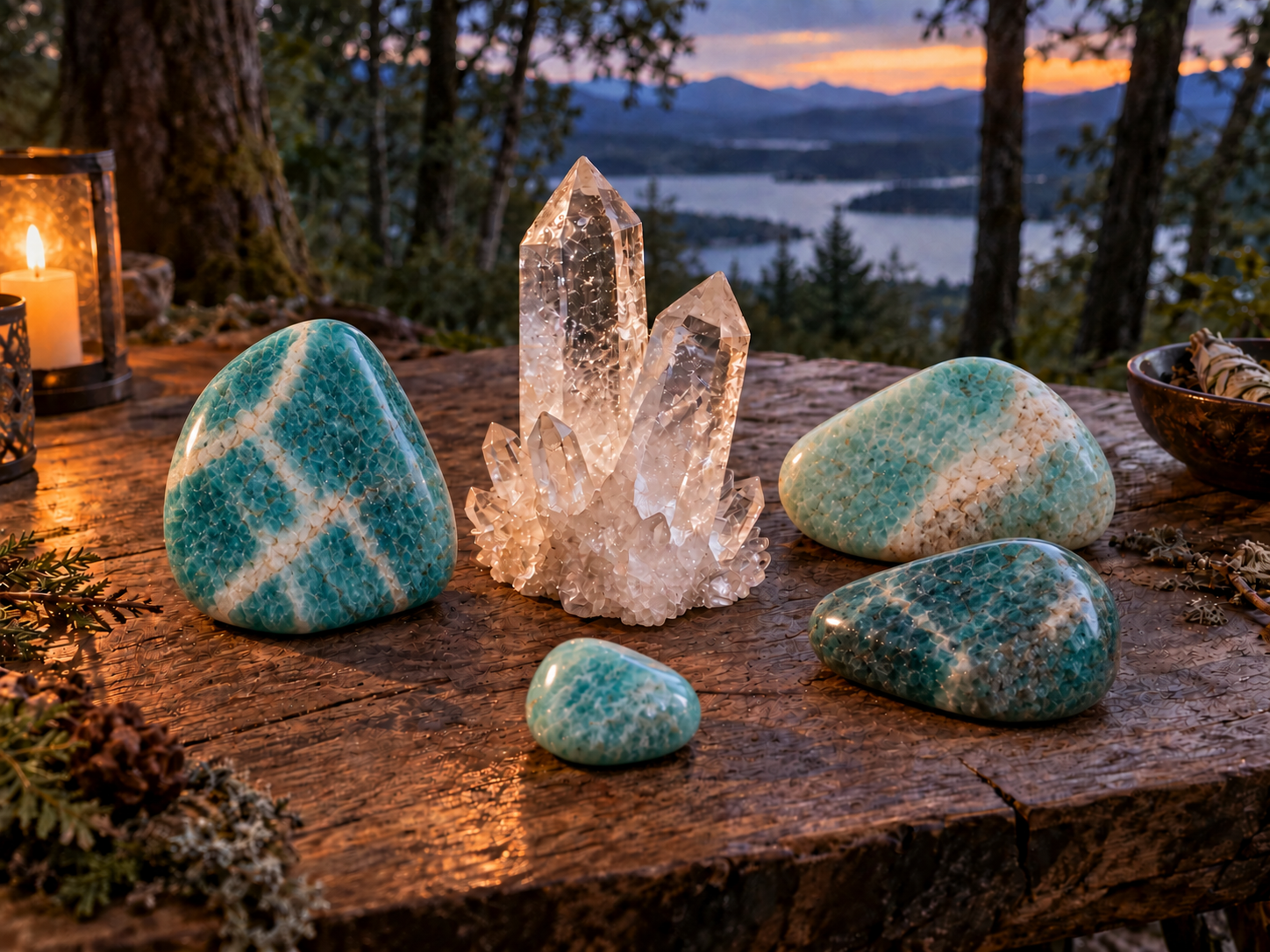
Amazonite is a blue-green variety of microcline, a common potassium feldspar. Its color ranges from soft green to vivid turquoise, sometimes crossed by a web of white lines. Its name points to the Amazon River, but the historical record does not establish that the material described there was actually amazonite.
In crystal traditions, it is a stone of truth, communication, and balance between inner peace and setting boundaries. Its calm appearance and the distinct planes along which it breaks tell its story together: softness with clear lines.
In our library, it also appears as a companion stone: it sits below the center of the Blue Breath Grid, alongside Blue Lace Agate and Larimar.
What Is Amazonite?
Amazonite is a variety of microcline, with the chemical formula KAlSi₃O₈. It belongs to the feldspar family, the most abundant group of minerals in the continental crust. Microcline crystallizes in the triclinic system and sometimes displays microscopic twinning that creates a characteristic crosshatched pattern under magnification.
Its hardness is 6 to 6.5 on the Mohs scale. It has two good cleavage directions at nearly right angles, so a blow can break it even though it is harder than larimar or fluorite. Its luster is vitreous to pearly, and it ranges from opaque to translucent, with relatively transparent material occurring only rarely.
What the Stone Evokes
The cool color and smooth texture evoke a sense of spaciousness, freshness, and quiet stability. The white lines suggest currents or a map. Compared with Blue Lace Agate, which soothes, amazonite feels more alert: not the quiet of drifting toward sleep, but the quiet of knowing what you want to say.
People describe a feeling of “I’m allowed” when working with it. Neither excitement nor relaxation, but a kind of quiet confidence that they can say what needs to be said without apologizing.
Which Chakras Is It Associated With?
Amazonite is commonly associated with both the throat chakra and the heart chakra, and this is what sets it apart: its shade between blue and green forms a bridge between voice and heart. A stone associated solely with the throat, such as kyanite, centers on clarity; a stone associated solely with the heart, such as aventurine, centers on openness. Amazonite sits between them: speaking the truth while remaining kind.
In practice, it is often worn as a pendant that reaches the breastbone, between the two centers, or placed in the hollow at the base of the neck while lying down. These associations are symbolic and vary across traditions.
Energetic Uses
In crystal traditions, amazonite is associated with personal truth, calm communication, harmony, and setting boundaries without aggression. It can serve as a reminder that honesty does not have to be sharp, and peace does not require abandoning yourself.
It is a good stone for people who tend to please others, who say “yes” too quickly, or who realize after a conversation that they never said what they wanted to say. In the Blue Breath Grid, it fills precisely this role: while larimar above the center offers softness, amazonite below it offers a boundary.
How It Compares with Related Stones
Blue Lace Agate calms speech; amazonite strengthens it. Blue lace agate is for those who speak too quickly; amazonite is for those who do not speak at all.
Larimar is soft and watery, a stone of flow and release. Amazonite has a drier quality, a stone of clear lines. Together, they form a pair: softness and boundaries.
Aquamarine offers the courage to speak a difficult truth with cool clarity. Amazonite is warmer, bringing compassion to that truth.
Turquoise is an ancient stone of protection and communication, with a strong, outward presence. Amazonite is more understated and inward: less about shielding us from the world, more about organizing what we say to it.
The Spiritual Dimension
Crystal literature describes amazonite through themes of truth, harmony, and expression. These can be translated into concrete spiritual work: noticing where we say yes out of fear, and where we say no as an automatic defense. The stone symbolizes a covenant between honesty and responsibility.
The Emotional Dimension
Amazonite lends itself to practicing boundaries. Hold it and write: What actually happened? What am I feeling? What do I need? What am I asking for? It can also accompany work on people-pleasing, as its soft color reminds us that we can be kind without erasing our own wishes. In complex situations, professional mental health care is recommended; the stone is a companion, not a replacement.
How to Work with Amazonite
Before sending a sensitive message. Place the stone beside the text and ask: Is it truthful, necessary, and respectful?
A morning practice. Choose one boundary to maintain today and one way to practice flexibility.
In meditation. Follow the white lines and imagine a path that has curves, but also a direction.
Using It in a Grid
Amazonite can be placed at the center of a grid dedicated to communication, with a blue stone on one side and a green stone on the other. Four stones arranged around a note bearing a clear request create a visual frame that brings intention and behavior to mind. In the Blue Breath Grid, it is the stone below the center: inner truth and boundaries.
Using It in Holistic Care and Support
In holistic care, amazonite can open a conversation about truth, people-pleasing, and boundaries. The practitioner does not tell someone what the stone “says,” but invites personal associations. Do not place it on a wound, soak it in drinking water, or promise effects on organs.
A Geological and Gemological Perspective
So far, we have explored tradition and experience. From here, we turn to what mineralogy and gemology can tell us about the stone, for those who also want to understand the material itself.
How It Forms
Amazonite is found mainly in granitic pegmatites, where large crystals grow from a magmatic fluid rich in water and rare elements. It occurs alongside quartz, albite, mica, and sometimes topaz or beryl. Some sites produce large, well-defined crystals; others yield massive material suitable for cutting and polishing.
The Source of Its Color
An older explanation attributed the green color to copper, but spectroscopic research links amazonite’s color to color centers involving lead and water within the feldspar structure, together with natural radiation. The total amount of lead is minute and does not make an intact stone hazardous to touch. In any case, minerals should not be ground up or used to prepare a drink.
The White Lines and Patterns
Some stones display white bands or a white network resulting from albite intergrowths, twinning, fractures, or changes within the feldspar. A white pattern is not proof that a stone is natural, and natural amazonite can also be almost uniform. Color varies considerably from mine to mine.
Major Sources and the Origin of the Name
Famous amazonite crystals come from the Pikes Peak region of Colorado, sometimes together with smoky quartz. Other sources include Russia, Brazil, Madagascar, Ethiopia, India, and Namibia. A reliable claim of origin requires documentation.
The name arose from historical reports of “green stones” from the Amazon region, some of which may have been other minerals. It is therefore accurate to say that the name is connected to the river, not that amazonite was mined from it.
Identification and Buying
Natural amazonite has a blue-green color that is not entirely uniform, a feldspar luster, and sometimes white lines. Imitations include glass, resin, dyed howlite, and dyed or coated feldspars. “Amazonite” with a uniform neon color and an unusually low price warrants closer examination, but no single color rule is definitive.
Dyeing, resin impregnation, and coating are possible, especially in porous or fractured material. Ask for written disclosure of any treatments. Scratch tests are not recommended; a gemologist identifies the mineral using birefringence, specific gravity, and microscopy.
Cleaning and Care
Clean with lukewarm water, a little mild soap, and a soft cloth, then dry. Avoid ultrasonic cleaners, steam, acids, bleach, and temperature changes. Feldspars are sensitive to acids and can break along their cleavage planes. Do not leave the stone in strong sunlight for extended periods. Store it separately from harder stones.
What Science Says
Research explains the structure of microcline and the color centers associated with lead, water, and natural radiation. There is no clinical evidence that amazonite balances emotions or affects organs. A ritual with the stone can support a habit of pausing and writing, with any change attributed to the psychological process and behavior. A controlled study from 2025 on crystals and anxiety found that reported improvement was linked to expectation and prior belief, rather than to the stone itself.
Sources and Further Reading
Mineralogy: Mindat: Amazonite · Mindat: Microcline · Hofmeister & Rossman, A spectroscopic study of irradiation coloring of amazonite (American Mineralogist, 1985)
Care and Maintenance: GIA: Tips on Caring for Jewelry
Crystal Traditions: Robert Simmons, The Pocket Book of Stones (Destiny Books, 2021) · Judy Hall, The Crystal Bible (Godsfield, 2003)
The Placebo Study: Escolà-Gascón et al., Placebo effects in alternative medical treatments for anxiety (CNS Spectrums, 2025)
This page distinguishes research-based geological and gemological knowledge from spiritual interpretations rooted in crystal traditions and literature. Spiritual use of the stone can be part of a personal practice, but it is not a substitute for medical diagnosis or treatment.