
Aventurine
Aventurine is a shimmering quartz traditionally known as a stone of luck—but its luck lies in the willingness to recognize an opportunity and act. On its shimmer, how it differs from goldstone, the heart chakra, and new beginnings.
Aventurine: Opportunity, Growth, and Light in Motion
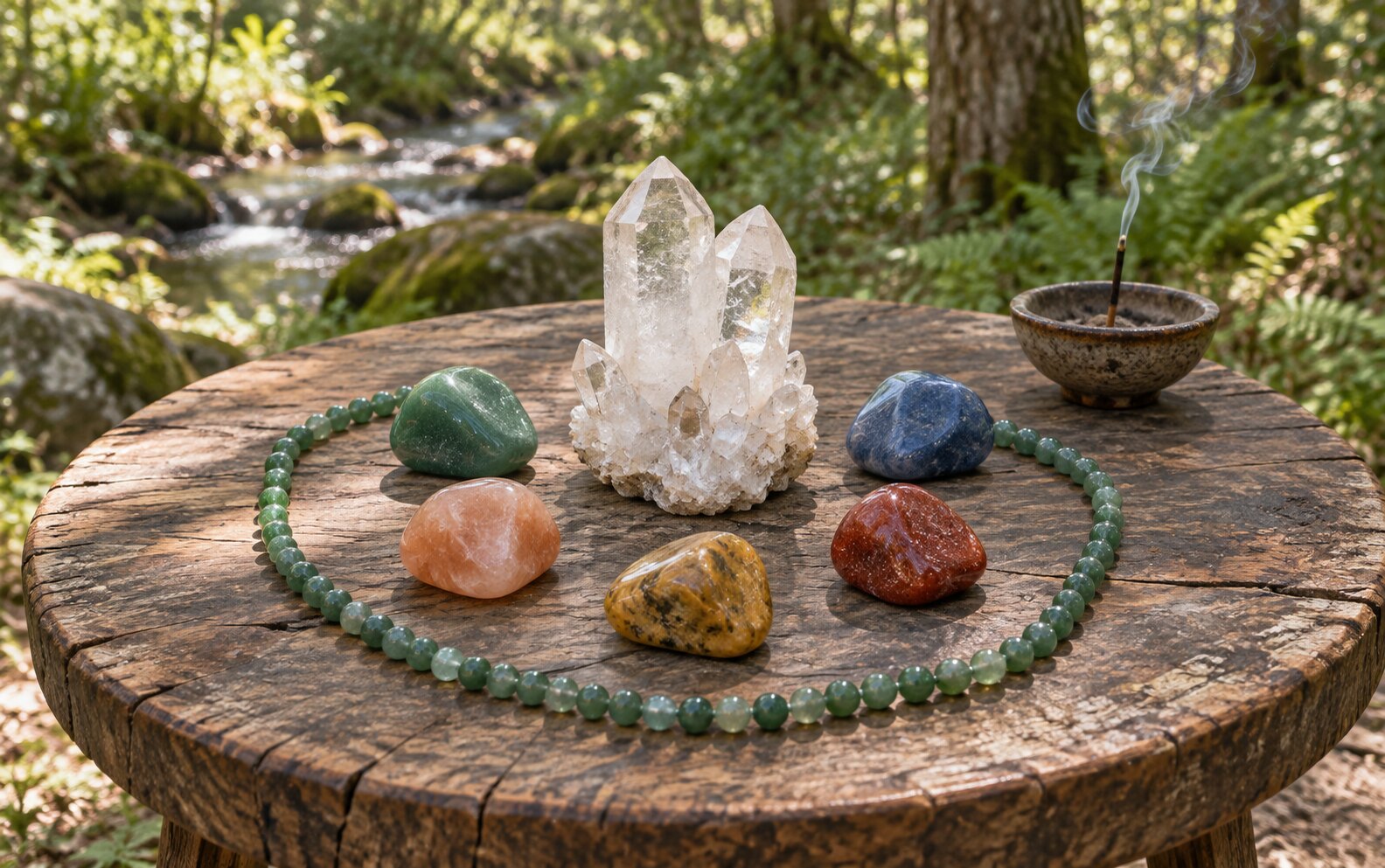
Aventurine is best known as a shimmering green stone, but it also appears in shades of orange, blue, yellow, red, pink, brown, gray, and white. Its sparkle is not a shine applied to the surface, but light reflected by tiny inclusions trapped within the material. As you turn the stone in your hand, points of light shift with the viewing angle, and something different seems to reveal itself each time.
In crystal traditions, aventurine is a stone of luck, growth, and abundance. But “luck” deserves a little clarification: not a promise of winning, but an openness to recognizing opportunity and daring to act without complete certainty. An opportunity becomes an outcome through choice, persistence, and real-world conditions. The stone can remind us of the moment when we tell ourselves: I can give this a try.
It also appears in the library as a companion stone: it is one of the stones in the Blue Breath Grid, alongside Blue Lace Agate.
What Is Aventurine?
Aventurine is the name for a variety of quartz or quartzite containing inclusions that create an optical effect called aventurescence: small flashes of light from within the stone. It is not a separate mineral species. The material consists primarily of silica, and its inclusions influence its color, texture, and sparkle.
Its hardness is close to that of quartz, approximately 6.5 to 7 on the Mohs scale, but its durability varies depending on the amount of inclusions, fractures, and the texture of the rock. It is generally opaque to translucent and is commonly found as a tumbled stone, bead, cabochon, or carved object.
What the Stone Evokes
The green recalls growth and nature, while the sparkle adds a sense of movement and play. This is what distinguishes it from Moss Agate: both are green and both are associated with growth, but Moss Agate feels like a quiet forest, while aventurine feels like sunlight filtering through the leaves. There is a lightness to it, and sometimes even a touch of playfulness.
Some describe their experience with it as gentle encouragement: not a forceful push, but a feeling of “I can give this a try.” Even turning the stone in the light can be a small practice in paying attention. The eye follows the flashes, and thoughts briefly make room for sensation and sight.
Aventurine Colors
The different colors invite different forms of symbolic practice. Color does not determine a single quality or a particular destiny; it offers a starting point for setting an intention.
Green Aventurine
Green is the classic and most familiar shade. In crystal traditions, it is associated with the heart, abundance, growth, and a willingness to receive. This is the aventurine of beginnings: submitting an application, meeting someone new, offering an idea, or opening a door that has remained closed until now.
It suits those moments when we want to ask not only “What do I want to happen?” but also “What small step am I willing to take toward this possibility?”
Orange Aventurine
Orange aventurine ranges from soft peach to deep orange, sometimes with a reddish cast. If green emphasizes opportunity, orange emphasizes the movement that follows. Traditionally, it is associated with creativity, vitality, and enjoyment of the activity itself.
You can work with it at the start of a creative project, while trying a new approach, or when you need to let go of the expectation that the first step must be perfect. The question the stone offers is: What can I begin today, even in a small, unfinished form?
Blue Aventurine
Blue aventurine may appear in smoky blue, grayish blue, or a deeper shade. In symbolic practice, it is associated with expression, listening, and mental clarity. It invites us to pause before an important conversation and find the right words: to say what matters without losing our gentleness.
You can hold it while writing or before a conversation and ask: What am I really trying to say? In chakra traditions, it is sometimes associated with the throat chakra.
Other Colors
Yellow is associated with choice, confidence in the next step, and the desire to turn an idea into a plan.
Red brings a more direct, earthy feeling to the practice. It may symbolize the courage to act, boundaries, and a sense of presence in the body.
Brown calls to mind the earth, rhythm, and persistence. It suits those looking for a way to stay with a process after the initial enthusiasm has faded.
Pink invites gentle openness, compassion, and acceptance. Purple also appears at times in material rich in inclusions and may be incorporated into symbolic work with imagination and inner reflection.
White and gray sometimes draw attention to texture and the play of light. They can be used as stones of clarity, simplicity, and discernment.
Which Chakra Is It Connected To?
Green aventurine is primarily associated with the heart chakra, Anahata: a heart open to opportunity, giving, and receiving. The other shades are commonly associated with chakras according to color: orange with the sacral chakra, red with the root chakra, yellow with the solar plexus, and blue with the throat chakra. Pink is also associated with the heart.
When working with the stone, you can hold it in your hand, carry it in a pocket, or place it on the area where you want to direct your attention. Each person can choose the shade that evokes the feeling they wish to bring into their practice.
Energy Work
Green aventurine is traditionally associated with luck, opportunity, abundance, optimism, and growth. It is a stone of beginnings: the moment when we decide to try, submit the application, or start the project. Alongside the openness it symbolizes, it invites us to ask what is needed to turn a possibility into action.
Absorbing Pain and Negativity
In crystal traditions, aventurine is known as a stone that absorbs pain, tension, and negativity from the body. A common practice is to hold it in the hand or place it on the area where pain is felt, imagining the heavy feeling moving into the stone and making room for softness and relief. Green aventurine is particularly associated with soothing the heart and releasing emotional burdens.
Some prefer to work with it after a busy day: sitting quietly for a few minutes, holding the stone, noticing where tension has gathered, and giving it a name. In this kind of practice, the stone becomes a focus for intention and a sense of release.
Compared with Similar Stones
Green Moss Agate symbolizes slow, rooted growth. Aventurine is the spark that sets growth in motion. Moss Agate suits the months that follow; aventurine, the first day.
Citrine is also associated with abundance, but in crystal traditions it speaks to the solar plexus: will, personal power, and putting things into action. Green aventurine speaks to the heart: openness and a willingness to meet opportunity. Citrine pushes forward; aventurine opens a door.
Jade carries symbolism of wisdom and tradition and feels weightier and more dignified. Aventurine has a lighter quality, an advantage when we want to bring play and curiosity into a process.
Chrysoprase is associated with sweetness and youthful joy. Aventurine is less sweet and more practical: less “feel good” and more “let’s try.”
The Spiritual Dimension
Crystal literature presents aventurine as a stone of vitality, growth, and abundance. Abundance does not have to mean money: it can mean time, relationships, knowledge, skill, or the ability to accept help. The stone invites us to ask what opportunity is already nearby and what might help us make room for it.
The sparkle within the stone is a beautiful image for this. The light does not appear from every angle. Sometimes you need to move the stone slightly to see it, just as a small shift in perspective can sometimes reveal a possibility we had not noticed before.
The Emotional Dimension
Aventurine can accompany work with a fear of failure or a tendency to remain with what is familiar. It symbolizes a “small experiment”: we do not have to know how everything will turn out before taking the first step. We can choose one small action, observe what happens as a result, and then decide how to proceed.
Green brings openness to the practice, orange adds movement, and blue helps us put into words what is not yet clear. There is no need to choose among them according to a fixed rule; you can respond to whichever color draws your attention that day.
How to Work with Aventurine
Beside a list of goals. Place the stone next to the list and choose one step you can take today. The stone symbolizes the shift from idea to movement.
Before an important conversation. Hold blue aventurine, formulate one sentence that expresses the essential point, and let it guide the conversation.
Before creative work. Place orange aventurine beside a notebook, paints, or tools, and begin with ten minutes of free experimentation.
When you feel overwhelmed. Hold green aventurine, notice where you feel tension in your body, and imagine it softening and releasing with your breath.
In meditation. Turn the stone in front of a light source and follow the flashes. Each flash can be a reminder to return to your breath and the present moment.
Using It in a Grid
In an abundance grid, you can place green aventurine at the center, surrounded by notes representing resources: time, knowledge, people, and a budget. Clear quartz can represent clarity. In this way, the symbolism of abundance takes on a personal, tangible form.
You can also create a small grid in three colors: green for the opportunity you want to meet, orange for the first action, and blue for the conversation or request that will allow you to move forward. Beside each stone, you can place a word or sentence expressing the intention.
In the Blue Breath Grid, aventurine sits on either side of Blue Lace Agate as a stone that brings patience and gentleness to the heart.
Use in Holistic Care and Support
In holistic care, aventurine can accompany a conversation about hope, risk, pain, and the capacity to act. You can hold the stone while describing a feeling that is difficult to put into words, or choose a color to express what you want to invite into the process. Working with the stone creates a moment of attention, imagination, and intention.
A Geological and Gemological Perspective
So far, the focus has been on tradition and experience. For those who also want to understand the material, aventurine tells another story—one about quartz, inclusions, and light.
What Creates the Sparkle?
In green aventurine, the common inclusion is fuchsite, a chromium-rich mica. The mica platelets reflect light, creating small flashes. In shades of orange, red, and brown, inclusions of iron minerals, including hematite and goethite, may contribute to the color and sparkle. Pink and purple may be associated with other mica inclusions.
Not every stone sold as aventurine sparkles with the same intensity. Sometimes the color stands out more than the flashes, and some stones require a focused light source to make them visible.
Formation and Sources
Inclusion-rich quartz material forms when silica and other minerals crystallize together. Some aventurine is metamorphic quartzite, in which quartz grains have fused under heat and pressure, while some is described as massive quartz. The commercial definition is broader than the mineralogical one, so a description of the material and its inclusions is more useful than the color name alone.
India is a major source of commercial green aventurine. Material also comes from Brazil, Russia, Tanzania, Spain, and other locations. Color alone does not tell us where a stone came from.
The Name and the Glass That Causes Confusion
The name is related to the Italian expression a ventura, meaning “by chance.” According to tradition, a sparkling glass made in Italy received this name following an accidental discovery. Today, “aventurine glass,” also known as goldstone, is an artificial material containing sparkling particles. It is beautiful in its own right, but it is different from natural aventurine.
A very dense, uniform sparkle with a glassy appearance may suggest goldstone. Blue goldstone is also available on the market, so blue color and sparkle alone are not enough to identify natural blue aventurine.
Colors and Trade Names
Green is the most familiar shade and is usually associated with fuchsite. Orange, red, and brown may derive their color from iron minerals. Shades of yellow, pink, purple, white, and gray also occur, sometimes depending on the type and concentration of inclusions.
“Blue aventurine” calls for particular care. Quartz can acquire a blue color from inclusions such as dumortierite, but not all blue quartz displays clear aventurescence. When the name is used loosely, it is worth looking for a description of the material and its optical effect rather than relying solely on the label on the shelf.
Identification and Buying
To see aventurescence, rotate the stone under a single light source and look for flashes from within the material. In a natural stone, the inclusions are not arranged in a perfect pattern. Round bubbles or a mold seam may suggest glass or resin; color concentrated in fractures may indicate dyeing.
Quartz and quartzite may be sold after dyeing or stabilization, so it is worth asking for a description of any treatments the material has undergone. An at-home scratch test can damage the stone and is not a substitute for gemological identification.
Cleaning and Care
Aventurine can be cleaned with lukewarm water, mild soap, and a soft cloth or brush, then dried. Protect it from impacts, extreme heat, and sudden temperature changes. If the stone is dyed, coated, or stabilized, it is best to avoid soaking, steam, and ultrasonic cleaning. When storing it with other stones, keep it separate from softer stones that could be scratched.
What Science Says
Gemology explains the sparkle as light reflected by inclusions within the stone, and the colors through the composition of those inclusions. The energetic and emotional uses described in this article belong to crystal traditions and the personal experience of working with the stone. This distinction allows us to approach aventurine from two directions: understanding how it is structured and choosing what it symbolizes for us.