

Carl Jung: From the Persona to the Self
Jung grew up as a lonely, sensitive child in a home where love and security did not always feel stable, with a mother who experienced psychological instability and a father who struggled to give him a sense of protection. Even after finding a mentor and father figure in Freud, he faced rejection and the loss of his place when he refused to abandon his independent path. The rupture plunged him into a profound psychological crisis, flooded with dreams, visions, and fears. Yet rather than flee his inner demons, he chose to observe them, record them, and enter into dialogue with them. From this journey emerged his ideas about the shadow, the persona, individuation, and synchronicity—ideas that transformed his personal pain into a map of the human psyche. Having nearly lost himself in the depths of his own psyche, he emerged with a new way of understanding human beings and went on to achieve success, recognition, and a renewed appreciation that his ideas continue to enjoy today.
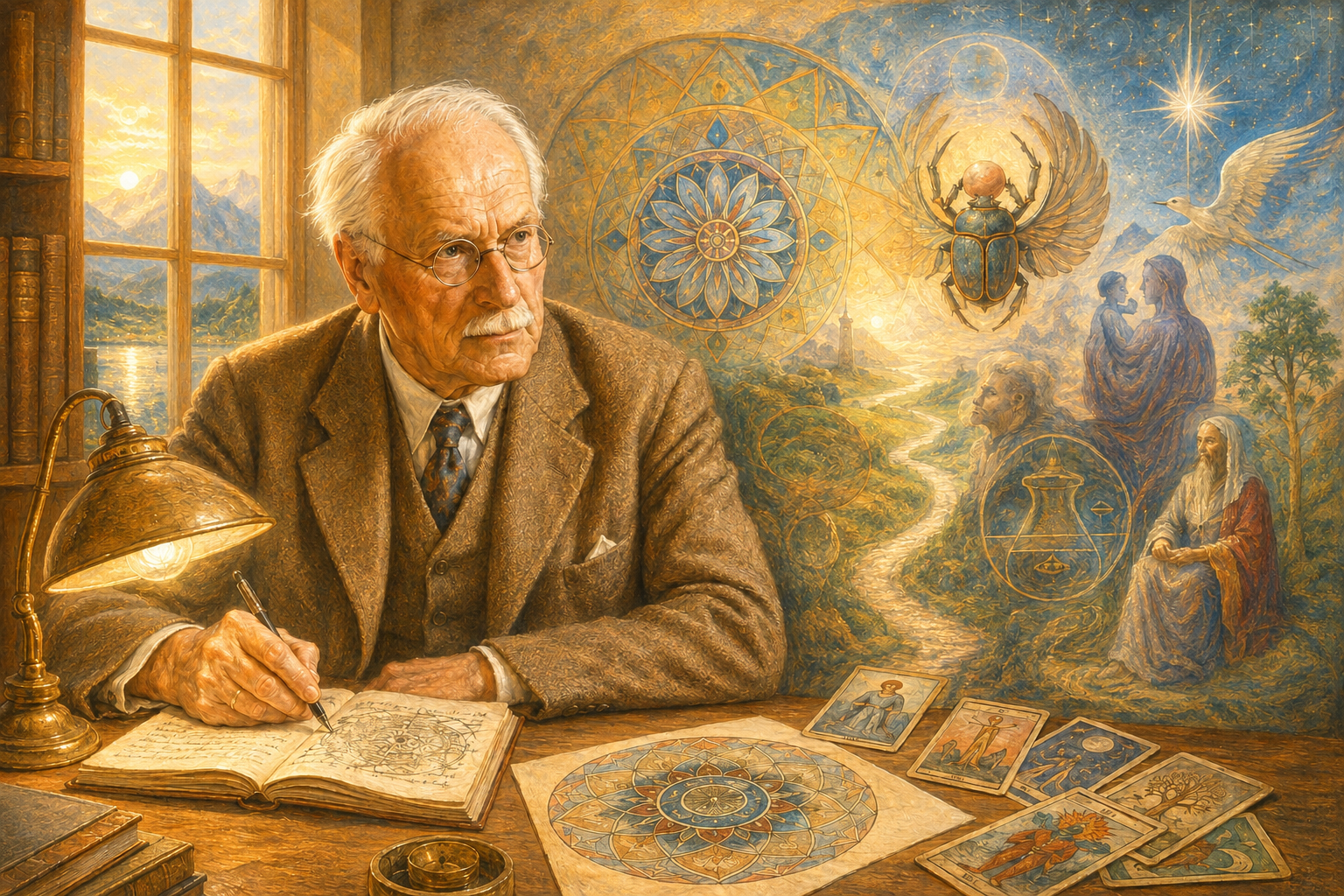
Carl Jung—From the Child Who Learned to Adapt to the Man Who Dared to Become Himself
A child needs love almost as much as they need food and protection. So when love at home feels unstable or conditional on their behavior, they do not stop needing it. Instead, they learn to adapt to the conditions under which it is given.
They learn which feelings they are allowed to express, when to be quiet, what to hide, and who they need to become to receive closeness, belonging, and a sense of safety. They may become the good child, the smart one, the people-pleaser, the independent one, or the strong one—not because this is their whole personality, but because it is the way they have found to preserve their connection with the people they depend on.
This is one of the keys to understanding the story of Carl Gustav Jung.
The Child Who Searched for Stability
His mother, Emilie Preiswerk, suffered periods of depression, withdrawal, and psychological instability. When Jung was three, she was hospitalized for several months, leaving him with a profound sense that a mother’s presence and love were not always secure or available. Jung described her as though two figures existed within her—a warm, familiar mother by day and a more mysterious, threatening presence at night—an experience that shaped his relationship with love, women, and the unconscious.
His father was a Protestant minister, but behind his religious standing was a man struggling with deep doubts about his faith, who found it difficult to give his son a sense of steady, dependable authority. There were also tensions between his parents and financial difficulties at home.
The home Jung grew up in appeared to rest on clear rules, beliefs, and roles, yet beneath the surface lay uncertainty, silences, and contradictions.
As a child, Carl was lonely, introverted, and acutely sensitive to what was happening around him. He noticed his mother’s shifting moods, his father’s weakness, and the gap between what the adults said and what he felt.
His inner world grew increasingly filled with vivid dreams, figures, symbols, fears, and experiences that had no place in the language the adults around him spoke. The less stable and understandable his home became, the more his dreams and inner images became a source of security, guidance, and meaning.
Jung’s Two Personalities
Jung described feeling, even as a child, that he had two personalities. He later called one “Personality No. 1”—the child who went to school, dealt with the demands of everyday reality, and tried to fit into society.
He experienced the other, “Personality No. 2,” as an ancient, authoritative, mysterious inner figure, connected to wisdom and a reality beyond the everyday world.
Here we can see the beginnings of the distinction Jung would later draw between the persona and the Self.
The Persona—The Mask We Became
The word persona comes from Latin and originally referred to the mask worn by an actor in the theater, and later to the character or role the actor portrayed. Jung adopted the term to describe the face a person presents to society and the identity they construct to meet its expectations.
The persona is the character we take on to function in the world. It is not necessarily a lie; we all need it to belong within a family, a community, and a workplace. The trouble begins when we identify with it completely and forget that it is only one part of us.
The boy who learns that he is loved when he is easy to manage hides his anger. The girl who receives appreciation for taking care of everyone pushes aside her own need to be cared for. Someone who learned to be strong so as not to burden others may lose the ability to acknowledge vulnerability, exhaustion, and the need for closeness.
The parts that do not fit the identity we have adopted do not disappear. They sink beneath the surface and continue to live within us.
This is the shadow.
The Shadow—What We Push Aside So We Can Belong
The shadow is not simply a person’s bad or dark side. It contains everything that did not fit the person we needed to be: anger, fear, envy, and aggression, but also creativity, sexuality, independence, sensitivity, freedom, and the ability to set boundaries.
Sometimes our most vital parts are precisely the ones that end up in the shadow, because we understood in childhood that they might threaten love or our sense of belonging.
Complexes also form within this inner world.
For Jung, a complex is not merely a weakness or a flaw. It is a cluster of memories, feelings, beliefs, and reactions organized around an emotionally charged experience. A complex can form around a mother, a father, abandonment, authority, rejection, worthlessness, or the need for recognition.
When something in the present touches the old wound, the complex awakens. The adult is still in the room, but suddenly the child within is interpreting what is happening and responding to it. This is why the reaction can be far more intense than the actual event would warrant.
When His Psyche Found a Way to Protect Him
At the age of twelve, Jung was knocked to the ground by another boy and injured his head. Afterward, he began to suffer fainting spells whenever he approached school or tried to study. The fainting allowed him to stay home and avoid a place he found difficult and threatening.
Only after hearing his father express concern about his future and his ability to support himself did Jung begin to confront the problem. He returned to his books, struggled against the urge to faint, and gradually the symptom disappeared.
Jung saw this as one of his first encounters with the power of neurosis. His psyche had found a solution without consulting his conscious mind: it used his body to keep him away from school. But the solution that protected him also imprisoned him.
Many complexes work this way. They arise as attempts to protect us, preserve a bond, or prevent pain, yet the protection we needed in childhood continues to operate even after reality has changed.
Freud—The Mentor Who Became a Father Figure
Years later, Jung met Sigmund Freud.
Their first meeting, in 1907, became a conversation lasting about thirteen hours. Jung found someone who dared to speak openly about the unconscious and the hidden forces that govern human life. Freud found a brilliant, charismatic young psychiatrist who could carry on his work.
Freud saw Jung as his successor and the “crown prince” of psychoanalysis. For Jung, Freud was not only a mentor but also an intellectual father figure. He gave him recognition, a place, and a sense of belonging within a new and revolutionary movement.
Gradually, however, it became clear that this recognition came with conditions.
Jung was expected to remain faithful to the principles on which Freud had built psychoanalysis, particularly the central role he assigned to sexuality and repressed drives. Jung held Freud in high regard, but he could not reduce the human psyche to a single explanatory framework.
In his view, the unconscious was not merely a storehouse of forbidden desires and repressed experiences. It was also a source of creativity, symbols, myths, wisdom, and development. For him, libido was not only sexual energy but psychic energy that could find expression in love, creativity, spiritual aspiration, and the search for meaning.
The more Jung insisted on following his own path, the more his relationship with Freud deteriorated.
Their rupture can be seen as more than a professional disagreement. Jung once again found himself facing a significant figure who offered love, recognition, and belonging as long as he stayed on the path laid out for him. To remain Freud’s chosen son, he would have had to give up essential parts of his inner truth.
This was a defining moment in his life: remain loyal to the father and the path he had laid out, or accept the loss of his love in order to remain true to himself.
The Descent into the Depths of the Psyche
Their personal relationship ended in 1913. Jung lost his place as Freud’s successor, distanced himself from part of the professional community, and went through a period of profound psychological crisis. Dreams, visions, and powerful images began to flood his mind.
But instead of fleeing them, he began to descend into the depths of his own psyche.
He recorded his dreams, drew the symbols, and spoke in his imagination with the figures that appeared there. He did not regard them as worthless thoughts, but as expressions of parts of himself seeking to be seen. This process was documented in his notebooks and later in The Red Book.
This was Jung’s great encounter with his shadow.
Encountering the shadow is not an attempt to defeat it. As long as we fight the shadow, we continue to treat it as an external enemy. The real encounter begins when we are willing to acknowledge that even the parts that frighten or embarrass us, or contradict our self-image, belong to us.
Jung had to encounter within himself the frightened child, the son seeking his father’s approval, the ambitious man, the mystic, the scientist, and the fears and forces that did not fit his public identity as a respected physician.
From this encounter emerged the idea of individuation.
Individuation—Becoming a Whole Person
Individuation is not an attempt to become more special, independent, or successful than others. Nor is it a demand to become a perfect person.
It means gradually becoming a more whole person—someone able to hold the full complexity of who they are.
It is a shift from a life organized around gaining approval to one rooted in a relationship with the Self.
Early in life, we build an identity that allows us to fit into the world. We become the good child, the responsible parent, the strong one, the successful employee, or the person everyone can always rely on. But at some point, this identity may become too narrow. Something within us begins to ask for room.
A crisis sometimes arises when someone who has managed to become everything others expected discovers that, along the way, they have grown distant from themselves.
Individuation does not ask us to destroy the persona, but to stop believing it is all we are. It invites us to bring the rejected parts back into our lives, recognize the complexes that drive us, and develop a more conscious relationship with the unconscious.
Through this process, a person gradually stops asking the world for the love they have been unable to give themselves. They no longer have to be strong all the time to be worthy, useful all the time to be wanted, or always faithful to other people’s expectations to feel that they belong.
What We Do Not Recognize in Ourselves, We Meet in Others
Encountering the shadow also changes how we engage with reality.
What we do not recognize within ourselves, we tend to project onto other people. Someone who does not acknowledge their own anger sees aggressive people all around them. Someone unable to recognize their own strength attributes exaggerated power to others. Someone who has pushed away their need for freedom may judge people who dare to live as they choose.
In this way, our complexes influence what we see, whom we choose, what we fear, what draws us, and how we respond.
As long as the shadow remains unconscious, we encounter it again and again in people and events outside ourselves.
Yet Jung did not stop at the idea of projection. Later in life, he proposed that there is sometimes a deeper, more mysterious connection between the human psyche and the surrounding world. He called this connection synchronicity.
Synchronicity—A Coincidence That Carries Meaning
Synchronicity is a meaningful coincidence: a situation in which an event within the psyche and an event in the external world occur together, without an explainable causal connection, yet are linked for the person through a shared meaning.
The best-known example occurred when one of Jung’s patients told him about a dream in which she had received a piece of jewelry shaped like a golden scarab. As she recounted the dream, there was a tapping at the window. Jung opened it and found a beetle whose coloring resembled a scarab. He caught it, handed it to the patient, and told her that this was her scarab.
The event did not prove that the dream had caused the beetle to arrive. Its significance lay in the dream and the event coming together at such a precise moment that the encounter broke through the patient’s rigid thinking and made change possible.
Synchronicity is not a promise that the universe fulfills every wish. Nor does it mean that every recurring number, every song on the radio, and every chance encounter is necessarily a message. It describes a moment in which an inner experience and an actual event connect through profound meaning and affect consciousness.
Love, the Shadow, Individuation, and Synchronicity
Here, four central strands of Jung’s thought come together:
Conditional love* teaches a child who they need to become.
That identity becomes the persona, while everything that does not fit it sinks into the shadow* and takes shape as complexes.
Encountering the shadow allows a person to reclaim the parts they have lost and move through the process of individuation*.
As they become more attuned to what is happening within them, they can recognize the places where the psyche and reality meet through meaning—the moments Jung called synchronicity*.
Jung Between Psychology and Mysticism
Jung was never content to remain within the boundaries of conventional psychology, and he was not afraid to explore mysticism. He saw dreams as the natural language of the unconscious, and myths, alchemy, astrology, and the I Ching as symbolic systems through which the psyche could express what could not yet be put into words.
The institute he founded even examined the use of tarot cards as part of its exploration of intuitive and synchronistic methods—not in an attempt to predict a fixed future, but to investigate how a randomly drawn image might evoke an archetype and reveal inner meaning.
Jung did not seek to choose between the scientific and the mysterious, but to stand where reason, dream, and symbol meet. Perhaps this is why his ideas continue to touch people today: they make room not only for what can be explained, but also for what the psyche knows before the words arrive.
Becoming the Person Only He Could Be
Jung’s life embodied the journey he wrote about.
The child who tried to find security in an emotionally and spiritually complex home learned to listen to his dreams and build a rich inner space of symbols and meaning. The man who received love, status, and recognition from Freud had to give them up rather than betray his own truth. And the one who lost his place as the chosen son set out on a journey that made him the father of a new psychological approach.
Perhaps this is the deepest meaning of individuation: to stop shaping ourselves solely around the conditions under which we learned to receive love, to encounter what we hid in order to be wanted, and gradually to become the whole person who was already waiting within us.