

The Suit of Cups in Tarot — Emotion, Love, Abundance, and the Ability to Receive
Emotion, love, relationships, intuition, and the world of the heart.
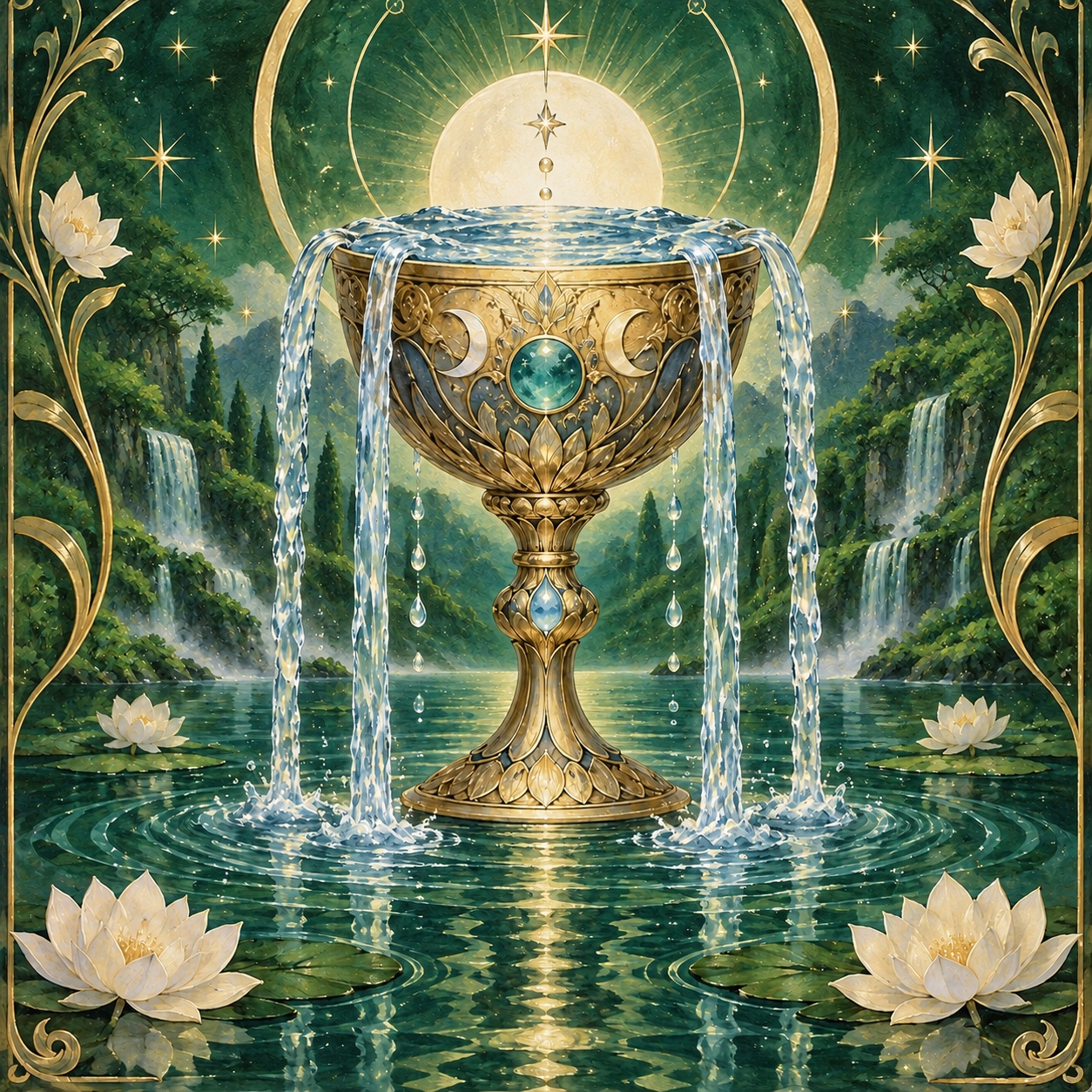
The Suit of Cups is the suit of water. It deals with emotion, love, relationships, intuition, memory, longing, compassion, abundance, and our ability to open ourselves to what life brings us.
If Wands ask what moves us to act, Swords how we think and understand, and Pentacles how things take shape in the material world, Cups ask how we experience all of it from within.
They do not speak only of romantic love. They can concern friendship, family, longing, disappointment, joy, intimacy, creativity, faith, healing, fantasy, and our relationship with ourselves. Alongside all of these lies another subject that is easy to miss: the ability to receive.
A cup is a vessel. For something to fill it, it must be open. The Suit of Cups therefore concerns not only what we feel, but also the extent to which we are able to receive love, support, joy, inspiration, and abundance when they arrive.
The Element of Water
Cups are associated with the element of water. Water flows, changes shape according to the vessel that holds it, and reaches places that cannot always be seen from the outside. It can be calm and clear, but also turbulent, deep, or overwhelming.
This is exactly how the emotional world works. Emotion is not always orderly or logical. We can love and feel angry at the same time, long for something we know is not right for us, or feel fear precisely as we approach something we truly want.
Water teaches us that emotion is not always a problem to be solved. Sometimes it first needs to be given space. When water flows, it gives life. When it stands still for too long, it can grow murky. And when it floods, it is difficult to see anything but the water itself.
So it is with Cups. Emotion can be a source of deep connection, but it can also become overwhelm, dependence, idealization, or escape from reality.
The Cup as a Symbol — The Vessel That Can Receive
The cup does not create the water. It holds it. One of the suit's central meanings is already present here: the ability to contain.
Containing an emotion does not necessarily mean controlling it. It is the ability to give space to what arises without requiring it to disappear and without allowing it to take over the entire space.
In this sense, the cup is also an image of the heart. A heart can fill, empty, open, close, and crack. In a reading, we can therefore ask not only what is inside the cup, but also about the condition of the vessel holding the emotion.
Is there room in me to receive something new? Am I still full of what was? Am I waiting for someone else to fill my cup? And do I know how to recognize when it is already full?
Cups and Abundance
The connection between Cups and abundance is especially important. When we think of abundance in tarot, it is easy to go straight to Pentacles — money, work, possessions, and material security. But abundance is not only what we have in the bank.
Abundance can also be love, friendship, a home that feels safe, creativity, a sense of meaning, the ability to enjoy, and the ability to feel that we are allowed to receive good things.
The cup represents the possibility of being filled. This is a very different meaning from that of the pentacle. The pentacle asks what we have built and held. The cup asks whether we are able to receive what comes.
We can be surrounded by love and still feel lacking. We can receive compliments and not believe them. We can achieve success and be unable to experience satisfaction. In such cases, abundance exists on the outside, but the inner vessel struggles to hold it.
Cups therefore add an emotional dimension to abundance: not only how much there is, but how much we are able to experience that there is.
A Full Cup and a Cup That Overflows
One of the beautiful images of the Suit of Cups is the overflowing cup. Once the vessel is full, the water no longer remains only within it. It begins to flow outward.
We can see this as an image of healthy love and abundance. A person who is not constantly looking for someone else to fill them can begin to give from what they already have within.
This is not giving out of duty or people-pleasing. It is giving from surplus: there is enough in me to share.
But a shadow exists here too. If a person gives without boundaries, they may be emptied. Emotional abundance therefore requires more than openness. It also requires the ability to protect the vessel.
The Astrological Connection — Cancer, Scorpio, and Pisces
The connection between Cups and water links them to the three water signs: Cancer, Scorpio, and Pisces. All three express sensitivity, intuition, and emotional depth, but each does so differently.
Cancer — Water That Seeks a Home
Cancer is connected with belonging, family, memory, emotional security, and the need for a place where the armor can be set down. This is an important aspect of Cups: love is not only a powerful emotion. Sometimes love is the feeling that there is a place where we are allowed to be vulnerable.
But that same energy can also cling to the past, fear change, or continue to carry relationships that have already ended.
Scorpio — The Deep Waters
Scorpio is not satisfied with what is on the surface. It is connected with intimacy, passion, jealousy, loss, secrets, emotional power, and transformation.
Here we meet the aspect of Cups in which love is not only pleasant — it changes us as well. A meaningful relationship can open places we tried to hide, bring a fear of abandonment to the surface, or break down old defenses.
Scorpio's waters remind us that the path to deep love sometimes passes through the places we are most afraid to feel.
Pisces — Water Without Boundaries
Pisces is connected with compassion, imagination, dreams, inspiration, spirituality, and the ability to feel what cannot always be explained in words.
In its light, this is great sensitivity and a capacity for deep connection. In its shadow, it can become blurred boundaries, idealization, or escape from reality.
The astrological modalities add another layer: Cancer, as a cardinal sign, creates emotional space; Scorpio, as a fixed sign, deepens and holds emotion; and Pisces, as a mutable sign, dissolves boundaries and allows emotion to change and flow. We can think of them as three movements of water: bonding, deepening, and merging.
Emotion Is Not Weakness
One common mistake is to see emotion as something that interferes with reason. The Suit of Cups offers another view: emotion is information.
It tells us what matters to us, what we fear, what we long for, where we were hurt, and what draws us. But the fact that we feel something does not necessarily mean our interpretation is correct.
We can feel rejected when the other person is simply busy. We can feel love even within a relationship that is not good for us. We can feel fear precisely when we are approaching something important.
Cups therefore do not tell us to act automatically according to emotion. They ask us to listen to it first.
Love, Intimacy, and Connection
Cups are the suit most closely identified with romance and relationships. But love in the world of Cups is not only attraction. It requires the ability to open, receive, listen, and be vulnerable.
True intimacy begins when a person can let another see something within them that is not under complete control. This is also why relationships can awaken such deep fears: the more attached we become, the more there is to lose.
And so, in the world of Cups, we encounter not only love but also longing, disappointment, jealousy, grief, and fear of abandonment.
Many Cups in a relationship reading can indicate deep emotion, but not necessarily a stable relationship. There can be much emotion and little reality, much love and little ability to commit, much longing and little action. One of the reading's roles is to distinguish between what we feel and what can actually be built.
Eros and Psyche — The Myth of Love Growing Up
In the Mythic Tarot deck, the Suit of Cups gains a mythological layer through the story of Eros and Psyche. This is not the historical origin of the Suit of Cups in every tarot tradition, but a modern mythological interpretation that connects the cards in the suit with different stages of the myth.
The connection suits Cups almost naturally. Psyche's name in Greek is also associated with the soul. The story is therefore not only a love story between a woman and a god; it can be read as the soul's journey through love.
Psyche meets Eros and experiences an almost perfect relationship, but she is forbidden to see his face. She is asked to trust. A central theme of Cups already appears here: we can feel something intensely even when we do not know everything.
But fear enters. Influenced by her sisters, she begins to suspect. She lights a lamp to look at Eros while he sleeps, and the trust between them is broken. Eros leaves. Love, which had been a source of happiness, now becomes a source of pain.
This is a profoundly Cups-like moment: the same heart that allows us to feel joy is also capable of feeling loss.
Psyche Sets Out on Her Journey
After Eros disappears, Psyche cannot simply return to her former life. Love has changed her.
She sets out on a journey and receives difficult tasks from Aphrodite. Here the myth shifts from a story of falling in love to a story of development.
Psyche must learn patience, discernment, perseverance, boundaries, and trust in herself. In other words, the relationship with another becomes a journey within herself.
This is one of the deepest messages of the Suit of Cups: a meaningful relationship is not only the place where we receive love. It is the place where we meet our emotional structure — our fears, needs, expectations, and the places where we are still asking another person to save us.
The Descent into the Underworld
One of Psyche's tasks takes her into the underworld. This is a highly significant point in the myth.
True love is not always an upward journey. Sometimes it takes us downward instead — into places of pain, loss, fear, jealousy, loneliness, and memories we would rather not meet.
But emotional maturation can occur precisely there. In the Mythic Tarot, the connection between Psyche's journey and the Cups cards emphasizes that emotion is not only a place of comfort. It is also a gateway to the unconscious.
Union Is Not a Return to the Beginning
When Psyche and Eros finally reunite, they do not return to exactly the same point where they began. Psyche has changed.
She is no longer only the one who fell in love. She has undergone trials, lost, searched, descended into darkness, and returned. This is another kind of love — less innocent and more conscious.
We can see this as the journey of the entire Suit of Cups: from the desire to feel love to the ability to be in a relationship without losing ourselves.
Intuition and Inner Listening
Water is also connected with intuition. Sometimes we feel something before we can explain it. The body detects a change in tone, the heart recognizes distance, and something within us knows before thought has formulated a reason.
But subtle discernment is required here. Intuition is not always fear, nor is it always a wish. When we very much want something to happen, it is easy to call hope a gut feeling.
One of the skills of the Suit of Cups is therefore learning to distinguish between a deep emotional voice and the story we want to believe.
Memory and the Past
Water is deeply connected with memory. A smell, piece of music, place, or sentence can return us in an instant to a moment we experienced years ago. Cups work in the same way.
They can bring up longing, old relationships, innocence, childhood wounds, and family patterns. Sometimes we think we are responding to what is happening now, while in fact we are meeting something that happened long ago all over again.
Someone is late replying to a message, and our emotional response does not belong only to that evening. It can be connected to dozens of past moments in which we felt we were not chosen.
Cups invite us to recognize when the past is still directing the present.
Fantasy and the Shadow of Cups
The emotional world can create a very rich inner reality. We imagine what another person feels, how the relationship will develop, and what life will look like when we receive what we want.
This capacity makes hope, creativity, and love possible. But it also has a shadow. Cups can speak of idealization, nostalgia, illusion, emotional dependence, and preferring fantasy to what reality is actually showing.
And sometimes this is one of the most important questions in a reading: am I in a relationship with the person before me — or with the possibility I imagine they could become?
Cups in the World of Work
Cups have a place in career matters too. They concern a sense of meaning, satisfaction, relationships with people, connection with a team, and the emotional experience of work.
A person can be highly successful on the outside and feel completely empty within. On the other hand, someone can feel deeply connected to work that is not yet financially stable enough.
Cups therefore do not primarily ask how profitable the work is. They ask what it fills within us and whether we feel that what we do has heart.
When Many Cups Appear in a Spread
Many Cups usually mean that emotional experience is at the center. There may be much love, longing, sensitivity, intuition, or a need for connection.
But it is also important to see which suits appear beside Cups. Cups and Wands can bring passion and action. Cups and Pentacles can turn emotion into something stable and tangible. Cups and Swords can bring conversation, discernment, and clarity.
When almost the entire spread is filled with Cups, the inner experience may be so powerful that it begins to take the place of external reality.
And When There Are Almost No Cups?
An absence of Cups does not mean there is no emotion. Sometimes it means emotion is not being given space. A person can function, think, and do all the right things while still being disconnected from what is happening within.
In a relationship reading, an absence of Cups can be especially significant. A relationship may be based on commitment, comfort, attraction, or reason — but contain little softness or emotional openness.
On the other hand, if a person is emotionally overwhelmed, the absence of Cups in a spread can be part of a healthy process in which life is asking them to return to the ground.
The Court Cards of Cups
The court cards of Cups present different ways of experiencing and holding emotion. There is early sensitivity, innocence, and curiosity; there is emotion that moves in pursuit of love, beauty, and an ideal; and there are more mature forms of emotional containment — the ability to feel deeply without being swallowed by what we feel.
A Cups figure is therefore not simply an emotional person. Sometimes it points to our level of maturity in relation to emotion: do I feel, am I swept away, or can I feel and remain present at the same time?
Cups and Water in the Major Arcana
Cups and water also appear at significant moments in the Major Arcana.
In The Magician, the cup rests on the table beside the wand, sword, and pentacle. Emotion is one of the four powers available to a person — not the only power, but part of a complete system.
In Temperance, two cups are at the heart of the card. The angel transfers water from one vessel to the other. Here emotion is no longer only something that happens to us — it is something we can learn to regulate, integrate, and process.
In The Star, the figure pours water from two vessels. Some of the water returns to the pool and some flows onto the earth. She does not hoard it for herself. Abundance flows through her. This is an especially beautiful image of the connection between water and abundance: when we feel that the source is not exhausted the moment we give, we can allow the flow to continue.
In The Moon, water takes on an entirely different quality — unconscious depth, fear, imagination, and what cannot be seen clearly. Across the Major Arcana, the element of water therefore assumes different faces: vessel, regulation, healing, abundance, and the unconscious.
What Changes Between The Magician and The Star?
In The Magician, the cup is a tool available to the person. In Temperance, it is a tool for inner work. And in The Star, the water already flows outward.
We can see an entire emotional journey here. At first, we discover that we have a heart. Then we learn how to contain what happens within it. At a later stage, we discover that we can also become a source of love, inspiration, and healing for others.
The Great Lesson of the Suit of Cups
The Suit of Cups teaches us that emotion is not an enemy. But not every emotion needs to become action immediately. Maturity lies between the two extremes: neither repressing what we feel nor allowing every emotional wave to determine the course.
The cup is a vessel. The question is whether we are able to hold what is within it.
To love without losing ourselves. To long without remaining in the past. To feel pain without turning it into an identity. To hope without replacing reality with fantasy. To receive abundance without fearing that it will disappear. And to give to others from a place of fullness, rather than from a need to empty ourselves in order to be worthy of love.
This may be the deepest meaning of the Suit of Cups: not only the ability to feel, but the ability to open the heart enough for life to pass through us — to enter, fill, change, and flow onward.