

Kyanite
Kyanite is a blue blade of direction and precision, formed under high pressure deep within rock. Exploring the feeling of an antenna tuning in, chakra alignment, how it differs from sodalite and selenite, and the myth that it never needs cleansing.
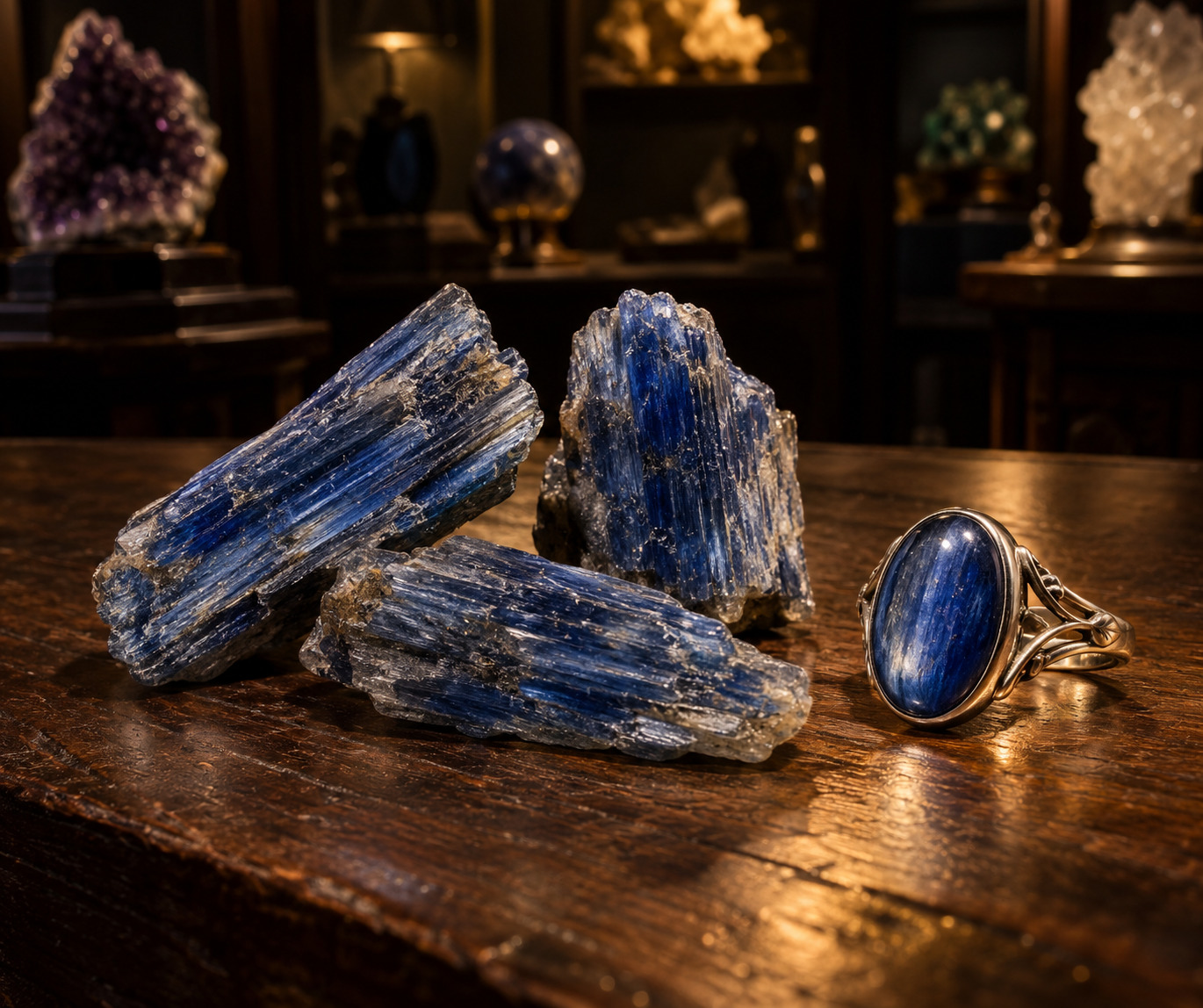
Kyanite is an aluminum silicate mineral best known for its blue, blade-shaped crystals. It forms under high pressure in metamorphic rocks, so geologists use it as a clue to the conditions a rock experienced deep within the Earth.
In the world of crystals, it is a stone of alignment, communication, and discernment. The combination of its directional structure and a hardness that cannot be expressed as a single number makes it a stone that invites precision—in both language and use.
In our library, it also appears as a companion stone: it forms the upper end of the Roots and Flow Grid, above Tree Agate, and is an optional addition to the other two grids.
What Is Kyanite?
Kyanite’s chemical formula is Al₂SiO₅. It is one of three polymorphs with the same formula, alongside andalusite and sillimanite, each with a different crystal structure and range of stability. Kyanite is stable at high pressures. It crystallizes in the triclinic system and usually appears as elongated plates or blades.
Its best-known property is directional hardness. Along the crystal, its hardness is approximately 4.5 to 5.5; across it, 6.5 to 7. This is why the number printed in reference guides varies. Kyanite has good to perfect cleavage, so despite its harder areas, it is relatively brittle and requires gentle handling.
What the Stone Evokes
For many people, the cool blade and parallel lines create a sense of direction, clarity, and focused stillness. If Blue Lace Agate feels like turning down the volume, kyanite feels like adjusting the antenna: not less noise, but noise drawn into a single line.
Some people find it too sharp in feel and prefer a polished stone to a raw blade. Try giving the experience a simple name, such as calm, alert, or curious, without searching for the “right” sensation.
Which Chakra Is It Associated With?
Blue kyanite is associated with the throat chakra, Vishuddha, and sometimes with the third eye, Ajna. Its distinctive quality is its axis: the tradition describes it as a stone that brings the energy centers into alignment, echoing the shape of its blade. It is therefore often described as a stone for “aligning” all the chakras rather than a single center. Green is associated with the heart, black with the root.
In practice, a common approach is to lie down, place a blade lengthwise along the breastbone, pointing down from the throat, and breathe along its length. These associations are symbolic and vary among traditions.
Energetic Use
In crystal traditions, blue kyanite is a stone of inner alignment, clear communication, and connection between thought and word. Black kyanite is associated with grounding and taking stock of habits, while green is associated with aligning decisions with values. “Alignment” here is a metaphor: bringing intention, thought, and behavior into a single line.
In grids, it serves as an arrow. In the Roots and Flow Grid, it forms the upper end of the axis, the point toward which the quartz guides movement from the root: direction, flow, and alignment. In the other two grids, it is an optional addition—above the larimar before an important conversation, and above the amethyst when seeking an axis connecting thought, intuition, and understanding.
How It Compares with Related Stones
Sodalite offers clarity of mind: order, logic, and the distinction between fact and interpretation. Kyanite offers clarity of direction: not what is right, but where to go. Sodalite for analysis, kyanite for a decision.
Lapis Lazuli embodies wisdom and royalty, weighty and ancient. Kyanite is light and direct, without the grandeur.
Blue Lace Agate soothes speech; kyanite refines it. Blue Lace Agate for those who need to speak more slowly, kyanite for those who need to speak more clearly.
Selenite shares kyanite’s reputation as a stone that “does not need cleansing,” along with its sense of a straight line and light. But selenite is soft, white, and distant—a stone of heights; kyanite is blue, sharp, and close to the earth—a stone of direction.
Spiritual Perspective
Robert Simmons describes kyanite in terms of connection, communication, and alignment. This can become a grounded spiritual practice: noticing the gap between what we know, what we say, and what we do. The stone is a tangible symbol of integrity, pictured quite literally as a straight line connecting the three.
Emotional Perspective
Kyanite suits moments when thoughts are plentiful but a clear sentence is hard to form. It can accompany putting a boundary into words, asking for help, or preparing for a conversation. Instead of asking, “What is the stone doing to me?” ask, “What truth am I willing to speak gently?” and “What is the next step that keeps me aligned?” In cases of anxiety, depression, or trauma, it is not a substitute for professional care.
How to Work with Kyanite
Before a conversation. Hold the stone and write three sentences: the fact, the feeling, and the request.
In meditation. Follow the crystal’s lines with your eyes and breathe at an even pace for two minutes.
Decision-making practice. Place the kyanite beside two written options and consider which better aligns with your values and the facts. The stone does not choose; it reminds you to choose in alignment.
Using It in a Grid
Kyanite blades are natural visual arrows. You can place four blades pointing toward the center to symbolize gathering attention, or outward to symbolize sending intention outward, with a written word or an object representing a goal at the center. In the Roots and Flow Grid, it forms the upper end of the axis; in the other grids, it is an optional addition.
Use in Therapeutic and Supportive Work
In holistic care, kyanite can serve as an object for exploring voice, boundaries, and integrity. Because of its cleavage, do not press a sharp blade against the body or place it where it could fall. Its use is complementary only, with consent and without promises of healing.
The Myth That It Needs No Cleansing
Crystal literature repeatedly claims that kyanite “does not accumulate negative energy” and therefore requires no cleansing. This is a traditional belief, not a measured property. Physically, it certainly accumulates dust and oils. As a ritual practice, cleansing it or not is a personal choice based on what feels meaningful. We discuss the different approaches in our article on Crystal Cleansing.
A Geological and Gemological Perspective
So far, we have explored tradition and experience. From here, we turn to what mineralogy and gemology can tell us about the stone, for those who also want to understand the material itself.
How It Forms
Kyanite usually forms through the regional metamorphism of aluminum-rich rocks, such as ancient shales. Pressure at depth and heat transform the original minerals, creating a new assemblage. The presence of kyanite allows geologists to reconstruct pressure and temperature conditions, especially when it occurs alongside garnet, staurolite, mica, and quartz.
Colors and Their Origins
The color most closely associated with kyanite is blue, sometimes with dark and light bands within a single blade. Studies attribute some of this blue coloration to charge transfer between divalent and trivalent iron. Kyanite can also be white, gray, green, black, orange, or nearly colorless. Orange kyanite from Tanzania has been linked to trivalent manganese. Black kyanite sometimes occurs as fans of thin blades, but not every similarly shaped black material is kyanite.
Major Sources and Industrial Uses
Brazil, Nepal, India, Kenya, and Tanzania supply material for collectors and for cutting and polishing. Well-known crystals also come from Switzerland, Austria, Russia, and the United States, including the Appalachian Mountains. Origin alone does not determine quality.
Kyanite is also a heat-resistant raw material: when heated, it transforms into mullite and silica, which is why it is used in refractory ceramics, bricks, and furnaces. A gemstone can also be an important industrial mineral.
Identification and Buying
In a raw crystal, look for a bladed shape, lengthwise striations, and color that may not be uniform. With a polished stone, appearance is less reliable. Cleavage and directional hardness provide clues, but do not perform scratch tests on jewelry. Blue glass, dyed quartz, and apatite can resemble kyanite in photographs.
Most kyanite on the market is untreated, but dyeing, impregnation, fracture filling, or composite construction are possible. For an expensive purchase, request written disclosure of any treatments. Thin raw blades may crumble at the edges; this results from cleavage and is not necessarily evidence of a fake.
Cleaning and Care
Wipe with a soft cloth. If needed, wash briefly in lukewarm water with a little soap, rinse gently, and dry immediately. Do not soak it or use salt, steam, or ultrasonic cleaning, and avoid stiff brushes. Store it separately from harder stones. A kyanite ring is less suited to everyday manual work; earrings or pendants are better protected.
What Science Says
Mineral science explains kyanite’s structure, its stability under high pressure, its directional hardness, and the origins of its colors. There is no clinical evidence that it opens communication, heals organs, or alters chakras. Practicing with a meaningful object supports attention and self-regulation, with the explanation lying in ritual, expectation, breathing, and habit. A controlled study from 2025 on crystals and anxiety found that reported improvement was related to expectation and prior belief, not to the stone itself.
Sources and Further Reading
Mineralogy: Mindat: Kyanite · Britannica: Kyanite · Virginia Department of Energy: Kyanite · Deer, Howie & Zussman, An Introduction to the Rock-Forming Minerals (Mineralogical Society)
Crystal Traditions: Robert Simmons, The Pocket Book of Stones (Destiny Books, 2021) · Judy Hall, The Crystal Bible (Godsfield, 2003)
The Placebo Study: Escolà-Gascón et al., Placebo effects in alternative medical treatments for anxiety (CNS Spectrums, 2025)
This page distinguishes research-based geological and gemological knowledge from spiritual interpretations rooted in crystal traditions and literature. Spiritual use of the stone can be part of a personal practice, but it is not a substitute for medical diagnosis or treatment.