
The Suit of Swords in Tarot — The Mind as a Sword
Thought, communication, truth, decisions, boundaries, and challenges.
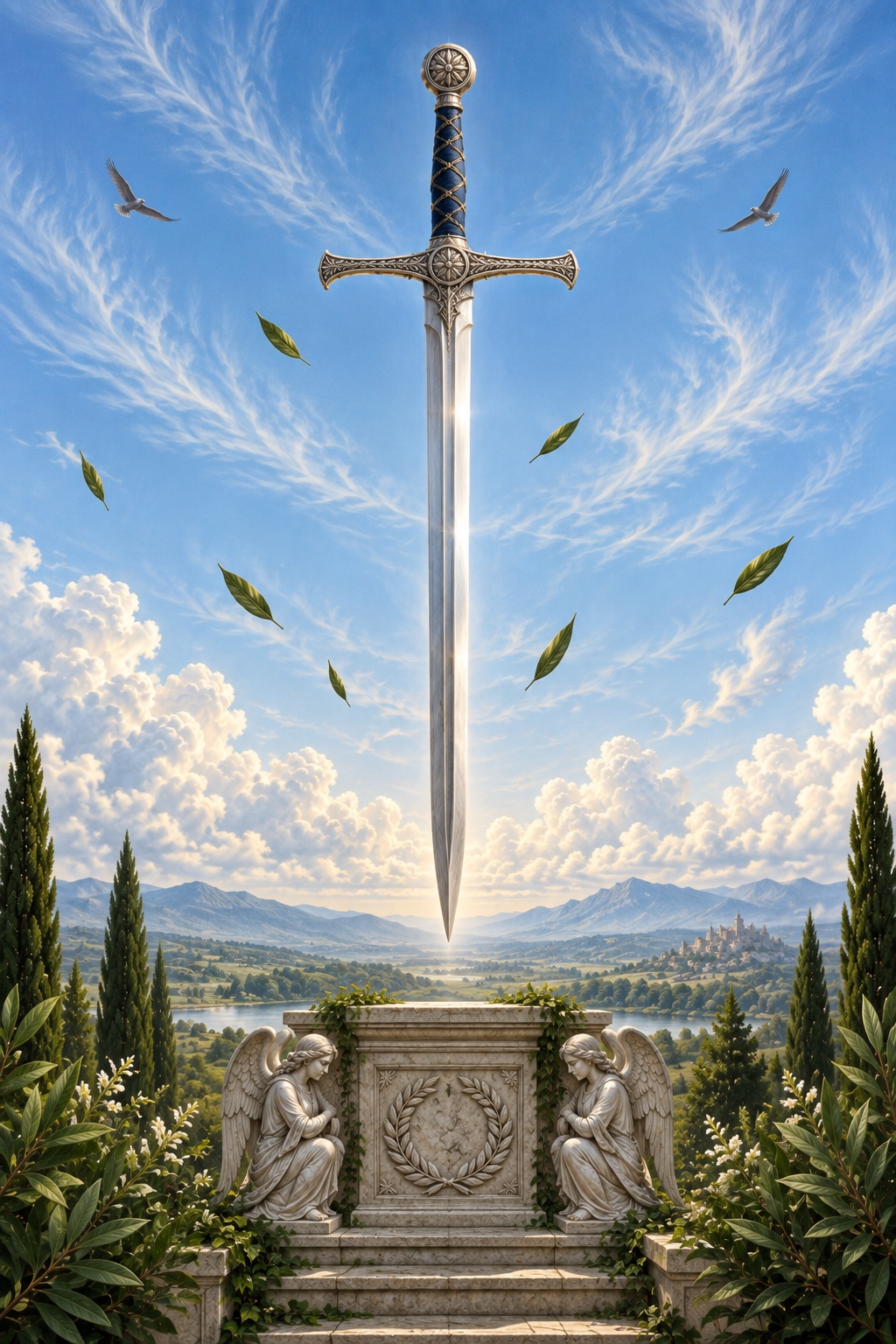
The Suit of Swords is connected with the element of air and the world of thought, but above all it teaches us that thought itself is a sharp tool.
Like a sword or a knife, when used skillfully it can be an excellent tool. It allows us to discern, cut through confusion, make decisions, set boundaries, solve problems, and reach the truth.
But a sharp tool requires control. A sword that is not held correctly can injure the person holding it, and when it is directed without discernment it can harm others as well. So it is with thought.
Unrestrained thought can become anxiety, overthinking, self-criticism, suspicion, or inner loops that damage quality of life. Truth can also wound, and words can be like knives. Wisdom is therefore not only knowing what is right, but knowing when, how, and for what purpose to use truth and thought.
If Wands tell of the desire to act, Cups of the emotional world, and Pentacles of what takes shape in reality, Swords concern the tool that interprets, analyzes, and decides among all of them. This is also one reason the Suit of Swords contains some of the most difficult cards in the Minor Arcana: the problem is not the sword itself, but what happens when it is no longer in our hand.
The Element of Air
Swords are associated with the element of air. Air cannot be seen, but it is around us all the time. Thought is the same: we live within a continuous stream of ideas, interpretations, memories, questions, and plans.
Air allows us to step back slightly from an experience and see it from the outside. It is connected with language, thought, curiosity, learning, communication, and the ability to understand relationships between things.
When the element of air is balanced, it brings clarity, open-mindedness, and an ability to make decisions. When it is out of balance, thought can become overload, doubt, excessive analysis, and an inability to stop. Instead of using thought to understand reality, the person begins to live inside their interpretation of reality.
The Sword as a Symbol
The sword is a tool of separation and discernment. It cuts one thing away from another.
Symbolically, this is one of the central roles of the Suit of Swords: to distinguish fact from interpretation, truth from fear, and what belongs to us from what belongs to another.
The sword is also connected with boundaries. It symbolizes the ability to decide, stop, separate, and say this far and no farther. In this sense, the Suit of Swords does not deal only with abstract thoughts, but also with the moment when thought becomes a choice.
Thought Is Not Reality
Our thoughts can be accurate, but they are not necessarily facts. We interpret what happens through past experience, beliefs, fears, and expectations.
One of the central lessons of the Suit of Swords is therefore to learn to observe thought itself. Not every thought should be granted the status of truth, and the ability to think well includes the ability to examine, correct, and change our position.
Truth and Clarity
Swords are connected with the ability to see reality soberly. Sometimes the difficulty is not that we do not know what is happening, but that it is hard to accept what we already understand.
Clarity requires separating facts, hopes, fears, and assumptions. It does not promise that the answer will be pleasant, but it allows us to choose from reality rather than from the story we want to exist.
This is one of the central functions of Swords: not to create truth, but to remove what prevents us from seeing it.
Words and Communication
The Suit of Swords is also connected with language and the way thought becomes communication. The same idea can be expressed in a way that brings people closer or in a way that awakens resistance.
Precision therefore concerns not only what we say, but also the manner, timing, and intention. There is a difference between directness and aggression, between criticism and belittling, and between setting a boundary and trying to cause pain.
Here Swords concern responsibility for our words: not only saying what we believe is right, but knowing how to deliver it in a way that serves clarity rather than conflict.
The Astrological Connection — Gemini, Libra, and Aquarius
The connection of Swords with the element of air links them to the three air signs: Gemini, Libra, and Aquarius. All three are connected with thought, communication, and perception, but each expresses air differently.
Gemini represents curiosity, information, language, and mental flexibility. It asks, learns, and changes perspective quickly. In its light, this is open-mindedness; in its challenging aspect, it can become scatteredness or restlessness.
Libra concerns judgment, relationships, justice, and balance among different points of view. It emphasizes the need to see more than one side, but also reminds us that a moment comes when we must stop weighing and decide.
Aquarius brings a broader kind of thinking. It is connected with ideas, innovation, systems, and the ability to see patterns beyond personal experience. In its light, this is independent and original thinking; in its challenging aspect, it can become distance and disconnection from emotion.
In terms of astrological modalities, Libra is cardinal and therefore initiates movement in relationships and decision-making, Aquarius is fixed and therefore holds an idea or principle, and Gemini is mutable and therefore moves information and changes the angle of view. We can see them as three actions of the mind: to ask, to weigh, and to widen perspective.
Conflict
A sword is also a weapon of struggle, so the Suit of Swords often concerns conflict. But conflict is not necessarily bad: sometimes it reveals what was already present and shows where the boundary lies and what can no longer be ignored.
The problem begins when the goal changes. Instead of understanding, we want to win; instead of solving, we want to prove who is right. Here the sword ceases to be a tool of discernment and becomes a tool of harm.
Swords and Anxiety
Swords also have a strong connection with anxiety and overthinking. The same ability that lets us plan and analyze can become a loop in which thought no longer solves the problem, but keeps it alive.
In such situations, there is not always a real external danger. The burden sometimes arises mainly from interpretation, anticipation, and the attempt to control what has not yet happened. This is one of the points where the Suit of Swords shows how deeply the mind can damage quality of life when there is no limit to its activity.
Thought and Control
We use thought to understand and plan, but sometimes we think again and again because it is difficult to accept uncertainty. There is an illusion that if we analyze just a little more, we will be able to feel certain.
But life does not allow complete certainty. The Suit of Swords therefore also concerns the ability to know when thinking has done its work. A moment comes when we need to stop analyzing, make a decision, and move to action.
Swords in Relationships
In relationship readings, Swords are especially connected with communication, boundaries, decisions, and confrontation. They can point to a need for a clear conversation or to a truth that can no longer be avoided.
Many Swords can also show a relationship in which the head is more active than the heart. When partners analyze every word, interpret every message, and remain constantly on alert, the relationship itself can disappear inside the thinking about it.
Swords in the World of Work
At work, the Suit of Swords is connected with strategic thinking, problem-solving, planning, analysis, and communication. It is a powerful suit in environments where the mind is the central tool.
But an excess of Swords can also show mental overload, politics, tension, or a situation in which work continues in the mind long after the day has ended. The body can be at home while consciousness is still at work.
When Many Swords Appear in a Spread
Many Swords usually point to a situation in which thought, communication, or conflict is central. The person may need to decide, clarify, or speak directly.
When almost the entire spread is filled with Swords, it is worth checking whether thought is still serving the person or has already become a loop closing around them.
And When There Are Almost No Swords?
An absence of Swords is not necessarily a sign of peace. Sometimes it can indicate avoidance of thought, clarification, or a conversation that needs to take place.
On the other hand, for a person who suffers from overthinking, few Swords can instead signal a need to return to the body, emotion, or action. Not everything in life has to be solved through the mind.
The Court Cards of Swords — Their Shared Visual Language
In the court cards of Swords, we can see a consistent visual language that reinforces their connection with the element of air and the world of thought.
The skies are generally relatively bright, with cool tones and a few clouds. They do not carry the heaviness and density seen in some of the more complex Swords cards. The air is open, and there is a sense of space in which the mind can operate.
The clouds matter too. They are present, but do not block the sky. We can see them as the movement of ideas and thoughts within a wider field of consciousness. They are not a full storm, but change and movement within the element of air.
The sword itself is always prominently present, but its position changes. When it is upright and straight, it emphasizes sharpness, focus, principle, and a clear aim. When it tilts slightly, it can be read as greater flexibility, judgment, and an ability to listen before deciding.
This difference is especially striking between the Queen of Swords and the King of Swords. The Queen's sword is upright and straight, emphasizing a sharp and uncompromising line of thought. The King's sword tilts slightly, and this can suggest a quality of listening, weighing, and adapting to changing circumstances.
The King of Swords also has a quality reminiscent of Libra: an attempt to find balance, see more than one side, and at times adapt the decision to the social context and the people before him.
The cool colors of the cards — blues, grays, whites, and occasional touches of yellow — also reinforce the feeling of air, distance, clarity, and intellect. The court cards of Swords are therefore not only four different figures, but variations on the same principle: active consciousness, open skies, a sword under control, and a mental space in which one can see, discern, and decide.
The Sword in the Major Arcana
The sword also appears in the Major Arcana, where it emphasizes the power of discernment and decision.
In The Magician, the sword lies on the table beside the cup, wand, and pentacle. It represents the power of thought as one of the four tools available to a person. The intellect is important, but it is not meant to operate alone; it also needs will, emotion, and the ability to manifest.
In Justice, the sword is already held in the hand. It is straight, visible, and ready to decide. Here it is connected with judgment, responsibility, truth, and the ability to make a decision after examining the facts. The scales weigh, and the sword decides.
We can see a clear development here: in The Magician, the sword is the ability to think; in Justice, it is the ability to use thought in order to choose.
The Great Lesson of the Suit of Swords
The Suit of Swords teaches us that thought is a powerful tool, but power requires skill.
The maturity of the suit is not found in the amount of thought, but in the ability to use it well: to distinguish fact from interpretation, make a decision when the time comes, speak precisely, set boundaries, and know when to stop analyzing.
The goal is not to think more. The goal is to see more clearly.