The Celtic Cross Tarot Spread: Ten Cards, One Broader Picture
Ten positions offer different perspectives on the same question: the situation, the challenge, the root, the past, conscious awareness, the near future, the querent’s stance, the surrounding influences, hopes and fears, and the direction things are heading. Explore where the name comes from, when to choose this spread, and how to read its horizontal and vertical lines, figures, colors, elements, and outcome card.
Some questions fit comfortably into a three-card spread. Others begin in one place and immediately branch out: a decision at work is tied to financial security, a relationship with someone else, and the fear of making a mistake. When we look only at the possible outcome, we miss the path that leads there. This is where the Celtic Cross spread can help.
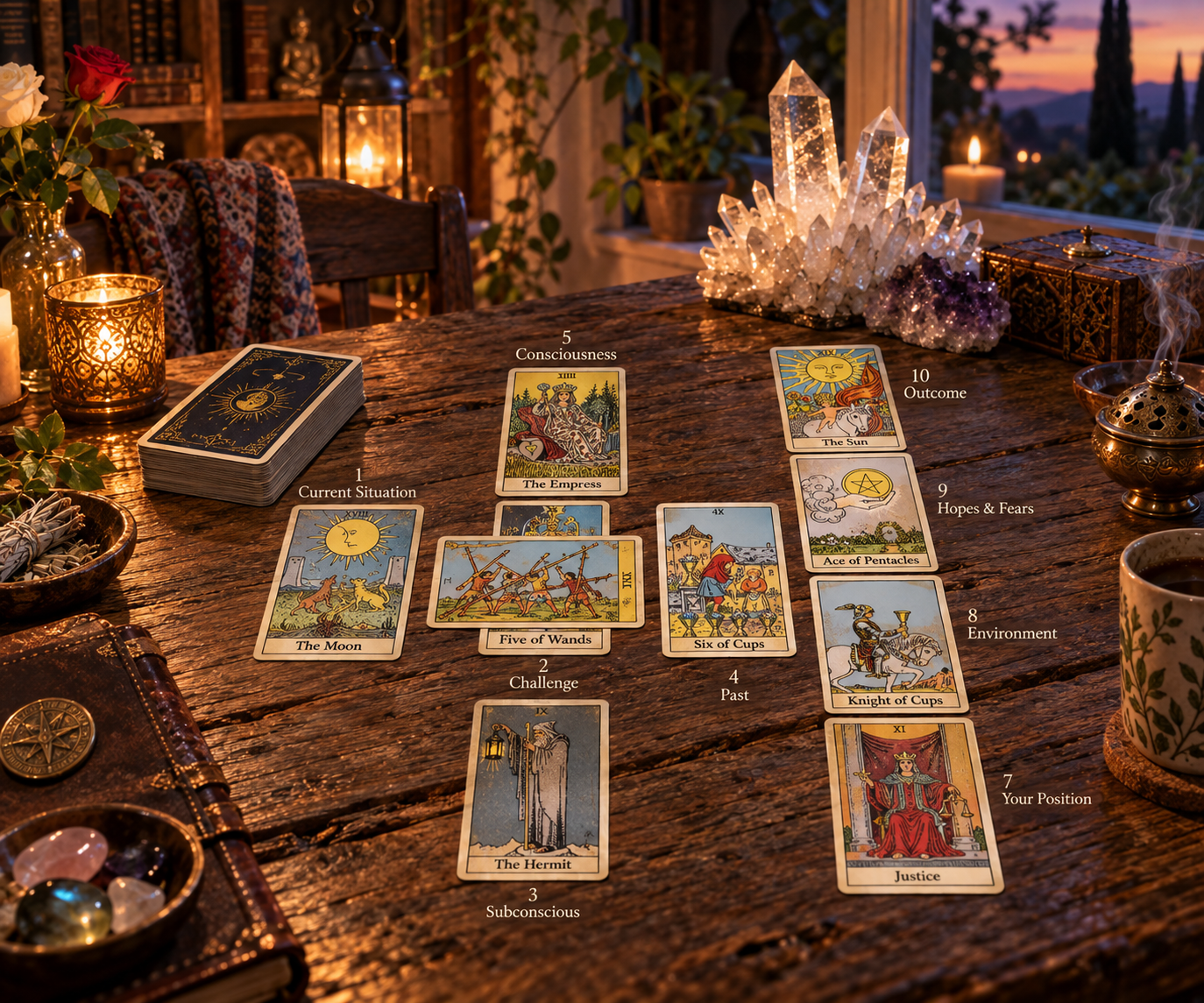
The spread has ten positions. Six cards describe the heart of the matter—the situation, what crosses it, its roots, the past, what is in conscious awareness, and the near future. Four more explore the querent’s stance, the surrounding environment, hopes and fears, and the direction things are taking. It allows us to ask not only “What will happen?” but also “What is at work here, and what might change if I understand it?”
Why Is It Called “Celtic”?
The name sounds as though the spread was handed down through generations in ancient Celtic times. The documentary record tells a more cautious story. Arthur Edward Waite described the method in his book The Key to the Tarot, published alongside the Rider–Waite–Smith cards in the early twentieth century. The later, better-known edition, The Pictorial Key to the Tarot, included the heading “An Ancient Celtic Method of Divination.” Waite did not provide a historical source proving that the spread itself was ancient or Celtic.
Research based on documents from Golden Dawn circles suggests that early forms of the method were in use in the late nineteenth century. Who created it, and exactly how it acquired its name, remain uncertain. Over the years, “Celtic Cross” became the established name, partly because the central group of cards resembles a cross. We can appreciate the name and the tradition that has grown around it without attributing unproven ancient origins to the spread. We explore tarot’s own journey up to Waite and Smith in The History and Symbolism of Tarot.
What Is the Spread Used For?
Its strength lies in placing several perspectives on the same issue side by side. It can reveal a gap between what someone wants and what drives them beneath the surface; between how they understand the situation and the pressures in their environment; between a step about to unfold and the broader direction of events. Sometimes the important question turns out to be not “Will this happen?” but “What is keeping me from seeing the whole picture?”
For example, someone asking about a change at work might see a new opportunity in the central card, difficulty choosing in the challenge position, a long-standing investment in their current workplace at the root, and other people’s demands in the environment position. These are not four competing answers. Together, they describe an opportunity that is difficult to pursue because the cost of choosing is not yet clear.
The Ten Positions in AGAT’s Spread
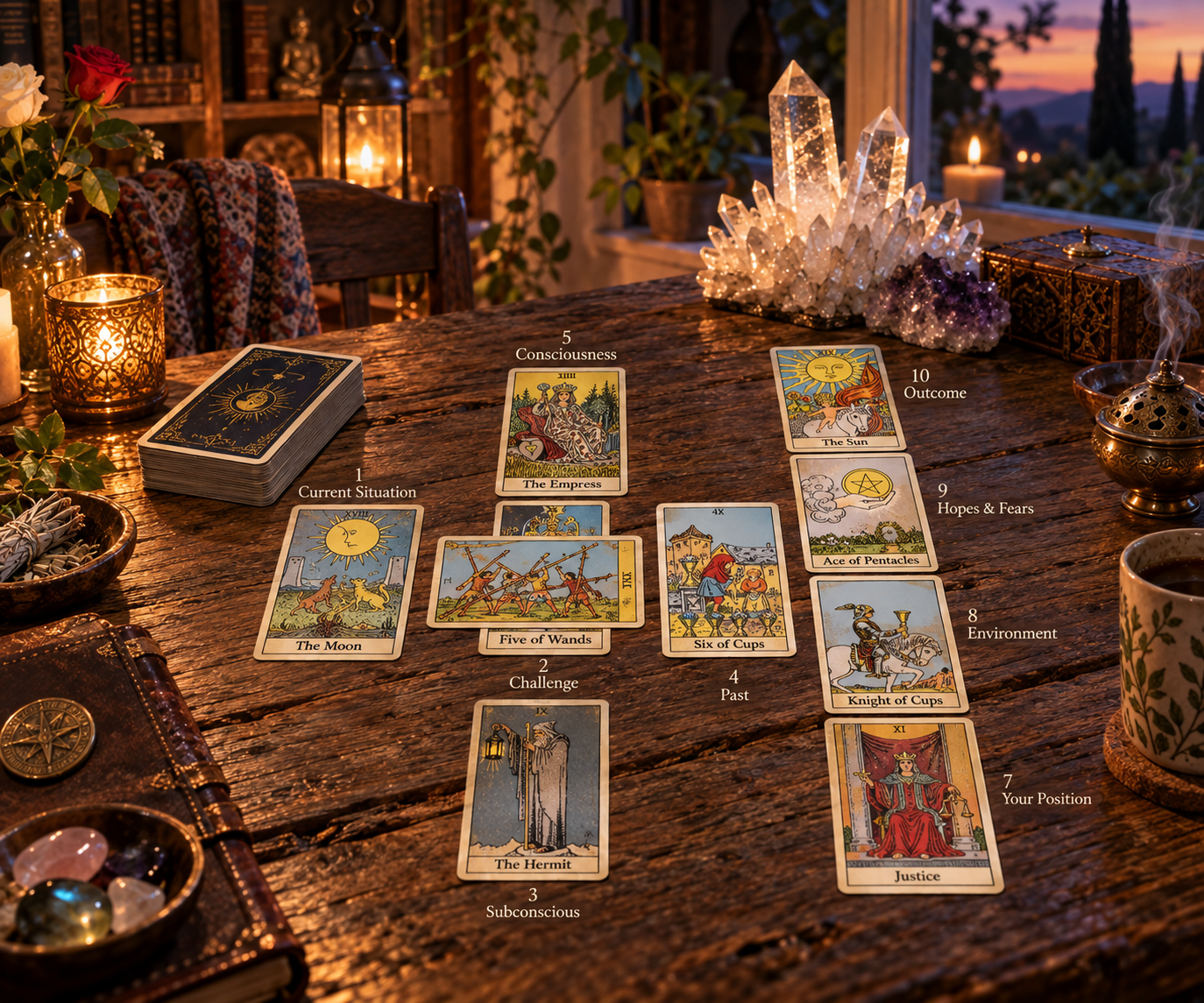
There are different versions of the Celtic Cross spread. Books and websites may use the same general structure with slightly different placement orders or definitions. It is therefore worth knowing what each position means in the spread you are using before you begin interpreting the cards. In AGAT’s Celtic Cross spread, the positions are:
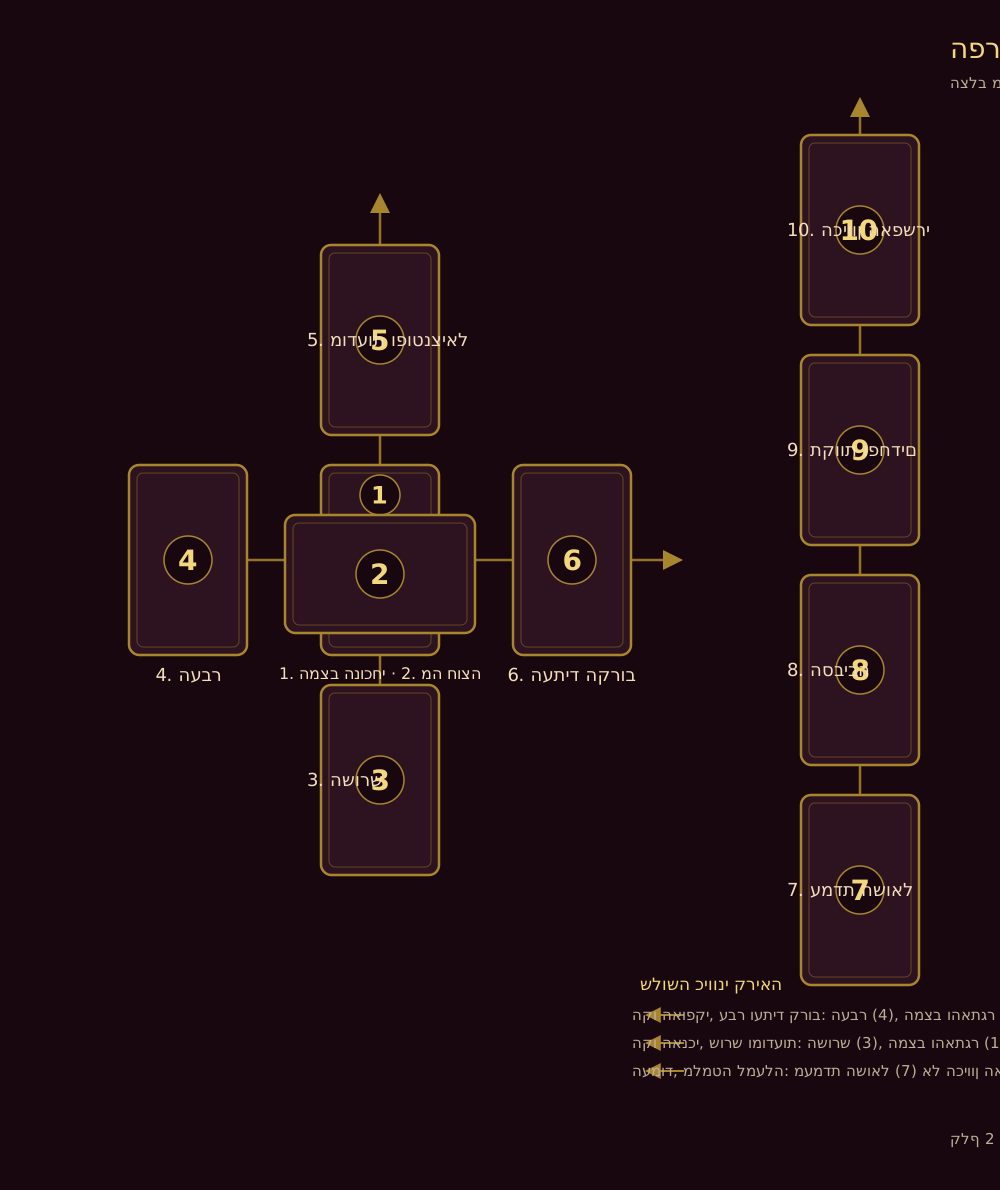
1. The current situation. What is at the center of the question right now; the prevailing atmosphere or influence.
2. What crosses it: the challenge. What conflicts with the situation, holds it back, or needs to be addressed. Even a seemingly pleasant card can point to a difficulty here.
3. The root. What underlies the situation: a need, a pattern, background circumstances, or a deeper factor.
4. The past. What brought things to this point, or what continues to exert an influence even though it has passed.
5. Awareness and potential. What the querent sees, aspires to, or can bring into expression; potential is not yet an outcome.
6. The near future. The next step or development if the current trend continues.
7. The querent’s stance. How the querent is approaching the situation, and what their approach makes possible or more difficult.
8. The environment. People, conditions, and constraints beyond the querent’s own stance that affect the question.
9. Hopes and fears. What is deeply desired and what causes concern; sometimes these are two sides of the same thing.
10. The possible direction: the outcome. Where the situation is tending, based on the picture emerging now—not a verdict on a future that cannot be changed.
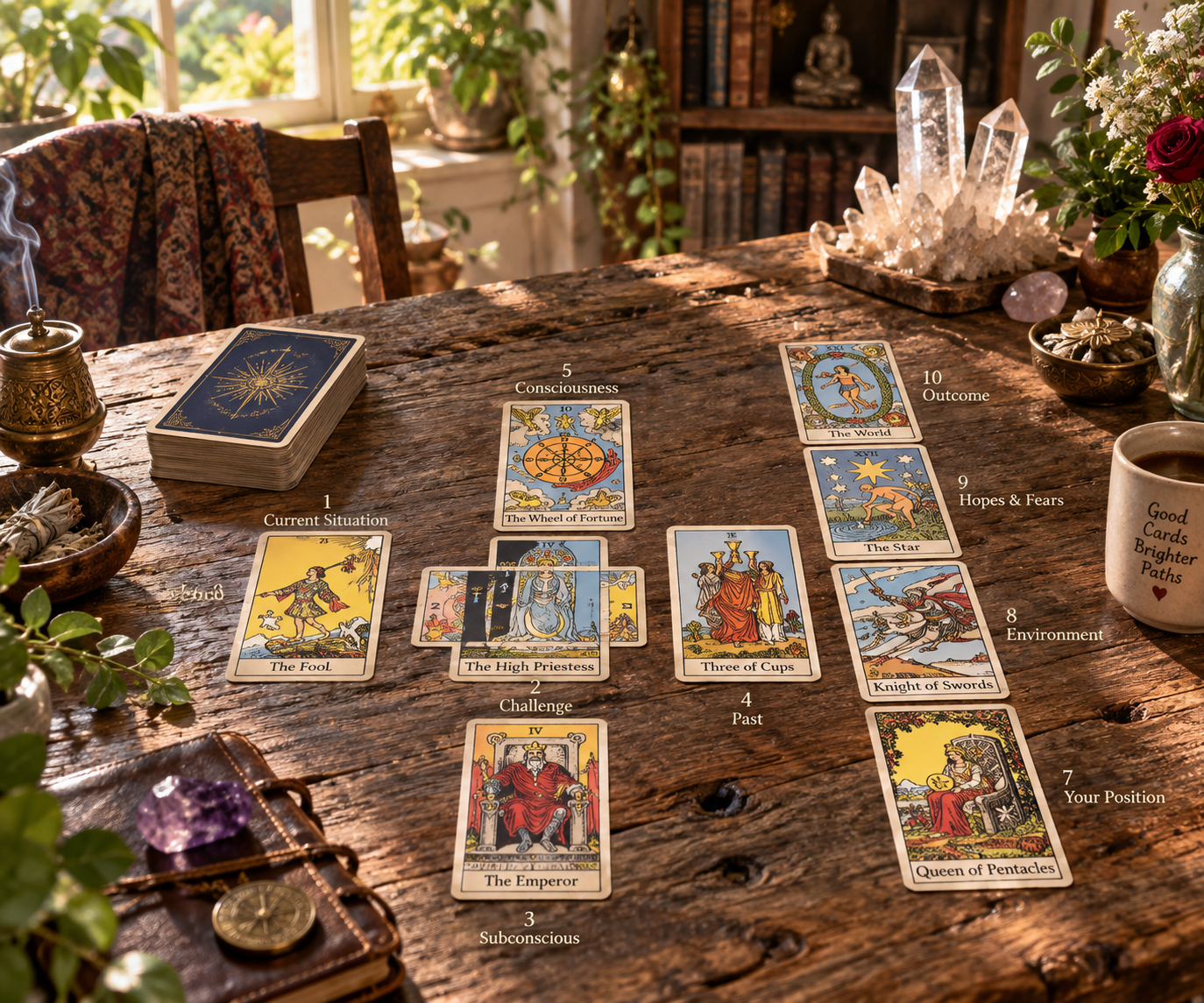
In an early version, Waite also used a significator chosen in advance, in addition to the ten cards drawn. You do not have to use one to read the modern ten-position version. His order for positions 3 through 5 differed from AGAT’s; this is one reason not to transfer an interpretation from a guide to a spread without checking its position order.
When Should You Choose It?
The Celtic Cross is well suited to questions with more than one layer, when you want to understand how a situation arose, what is at work within it now, and what might develop from it. It is useful at a professional crossroads, in a relationship involving several desires or influences, during a transition or negotiation, or when the same dilemma keeps returning and part of the picture seems to be missing.
You might ask, for example: “What is important for me to understand about this relationship before our upcoming conversation?”, “What is influencing my uncertainty about work over the coming months?”, or “How can I approach the change I am considering?” A defined focus and time frame help all ten cards address the same question. The more precise the question, the easier it is to distinguish the near future in position 6 from the broader direction in position 10. We discuss how to frame the question itself in How to Ask a Tarot Question.
When you want a brief answer to a focused question, three cards may be enough. For a direct comparison between two options, such as two job offers, a spread that examines each path separately may be clearer. “Will this happen, yes or no?” also leaves much of this spread’s richness unused. You can turn it into a question that opens the way to understanding: “What forces are influencing this possibility, and what do I need to know before I act?” You can compare all the spreads, from a single card to the Celtic Cross, on the spreads page.
Read the Lines, Not Just Individual Cards
The ten cards are not ten separate messages. You can begin at the center, where card 2 lies across card 1, then view the cross as two short readings that intersect. The horizontal line tells the story of what has been and what is approaching. The vertical line shows what underlies the situation and where conscious thought is reaching. The four cards to the side add the relationship between the querent and their environment, along with the question of direction. In the illustration above, arrows mark these three directions. This is one way to read AGAT’s spread; it does not change the meaning of any position.
The Horizontal Line: Past, Center, Near Future
This line runs from card 4, the past, through cards 1 and 2, the situation and challenge, to card 6, the near future. Read it as a single story: what has carried over from the past, what is happening now, and what stage is beginning to emerge. The challenge card crossing the center can explain why the transition from the past to the near future is not straightforward.
Suppose the Eight of Cups appears in the past, the Two of Pentacles at the center, and the Three of Wands in the near future. One possible reading is a move away from a situation that is no longer fulfilling, an effort to balance two demands in the present, and a view toward a broader possibility. If the Seven of Cups crosses the Two of Pentacles, the challenge may be an abundance of options or difficulty distinguishing a realistic plan from an alluring possibility. These cards are examples; the question determines what, specifically, lies behind the departure and the choice.
It is also worth noticing what changes from one image to another: is the figure in the past walking, while the figure in the future stands waiting? Does an open space follow an enclosed scene? This visual movement can help name a stage that has not yet found words. The line is not a clock: it suggests a sequence, not a date.
The Vertical Line: Root, Situation, Awareness and Potential
This line rises from card 3, the root, through cards 1 and 2, the situation and challenge, to card 5, awareness and potential. The lower position presents the foundation beneath the question; the upper position presents what is in conscious awareness, an aspiration, or a visible possibility. The center shows how the two meet in present circumstances.
For example, the Five of Pentacles at the root, The Emperor at the center, and the King of Swords above may describe a need for security born of an experience of lack, an effort to establish a stable framework, and an aspiration to make a clearheaded decision. In this reading, the King of Swords is not necessarily a particular person who will enter the picture; it can describe the quality of judgment the situation calls for. If a card of freedom and expansion appears above while the root speaks of holding on and seeking security, the gap between them may be the heart of the dilemma.
The upper position is not a promise of what will happen. Nor must the lower position represent “the unconscious” in every spread: sometimes it is an ongoing practical circumstance or an investment already made. At AGAT, we first consider what the root says in relation to the question, and only then whether it also has an inner dimension.
The Smaller Spreads Within the Ten Cards
When a spread feels crowded, you can read a few small groups and then connect them:
1 and 2. What lies at the heart of the situation, and what crosses it? Even a seemingly helpful card can create complications in the challenge position.
4, 1, and 6, with 2 at the center. What led here, what is happening now, and what is the next stage?
3, 1, and 5, with 2 at the center. What is the foundation, how does it express itself in the present, and what does the querent understand or seek to bring into being?
7 and 8. What depends on the querent’s stance, and what is at work in the environment?
5, 9, and 10. How do aspiration and fear color the direction seen at the end?
6 and 10. Is the near future already the beginning of the eventual direction, or is it only an intermediate stage?
The column of cards 7, 8, 9, and 10 is read from bottom to top, but it is not a second timeline. It moves from the querent’s stance to the conditions around them, then to their emotional relationship with the possibility, and from there to the direction things are taking. A card in position 8 may suggest pressure or support from the environment; it cannot reveal with certainty what another person secretly thinks. If 7 and 8 conflict, the querent and their environment may be moving at different paces. If 9 and 10 are similar, hope or fear may already be influencing how the outcome is perceived. We also discuss these lines of comparison in a full spread—including gazes, elements, and axes—in How to Read a Full Tarot Spread, with an example of a complete Celtic Cross.
What Are the Figures in the Images Doing?
Before looking for another interpretation in a book, take a moment to notice which way the figures face, how they stand, and what they are doing with their hands. Along the horizontal line, a figure facing from the past toward the center may be a reminder that the past’s influence is still active; a figure in the near future with their back to the center may raise a question about moving away or changing direction. When two figures look at each other, you can ask what connection is forming between their positions. When they look in different directions, consider whether they are occupied with different things.
The vertical line has a body language of its own: a figure at the root who crouches, hides, or clutches something tightly, contrasted with an open or upright figure in the awareness position, may illustrate the distance between a basic need and an aspiration. Rapid movement in card 6, set against a seated, steady figure in card 10, may suggest that a decisive move needs to be followed by stabilization. A figure who points, reaches out, or holds an object creates another visual connection with the neighboring card.
This is a way of asking questions about the images, not a rule that “right always means the future” or “a turned back means rejection.” The figures’ orientation varies from deck to deck. Card 2 also lies sideways in the traditional layout; physically rotating it does not automatically turn every gesture within it into a new sign. The card’s position, its meaning, and the question take precedence over any single gaze.
Card Types, Figures, and Archetypes
After tracing the lines, it helps to step back and ask what kinds of cards fill the spread. The Major Arcana may highlight a change, a principle, or a lesson that cannot easily be reduced to a single everyday event. The Minor Arcana often provide the substance of daily life: a conversation, work, a resource, a choice, or an emotion. Court cards can point to people, but also to roles, attitudes, and ways of acting. A large number of Major Arcana cards does not mean everything is predetermined; it invites us to consider where things carry particular weight.
It matters where each type of card appears. Major Arcana cards at the root and center, with Pentacles in the near future, may describe a deep issue that now calls for a practical step. Several court cards in positions 7, 8, and 10 may point to a relationship between different people’s approaches, or between roles the querent needs to move among. The repetition of a number can emphasize a similar stage in several areas of life; a numerical sequence can suggest development, but the numbers are not a timetable.
Figures perceived as masculine or feminine in the cards add a symbolic layer, but they do not necessarily identify a man or woman outside the spread. The Emperor can speak of boundaries, structure, and authority; The High Priestess of quiet knowing, listening, and what is not yet visible; the King of Swords of decision and discernment; and the Queen of Pentacles of nurturing something tangible and stable. A man can act through a queen archetype, and a woman through a king archetype. If several archetypes appear together, the interesting question is what each brings to the situation: does order listen to intuition, does emotion take practical form, and which of them is missing when a decision needs to be made?
Colors and Elements: What Dominates, and What Changes?
You can look at the spread from a distance and notice which colors recur. If most cards have cool tones and a bright red card suddenly appears in position 6, the shift in color may signal an increase in tension, vitality, or initiative. If the same hue runs from the past through the center into the near future, you can ask what theme continues to accompany the question. Sometimes a single card that breaks from the deck’s color palette is what draws attention.
There is no universal color dictionary that determines a reading. Red may suggest passion, anger, or life force; blue may suggest calm, distance, or clear thinking. Consider what the color brings into focus in that particular image and how it changes between positions. A deck’s illustrator also makes consistent stylistic choices, so the repetition of a color that appears in nearly every card is not a special sign in itself.
Alongside color, there are the elements commonly associated with the four suits:
Wands, Fire. Will, initiative, momentum, creativity.
Cups, Water. Emotion, connection, receptivity, and inner processing.
Swords, Air. Thought, language, discernment, decision, or conflict.
Pentacles, Earth. The body, work, money, time, resources, and establishing stability.
If many Pentacles appear in a question about love, perhaps the relationship calls for stability, a home, or shared responsibility; if many Cups appear in a question about a business deal, trust and relationships may be influencing it more than they seem to. Fire set against Water can point to a gap between the impulse to act and the need to process; Air set against Earth may reveal a gap between discussion and implementation. The elements do not mechanically cancel one another out. Consider which positions they occupy and what the question calls for.
The Major Arcana do not belong to any of the four suits. Some systems assign elements to them through astrological correspondences, but it is best to choose one system consistently rather than add an association simply to make it fit the story. The absence of a particular suit also invites a question, not a firm conclusion: if there are no Swords, is the theme of conversation and decision missing from the reading, or is it already represented by another archetype?
Movement and Time: What Is Developing, and What Remains Open?
There are two kinds of movement in the spread. One takes place within the images: a walking figure, a galloping horse, an outstretched hand, a spilling cup, or a figure pausing before a gate. The other takes place between positions: as we move from the past to the present and then to the near future, is there acceleration, slowing, a drawing inward, or an opening up? A shift from many Swords at the center to Pentacles in position 10 may also move the story from discussion and examination toward creating tangible conditions.
The reading’s time frame begins with the period defined in the question. If we asked about the next three months, position 6 is a near-term development within that window, while position 10 describes the direction taking shape as the reading progresses. The past in position 4 might mean last week or a years-old pattern, depending on the context. A Knight card does not require something to happen “tomorrow,” and a Pentacles card does not, on its own, establish “months.” Sometimes the spread points to a sequence of conditions: first a conversation, then a decision, and only then the possibility of an outcome. That is useful information even when no date can be attached to it.
Several courses of action can therefore emerge from the same spread: continue along the path currently shown, change the querent’s stance, clarify a condition in the environment, or ask a focused follow-up question about the gap between two cards. These are not contradictory futures. They show what is already at work and where choice remains.
How Do You Read the Outcome Card?
There is a tendency to skip straight to the tenth card. But The World, for example, may signify completion, expansion, or the closing of a chapter, and exactly what is being completed depends on the question and the nine cards before it. A challenging card does not necessarily mean “no,” either. It may point to a cost, a delay, or a direction that can be changed if recognized in time.
It helps to ask: does the outcome align with the potential in position 5? What in position 6 leads toward it? Do the querent’s stance and the environment support the same movement? If the outcome card raises a new question, you can frame a specific follow-up question to explore it. There is no need to lay out the same ten-card spread again and again in the hope of getting a more comfortable answer.
The Celtic Cross is especially useful when it leaves us with something to work with. Sometimes that is a practical action, sometimes a conversation worth having, and sometimes the realization that our original question was only the first thread to follow. If you would like to try it, the Celtic Cross spread is available here. We also cover shuffling, cutting, and choosing a spread in How to Lay Out Tarot Cards.