

Tourmaline
Tourmaline is a family of colors, from protective black to watermelon. On the feeling of a boundary that is not a wall, the movement between root and heart, the differences from smoky quartz and obsidian, and the electricity within the crystal.
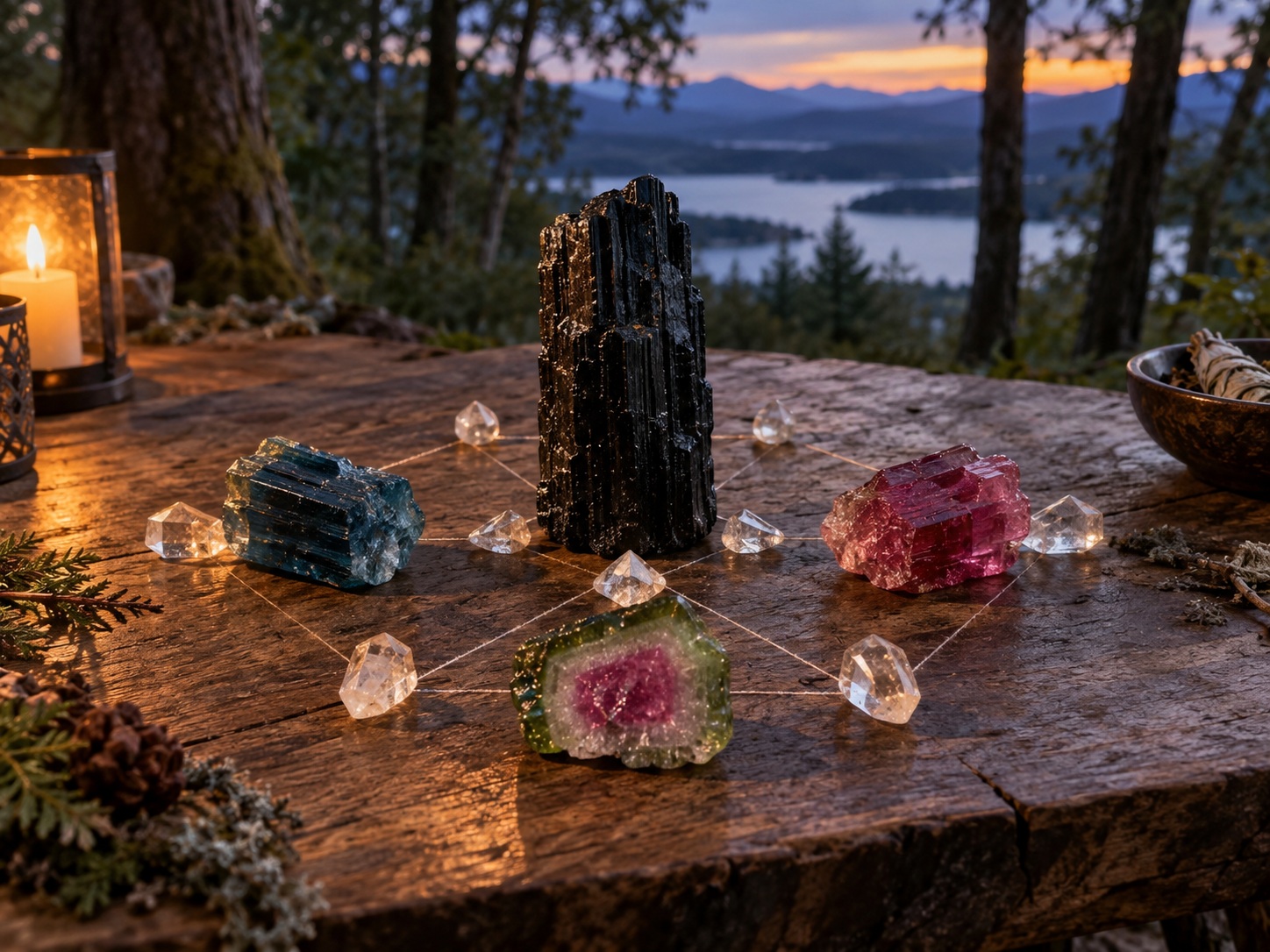
Tourmaline is not a single mineral but a large family of borosilicates. Its members share a similar crystal structure, but their chemical compositions vary widely. That is why tourmaline can be black, brown, green, pink, red, blue, or yellow—and why a single crystal can contain several distinct colors.
In the crystal world, tourmaline is a stone of protection, regulation, and balance. In mineralogy, it is remarkable for its variable chemistry, wide range of colors, and electrical properties. And in this library, it also appears as a partner: black tourmaline forms the root of the Roots and Flow Grid and the framework of the Temple of Quiet Thought Grid.
What Is Tourmaline?
Tourmaline is the name of a group of ring-structured silicate minerals. Its general formula is highly complex and can include sodium, calcium, lithium, magnesium, iron, aluminum, boron, and other elements. The best-known species are schorl, the iron-rich black tourmaline; dravite, which is usually brown and rich in magnesium; and elbaite, the species that produces many of the transparent, colorful gem-quality crystals.
The crystals belong to the trigonal system and tend to grow as long prisms with parallel striations running along their length. Their hardness is 7 to 7.5 on the Mohs scale, making them resistant to scratches but not immune to damage from impact. Cleavage is imperfect, but thin or cracked crystals can break.
What the Stone Evokes
Black tourmaline has a weight to it. People drawn to it describe stability, a sense of gathering inward, and the feeling of something closing around them, like a door shutting quietly. This is not so much calm as safety: the body knows it is protected, and only then allows itself to let go.
Pink or green tourmaline evokes a softer, more open feeling, while many people associate blue tourmaline with breath, communication, and spaciousness. A watermelon crystal, pink within green, often brings a smile: it looks like something that should not be possible.
Which Chakra Is It Connected To?
Tourmaline is a family, so its chakra associations follow its colors. Black tourmaline is associated with the root chakra, Muladhara—the strongest and most widely recognized association in the family. Pink and red are linked to the heart or root. Green to the heart. Blue to the throat. And purple to the third eye.
Tourmaline’s distinctive strength lies in the movement between root and heart: watermelon tourmaline, combining pink and green, is considered a heart stone with roots. In practice, black tourmaline is commonly placed near the feet while lying down, with a colored stone resting on its corresponding energy center.
Energetic Use
In crystal traditions, tourmaline is regarded as a stone of channeling and balance. Black is associated with grounding, boundaries, and a sense of protection; pink with tenderness and self-acceptance; green with renewal and generosity; blue with clear expression; and watermelon with the connection between vulnerability and resilience.
The stone can serve as an anchor for an intention: choose a word, such as boundary, clarity, or courage, hold the stone, and translate that word into one small action. The value of the practice comes from attention, repetition, and the meaning given to the object.
Black tourmaline is also the stone most people place near the front door, beside a computer, or in a pocket when traveling through crowded places. The image is of a boundary that is not a wall: it does not close us in; it marks where we end.
How It Compares with Similar Stones
Smoky quartz also grounds, but through release: it draws things downward and breaks them apart. Black tourmaline grounds through boundaries: it holds and protects. Smoky quartz when you need to put down a weight; tourmaline when you need a supporting wall.
Obsidian offers a sharp kind of protection and acts as a mirror: it reveals what is hidden, and not everyone is ready for that. Black tourmaline protects without revealing, making it the safe choice for someone who simply needs to feel protected.
Hematite grounds through weight and metal, and feels cool and heavy. Tourmaline feels warmer and less “metallic.”
Agate holds and stabilizes from within, over time. Tourmaline protects from the outside, here and now. In the Roots and Flow Grid, they work together: tourmaline at the root, agate in the trunk and at the corners.
Rose quartz compared with pink tourmaline: both are gentle heart stones, but rose quartz is love that accepts, while pink tourmaline is love with a backbone. Anyone who finds rose quartz “too soft” may find the same quality in pink tourmaline, with more structure.
The Spiritual Dimension
In his book on stones, Robert Simmons attributes different qualities to tourmaline’s varieties, and these descriptions can be read as a symbolic map: black invites an exploration of boundaries and safety, while the colored varieties invite us to examine the heart, voice, and will. Tourmaline teaches that protection and openness are not opposites: one family contains both, and sometimes a single crystal does, too.
The Emotional Dimension
Tourmaline lends itself to exploring the question, “What is mine, and what is not?” A black stone can serve as a reminder to pause before automatically agreeing; a pink one, to speak to ourselves with less criticism; a green one, to recognize where growth is possible without rushing; and a blue one, to express a truth directly without being hurtful. If fear, trauma, or ongoing distress arises, the stone can accompany professional support, not replace it.
How to Work with Tourmaline
Grounding practice. Place black tourmaline near your feet, breathe slowly, and name three things you can see, two you can hear, and one you can feel in your body.
Emotional practice. Hold pink tourmaline and ask what compassionate yet realistic response you can choose today.
Communication. Write down one truthful sentence before an important conversation, and place blue tourmaline beside it.
Using It in a Grid
In a symbolic grid, black tourmaline can be placed at four corners to represent boundaries, with a stone connected to the practice’s intention at the center. This is exactly how it is arranged in the Temple of Quiet Thought Grid: four corners defining a boundary around the fluorite. In the Roots and Flow Grid, it is the stone beneath the tree agate—the root from which the two quartz points rise. A grid of green tourmaline with clear quartz can represent focused growth.
Use in Healing and Support Sessions
Holistic practitioners place tourmaline near the body, use it during conversation, or offer it as a tangible reminder for practice between sessions. It is a complementary tool for focus, imagination, and meaning. Do not place a stone on a wound, ingest powders or “crystal water,” or delay diagnosis or treatment.
A Geological and Gemological Perspective
So far, we have explored tradition and experience. What follows is what mineralogy and gemology can tell us about the stone, for those who also want to understand the material itself.
How It Forms
Tourmaline forms in a wide range of environments. Colorful gem-quality crystals are common in granitic pegmatites—bodies of rock that cooled slowly from magma rich in water and rare elements. Schorl and dravite also form in metamorphic rocks, where heat, pressure, and boron-rich fluids alter preexisting rocks. Tourmaline’s durability allows grains to weather out of the rock and accumulate in alluvial deposits.
Colors and Varieties
Schorl is black and opaque. Rubellite is a trade name for pink-red tourmaline. Indicolite is blue, verdelite is green, and watermelon tourmaline displays a pink center surrounded by a green outer layer. Paraíba tourmaline is copper-bearing elbaite or liddicoatite in vivid shades of blue, turquoise, and green. The name Paraíba originated in Brazil, but copper-bearing tourmalines have also been found in Nigeria and Mozambique, and a geographic origin is stated only when supported by testing.
Color comes from trace elements and different oxidation states. Iron and titanium are associated with dark, green, and blue hues; manganese with pink and red; and copper gives Paraíba its electric appearance. Many crystals exhibit pleochroism: different hues when viewed from different directions.
Natural Electricity
Tourmaline is pyroelectric and piezoelectric: heating, cooling, or pressure creates a separation of electrical charge on the crystal’s surface. This is a measurable physical property, and it should not be taken to mean that the stone transfers “healing energy” to the body. The word energy in spiritual use is metaphorical and is not equivalent to the electrical concept.
Major Sources
Brazil is a major source of colored tourmaline. Notable crystals also come from Afghanistan, Pakistan, Mozambique, Nigeria, Namibia, Madagascar, Tanzania, Sri Lanka, and the United States, particularly California and Maine. Black tourmaline is far more common and occurs in many locations. Mining origin influences collector value, but color, clarity, cut, size, and treatment documentation are equally important.
Identification and Buying
In rough tourmaline, look for striated prisms, a rounded triangular cross section, and color that sometimes changes along the crystal’s length. In a cut or polished stone, pleochroism and color zoning can help, but definitive identification requires gemological equipment. Glass, dyed quartz, and other materials are sometimes sold under similar names.
Heating and irradiation are used to alter color. Fracture filling and oiling are also used in some stones. Vivid colors are not proof of treatment, especially in Paraíba, so ask for written disclosure of treatment and origin. For an expensive stone, request a report from an independent laboratory.
Choosing, Cleaning, and Care
Choose a stone that feels comfortable to the touch and whose origin and treatments are transparently described. The tips of rough crystals are delicate. For cleaning, lukewarm water, a little mild soap, and a soft cloth or brush are enough; dry afterward. Avoid steam and ultrasonic cleaning, sudden heat, impacts, and chemicals. Symbolic cleansing can be done with breath, sound, or placement in a quiet space; there is no need for salt or strong sunlight.
What Science Says
Mineralogy explains tourmaline’s structure, colors, pleochroism, and electrical properties well. In contrast, there is no clinical evidence that tourmaline heals diseases or changes “energy fields” in the body. Relaxation during practice is real and arises from attention, breathing, expectation, and ritual. A 2025 controlled study of crystals and anxiety found that reported improvement was associated with expectation and prior belief, not with the stone itself.
Sources and Further Reading
Mineralogy: Mindat: Tourmaline Supergroup · Britannica: Tourmaline · Deer, Howie & Zussman, An Introduction to the Rock-Forming Minerals (Mineralogical Society)
Gemology and care: GIA: Tourmaline · GIA: Tourmaline Care and Cleaning
Crystal traditions: Robert Simmons, The Pocket Book of Stones (Destiny Books, 2021) · Judy Hall, The Crystal Bible (Godsfield, 2003)
Placebo research: Escolà-Gascón et al., Placebo effects in alternative medical treatments for anxiety (CNS Spectrums, 2025)
This page distinguishes research-based geological and gemological knowledge from spiritual interpretations rooted in crystal traditions and literature. Spiritual use of the stone can be part of a personal practice, but it is not a substitute for medical diagnosis or treatment.