The Tree of Life in Tarot
Why does each tarot card mean what it means? From the Tree of Life and 22 Hebrew letters through the ten Sephiroth, four elements and 36 decans — the Golden Dawn system behind the Rider–Waite–Smith images.
Anyone who studies tarot long enough eventually reaches the simplest question: why? Why is the Five of Swords a card of defeat rather than victory? Why does the Eight of Pentacles show a craftsperson rather than treasure? Why do the cups of the Seven of Cups float in a cloud? The usual answer is “that is the tradition.” But behind the tradition is a system, and that system can be explained.
At the end of the nineteenth century, the Hermetic Order of the Golden Dawn placed tarot onto a vast symbolic map. The 22 Major Arcana were connected with the 22 Hebrew letters and the paths of the Tree of Life; the numbered cards with the ten Sephiroth; the four suits with the four elements and four worlds; and the 36 cards from Two through Ten with the 36 decans of the zodiac. The Golden Dawn document in which much of this tarot system was recorded became known as Book T. A little later, Pamela Colman Smith drew the deck we now know as Rider–Waite–Smith, and an abstract network of correspondences became a world of people, weather, landscapes and human situations.
One distinction matters throughout: what Book T assigns to a card is the Golden Dawn correspondence; what appears in the picture is Smith's visual interpretation. Sometimes the image expresses the correspondence almost directly. Sometimes it adds an idea of its own.
The Tree of Life in Brief
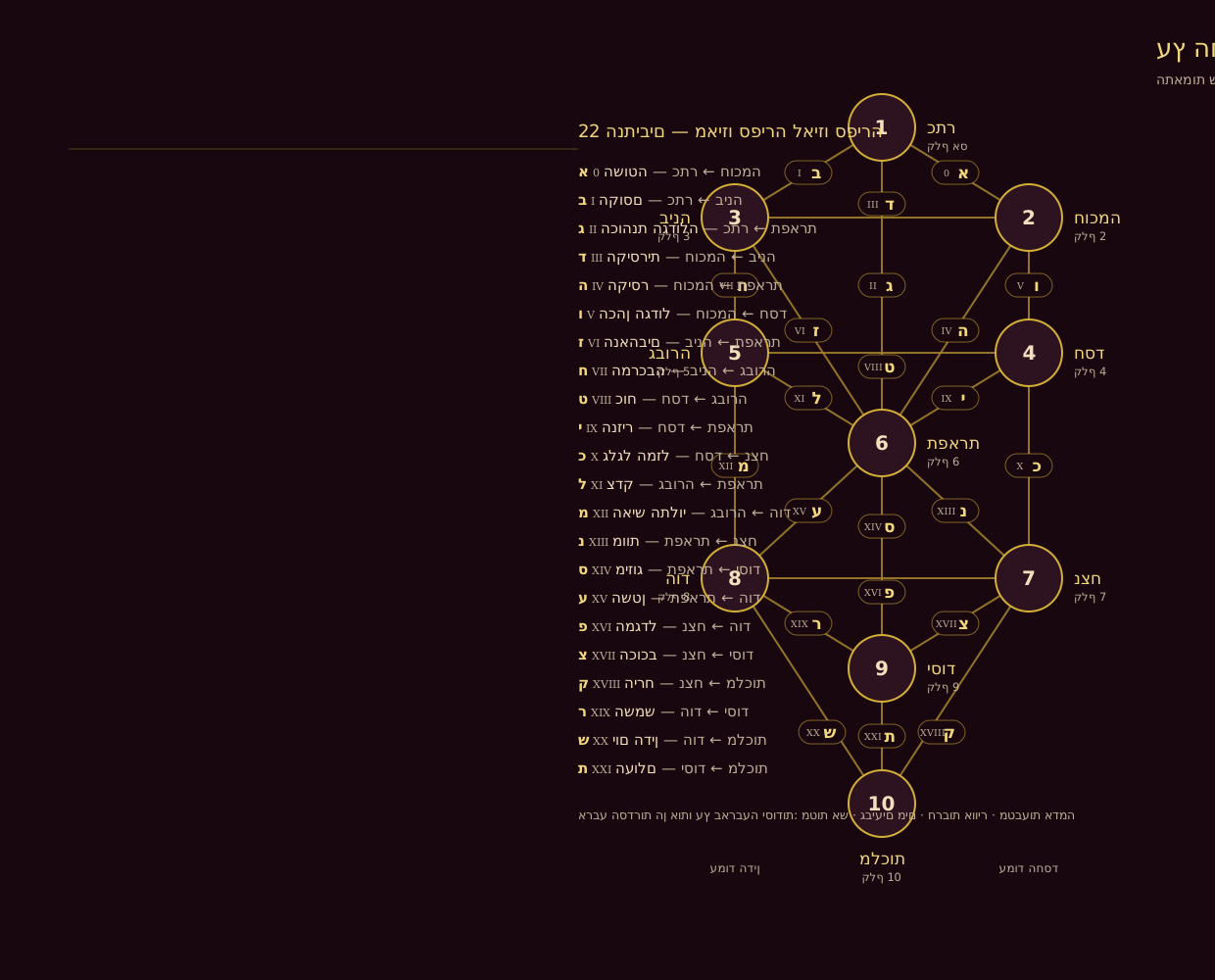
The Tree of Life is a diagram of ten Sephiroth connected by 22 paths. The Sephiroth are numbered from 1, Kether, to 10, Malkuth. In the Hermetic arrangement adopted by the Golden Dawn, the 22 paths are associated with the 22 letters of the Hebrew alphabet.
A second structure is laid over the same map: four worlds — Atziluth, Briah, Yetzirah and Assiah. In the Golden Dawn tarot correspondences, the four suits express these worlds through the four elements. Ten Sephiroth across four worlds give the forty numbered cards from Ace through Ten. The 22 paths give the 22 Major Arcana. The sixteen court cards complete the deck.
This is the first key: the Major and Minor Arcana do not occupy the Tree in the same way. The numbered Minor Arcana sit on the Sephiroth. The Major Arcana sit on the paths between them. One describes states; the other can be read as movement and relationship between states.
Hermetic diagrams also describe a Lightning Flash descending through the Sephiroth from Kether to Malkuth — source becoming manifestation — and a Serpent climbing through the paths in the opposite direction. This becomes a useful second way to understand the Fool's Journey.
There is more than one historical arrangement of the Tree. The diagram used by the Golden Dawn follows the Western Hermetic lineage commonly associated with the Kircher Tree. It is not identical to every Jewish Kabbalistic diagram. More importantly, tarot is not part of historical Jewish Kabbalah. The Sephiroth, Hebrew letters, four worlds and Tree of Life come from Jewish mystical traditions; placing tarot cards upon them is a later Western esoteric construction usually called Hermetic Qabalah.
The Major Arcana: 22 Letters, 22 Paths
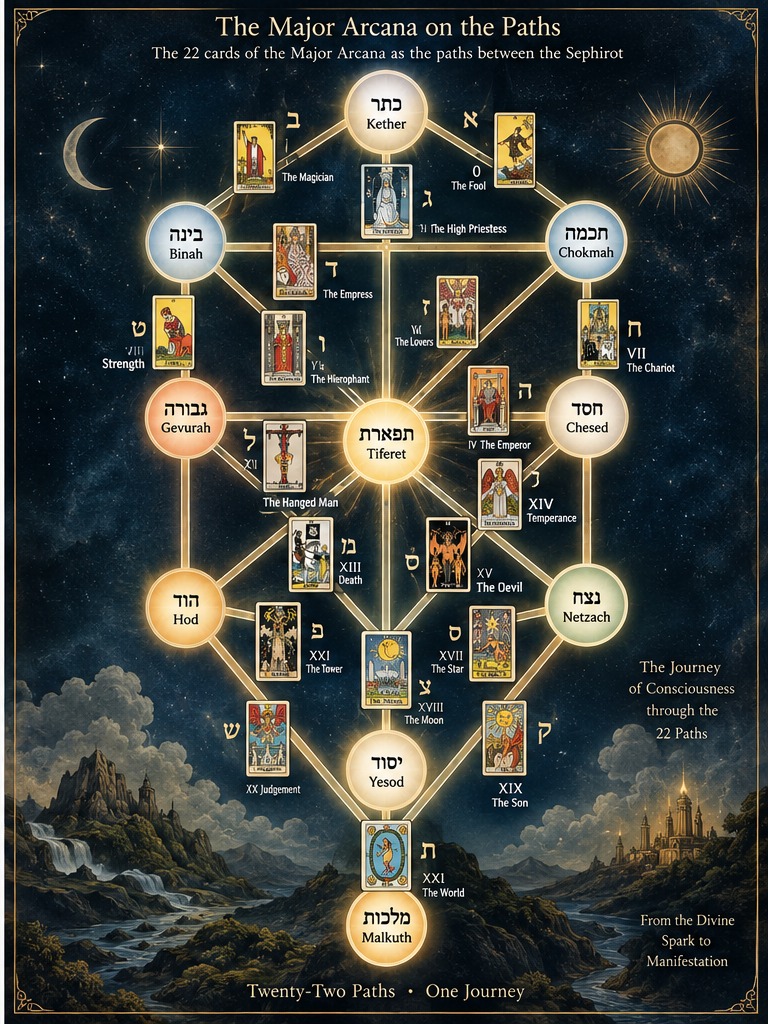
Sefer Yetzirah divides the 22 Hebrew letters into three families: three Mothers — Aleph, Mem and Shin — associated in the Hermetic reading with Air, Water and Fire; seven Doubles — Beth, Gimel, Daleth, Kaph, Peh, Resh and Tav — associated with the seven classical planets; and twelve Simples, associated with the twelve zodiac signs.
The Golden Dawn placed the 22 Major Arcana onto these letters in alphabetic sequence beginning with the Fool:
0 · The Fool — א Aleph · Air · Kether to Chokmah. Card page
I · The Magician — ב Beth · Mercury · Kether to Binah. Card page
II · The High Priestess — ג Gimel · Moon · Kether to Tiphareth. Card page
III · The Empress — ד Daleth · Venus · Chokmah to Binah. Card page
IV · The Emperor — ה Heh · Aries · Chokmah to Tiphareth. Card page
V · The Hierophant — ו Vav · Taurus · Chokmah to Chesed. Card page
VI · The Lovers — ז Zayin · Gemini · Binah to Tiphareth. Card page
VII · The Chariot — ח Cheth · Cancer · Binah to Geburah. Card page
VIII · Strength — ט Teth · Leo · Chesed to Geburah. Card page
IX · The Hermit — י Yod · Virgo · Chesed to Tiphareth. Card page
X · Wheel of Fortune — כ Kaph · Jupiter · Chesed to Netzach. Card page
XI · Justice — ל Lamed · Libra · Geburah to Tiphareth. Card page
XII · The Hanged Man — מ Mem · Water · Geburah to Hod. Card page
XIII · Death — נ Nun · Scorpio · Tiphareth to Netzach. Card page
XIV · Temperance — ס Samekh · Sagittarius · Tiphareth to Yesod. Card page
XV · The Devil — ע Ayin · Capricorn · Tiphareth to Hod. Card page
XVI · The Tower — פ Peh · Mars · Netzach to Hod. Card page
XVII · The Star — צ Tzaddi · Aquarius · Netzach to Yesod. Card page
XVIII · The Moon — ק Qoph · Pisces · Netzach to Malkuth. Card page
XIX · The Sun — ר Resh · Sun · Hod to Yesod. Card page
XX · Judgement — ש Shin · Fire · Hod to Malkuth. Card page
XXI · The World — ת Tav · Saturn / Earth · Yesod to Malkuth. Card page
The Card as a Path: Reading Its Two Ends
A Major Arcana card has an address on the Tree and two ends. The Empress, Daleth and Venus, joins Chokmah and Binah, 2 and 3. Chokmah is primordial force; Binah gives force boundary, structure and understanding. Between them stands the Empress: fertility and creation, the capacity to receive potential and give it form.
The High Priestess, Gimel and the Moon, joins Kether directly to Tiphareth along the central axis. She becomes a bridge between source and centre, hidden and revealed. The veil behind Smith's High Priestess becomes especially resonant in this position.
The Tower, Peh and Mars, joins Netzach and Hod. Netzach is desire, emotion and drive; Hod is intellect, ordering and conceptual structure. Between them comes lightning and a structure breaking apart. One Hermetic reading is the collision between what we feel and the mental structure through which we tried to organise reality.
Smith's Visual Hints
Once the correspondences are known, many Rider–Waite–Smith images reveal them. The ram imagery of the Emperor points to Aries; the pair in the Lovers evokes Gemini; Strength contains Leo's lion; Justice holds Libra's scales; the Devil carries Capricorn's goat imagery; and the Star's water-bearer echoes Aquarius.
Wheel of Fortune makes the system unusually explicit. The card includes the Hebrew letters of the divine name alongside T-A-R-O, which can also be read cyclically as ROTA, “wheel.” Around it appear the four fixed creatures associated with Taurus, Leo, Scorpio and Aquarius.
Not Every Tradition Uses the Same Table
The table above is the Golden Dawn arrangement used by AGAT, but it is not the only historical system. Éliphas Lévi placed the Magician rather than the Fool with Aleph. The Golden Dawn moved the Fool to the beginning and assigned it Aleph. Aleister Crowley later exchanged the Hebrew-letter attributions of the Emperor and the Star in the Thoth system. Other Continental traditions preserve different trump numbering.
The practical rule is simple: know which system you are using. A Hebrew letter from one table and an astrological attribution from another can create a correspondence that belongs to neither.
From Sefer Yetzirah to Book T
The correspondence developed in stages. Sefer Yetzirah, written centuries before tarot existed, supplied the division of the Hebrew alphabet. Athanasius Kircher published an influential Tree of Life diagram in the seventeenth century. Antoine Court de Gébelin, writing in 1781, promoted the historically unsupported idea that tarot preserved ancient Egyptian wisdom, helping launch esoteric tarot. Éliphas Lévi made the decisive nineteenth-century connection between 22 trumps and 22 Hebrew letters.
The Golden Dawn Cipher Manuscripts reorganised the sequence into the form underlying the order's system. Book T, developed in the 1890s, extended the architecture through the Minor Arcana: Sephiroth, decans, planetary rulers, titles and divinatory descriptions. Arthur Edward Waite and Pamela Colman Smith published their deck in 1909. Smith transformed the numbered Minor Arcana into illustrated scenes, making the cards readable through visual narrative as well as esoteric structure.
The Minor Arcana: Ten Sephiroth in Four Worlds
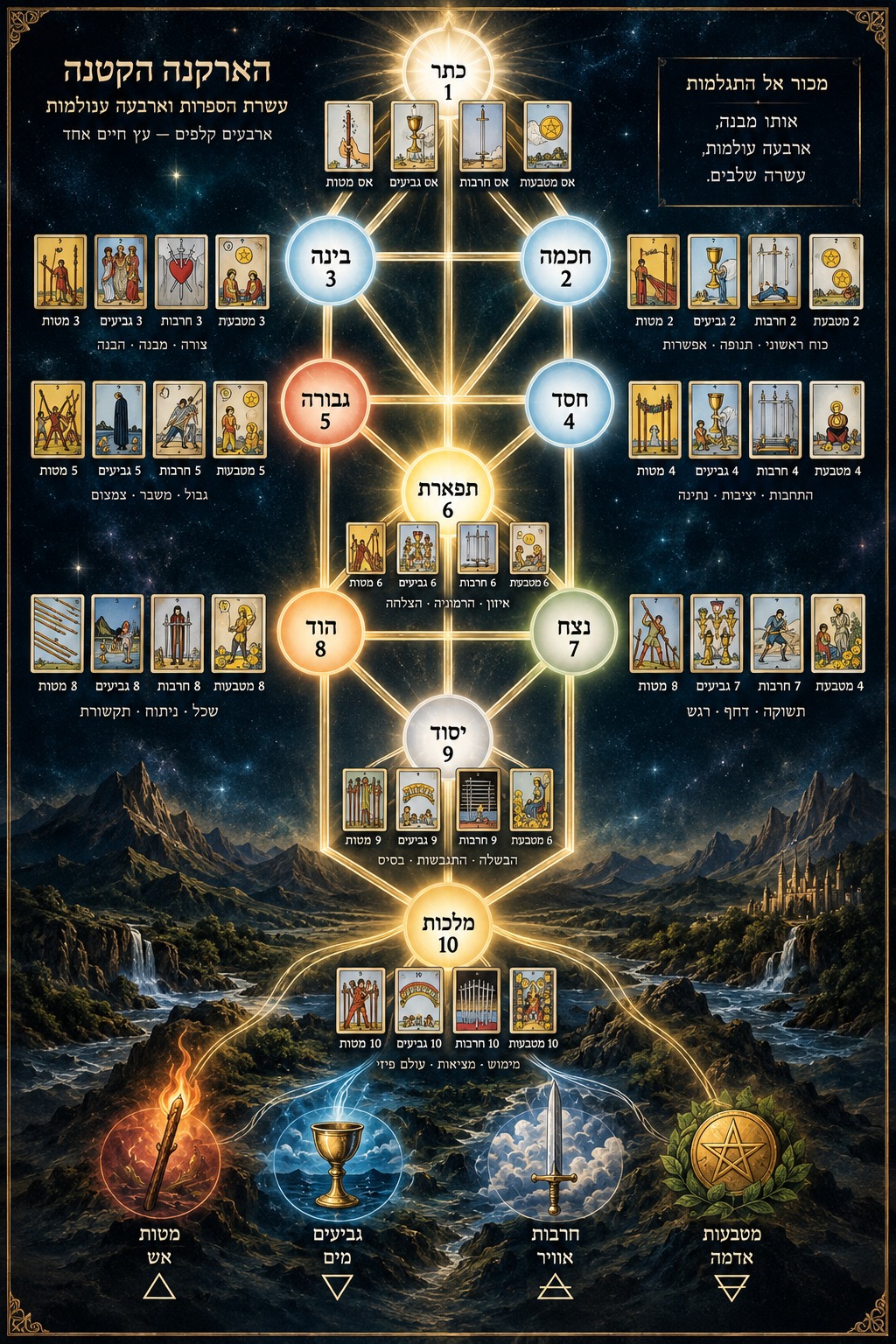
The numbered cards follow a simple map:
Ace — Kether. Source and elemental potential before direction.
2 — Chokmah. The first outpouring of force: impulse and movement.
3 — Binah. Formation: force receives boundary, shape and understanding.
4 — Chesed. Expansion, stability, abundance and structure.
5 — Geburah. Restriction, friction, judgement and challenge.
6 — Tiphareth. Centre, balance, harmony and integration.
7 — Netzach. Desire, passion, feeling and drive.
8 — Hod. Intellect, discrimination, method, order and skill.
9 — Yesod. Foundation, gathering and ripening before manifestation.
10 — Malkuth. Manifestation: the result as something that exists in the world.
The suit tells us the world and element: Wands — Fire / Atziluth; Cups — Water / Briah; Swords — Air / Yetzirah; Pentacles — Earth / Assiah. The forty cards from Ace through Ten can therefore be imagined as the Tree of Life appearing four times, once in each element.
Reading Horizontally: Cards of the Same Number Are Neighbours
Three of Wands, Three of Cups, Three of Swords and Three of Pentacles are four expressions of Binah. All Fives express Geburah. All Sixes express Tiphareth.
Look at the Fives. Five of Wands is struggle and competition; Five of Cups, emotional loss; Five of Swords, conflict and defeat; Five of Pentacles, material hardship. They look like four different stories, yet Geburah runs through all of them. Through Fire it becomes competing wills; through Water, emotional loss; through Air, conflict; through Earth, scarcity.
Move one Sephirah further. The Sixes occupy Tiphareth. Book T calls the Six of Wands Victory, the Six of Cups Pleasure, the Six of Swords Earned Success, and the Six of Pentacles Material Success. After the disturbance of the Fives, something repeatedly moves toward balance.
Binah in Four Elements
Binah gives form. In the Three of Pentacles, Earth, Smith shows people literally building. In the Three of Cups, Water, emotional connection receives social form. In the Three of Swords, Air, formation can become a recognition that can no longer be avoided, sharpened by Saturn in Libra. In the Three of Wands, Fire, will gains horizon and direction.
A card's meaning therefore emerges through layers: Sephirah + world/element + decan/planet + divinatory tradition + Smith's image.
A Ten-by-Four Matrix — and the Major Arcana Between It
If each suit is a complete Tree, cards relate in two directions. We can move vertically within a suit — Four, Five, Six, Seven of Swords — following Air through the Sephiroth. Or horizontally within a Sephirah — Five of Wands, Cups, Swords and Pentacles — seeing Geburah through four elements.
Now return to the Major Arcana. If a Major card is a path between two Sephiroth, its ends correspond to two numbers and therefore to two families of Minor Arcana. The Empress, between Chokmah and Binah, stands between the Twos and Threes. The Lovers, between Binah and Tiphareth, stand between the Threes and Sixes. Death, between Tiphareth and Netzach, stands between Sixes and Sevens. The Tower joins the Sevens and Eights. The World joins the Nines and Tens.
The Minor Arcana describe states. The Major Arcana describe forces and passages between states. Once this relationship is seen, the deck stops looking like 78 isolated meanings.
The Court Cards
The Golden Dawn also gives the court ranks elemental functions, producing “element within element” combinations. This adds another recursive layer to the system: a court card can express the element of its rank through the element of its suit.
The court cards also receive astrological territories. Rather than occupying a single ten-degree decan like a numbered card, most court figures span thirty degrees across parts of neighbouring signs. The important point here is structural: the Golden Dawn tried to leave no card without an address.
Three Rules Instead of Memorising 36 Cards
Each zodiac sign contains three ten-degree decans. Twelve signs times three gives 36 decans — exactly the number of Minor Arcana cards from Two through Ten.
The Golden Dawn map can be reconstructed from three rules.
The element determines the suit. Fire signs go to Wands, Earth to Pentacles, Air to Swords, Water to Cups.
The modality determines the number group. Cardinal signs receive 2, 3 and 4; Fixed signs receive 5, 6 and 7; Mutable signs receive 8, 9 and 10.
The decan determines the planet, following the repeating Chaldean order of the planets.
Example: Gemini is Air, so Swords. Gemini is Mutable, so 8, 9 and 10. Its three decans are assigned Jupiter, Mars and Sun. Therefore Eight of Swords is Jupiter in Gemini, Nine of Swords Mars in Gemini, and Ten of Swords Sun in Gemini.
The decans themselves are far older than the Golden Dawn. Their history reaches back through Egyptian astronomy and Hellenistic astrology. The Golden Dawn did not invent them; it placed tarot cards upon them.
The 36 Decans
Aries — Two of Wands, Mars, Dominion · Three of Wands, Sun, Established Strength · Four of Wands, Venus, Perfected Work.
Taurus — Five of Pentacles, Mercury, Material Trouble · Six of Pentacles, Moon, Material Success · Seven of Pentacles, Saturn, Success Unfulfilled.
Gemini — Eight of Swords, Jupiter, Shortened Force · Nine of Swords, Mars, Despair and Cruelty · Ten of Swords, Sun, Ruin.
Cancer — Two of Cups, Venus, Love · Three of Cups, Mercury, Abundance · Four of Cups, Moon, Blended Pleasure.
Leo — Five of Wands, Saturn, Strife · Six of Wands, Jupiter, Victory · Seven of Wands, Mars, Valour.
Virgo — Eight of Pentacles, Sun, Prudence · Nine of Pentacles, Venus, Material Gain · Ten of Pentacles, Mercury, Wealth.
Libra — Two of Swords, Moon, Peace Restored · Three of Swords, Saturn, Sorrow · Four of Swords, Jupiter, Rest from Strife.
Scorpio — Five of Cups, Mars, Loss in Pleasure · Six of Cups, Sun, Pleasure · Seven of Cups, Venus, Illusionary Success.
Sagittarius — Eight of Wands, Mercury, Swiftness · Nine of Wands, Moon, Great Strength · Ten of Wands, Saturn, Oppression.
Capricorn — Two of Pentacles, Jupiter, Harmonious Change · Three of Pentacles, Mars, Material Works · Four of Pentacles, Sun, Earthly Power.
Aquarius — Five of Swords, Venus, Defeat · Six of Swords, Mercury, Earned Success · Seven of Swords, Moon, Unstable Effort.
Pisces — Eight of Cups, Saturn, Abandoned Success · Nine of Cups, Jupiter, Material Happiness · Ten of Cups, Mars, Perfected Success.
Each sign becomes a three-part story, and each numbered card can be understood as one precise meeting point between number, element, sign and planet.
What the System Explains: Seven Examples
Two of Cups — Reciprocity, Not Only Love
Book T calls the Two of Cups Love: Venus in Cancer, Chokmah in Water. Smith shows two people, each holding a cup. Neither is merely giver or receiver. Both bring a vessel. That small detail turns “love” into reciprocity: two emotional worlds meeting.
Five of Swords — When Victory Feels Like Defeat
Book T calls the Five of Swords The Lord of Defeat: Geburah in Air, Venus in Aquarius. Yet Smith shows someone who appears to have won, collecting swords while two figures walk away.
That contradiction is the card's power. The Golden Dawn says defeat; Smith paints an apparent victor. A richer reading emerges between them: you may win the confrontation and still lose something through the way you won. The question is not only who prevailed, but what remains of the relationship afterward.
Seven of Cups — Why Abundance Can Be Empty
The Seven of Cups is The Lord of Illusionary Success: Netzach in Water, Venus in Scorpio.
In Book T's symbolic description, the cups present the appearance of abundance without being truly filled. Smith translates the idea into an unforgettable scene: seven cups appear in a cloud, filled with visions — treasure, figures, danger, desire. Everything exists as an image; nothing is yet in the person's hands.
The card therefore says something subtler than “many choices”: possibility is not manifestation, imagination is not achievement, and wanting something does not mean it already exists.
Eight, Nine and Ten of Pentacles — Skill, Fruit, Legacy
These three cards belong to mutable Earth, Virgo.
The Eight of Pentacles is Prudence: Hod in Earth, Sun in Virgo. Smith shows a craftsperson working coin after coin, with completed work already behind him. It is not merely labour. It is learning through repetition: make, inspect, refine, repeat.
The Nine of Pentacles is Material Gain: Yesod in Earth, Venus in Virgo. The work has borne fruit. A solitary figure stands in a cultivated garden. This is not yet the family and lineage of the Ten; it is the ability to enjoy what has been cultivated through one's own capacity.
The Ten of Pentacles is Wealth: Malkuth in Earth, Mercury in Virgo. Now the image contains generations, architecture, animals and a social world. Wealth has become larger than one person's possession: home, continuity, family, structure and legacy.
The sequence is clear: 8 — skill is built. 9 — skill produces independence. 10 — what was built becomes a world.
Five, Six and Seven of Cups — A Story Inside Scorpio
The three Scorpio cards are Five of Cups, Mars in Scorpio, Loss in Pleasure; Six of Cups, Sun in Scorpio, Pleasure; and Seven of Cups, Venus in Scorpio, Illusionary Success.
In Smith's pictures they can be read as a sequence: what I lost; what I remember; what I imagine. This is our reading of the Rider–Waite–Smith sequence rather than a quotation from Book T, but it sits naturally on the astrological structure behind the three cards.
Eight, Nine and Ten of Wands — Mutable Fire in Three Stages
The Sagittarius cards are Eight of Wands, Mercury, Swiftness; Nine of Wands, Moon, Great Strength; and Ten of Wands, Saturn, Oppression.
In the Eight there are not even people — only movement. In the Nine, a wounded person remains standing. In the Ten, all ten wands have become a burden. The same Fire that gives momentum can, when accumulated without limit, become weight.
Two, Three and Four of Swords — Why Swords Are Not Simply “Bad”
The Libra cards are Two of Swords, Moon, Peace Restored; Three of Swords, Saturn, Sorrow; and Four of Swords, Jupiter, Rest from Strife.
The Two holds a tense balance. The Three introduces separation, limit and painful recognition. In the Four, the swords remain present but the battle has stopped. The problem may not be solved; the struggle has paused. That is why the Four of Swords is more than “get some rest.” It is the moment in which the mind stops fighting long enough to reorganise.
The Fool's Journey, Read Backward
In the familiar Fool's Journey, the Major Arcana form a story from the Fool to the World. On the Tree, this can be read as a descent from the first path near Kether toward the final path entering Malkuth.
But the Golden Dawn initiate moved in the opposite direction: upward from Malkuth. The first path encountered in return is Tav, the World — the card we normally call completion becomes the beginning of the return. Then come Shin and Qoph, Judgement and the Moon; then Resh, the Sun; and so on upward.
This gives the same 22 cards a second reading. The World can be an ending in one direction and a threshold in another. A path is the same path; what changes is the direction of travel.
Another Layer: the 72 Names
The correspondence system continues beyond the decans. Each ten-degree decan can be divided into two five-degree sections, and Golden Dawn material associates these with names drawn from the traditional 72-fold Name.
For most readers this is a study layer rather than a practical requirement. Its importance here is structural: Tree, Sephiroth, four worlds, elements, zodiac, decans, planets and tarot were intended to form one network of correspondences.
How to Use This in a Reading
The system is a layer, not a replacement for the card. A card is still read first through its image, the question and its position in the spread. Sephirah, element and decan can then explain why the image carries the meanings it does.
Two practical rules help. First, know which correspondence system you are using and do not casually mix tables from different traditions. AGAT uses the Golden Dawn table described here. Second, distinguish between what the system assigns and what Smith adds. “Lord of Defeat” belongs to Book T; the apparent victor gathering swords belongs to Smith; the interpretation born from the tension between them belongs to the reading.
And one invitation: read sequences. Three cards belonging to one zodiac sign form a three-part movement. When one appears, it can be illuminating to remember where it came from and where it goes.
Questions and Answers
Is tarot part of Jewish Kabbalah?
No. Tarot originated in fifteenth-century Italy as a card game. Its systematic connection with the Tree of Life and Hebrew letters was made much later by Western occultists, especially within the Golden Dawn, as part of Hermetic Qabalah. The system is coherent and influential, but it is a later interpretation rather than an ancient Jewish tarot tradition.
Which Hebrew letter belongs to each Major Arcana card?
In the Golden Dawn system used here, the letters run alphabetically from the Fool as Aleph through the World as Tav, with Strength as VIII and Justice as XI. Other historical systems differ, so the table should always be identified before correspondences are compared.
How do we know the planet and zodiac sign of a numbered Minor Arcana card?
Three rules reconstruct the system: the sign's element determines the suit; its modality determines whether the cards are 2–4, 5–7 or 8–10; and the decan determines the planetary ruler according to the repeating Chaldean order.
What is the difference between a card on a Sephirah and a card on a path?
The numbered Minor Arcana sit on the ten Sephiroth: Ace is Kether, Five is Geburah, Ten is Malkuth, with each suit expressing the Tree through another element. The Major Arcana sit on the 22 paths connecting the Sephiroth. The Minor Arcana describe states; the Major Arcana describe archetypal forces and transitions between states.
What is the difference between Book T and the Rider–Waite–Smith cards?
Book T is Golden Dawn material assigning titles, Sephiroth, elements and decans to tarot cards. Smith's 1909 illustrations are a visual interpretation developed within that esoteric environment. Often the picture strongly reflects the correspondence; sometimes it adds a productive tension of its own.
Sources and Further Reading
Primary and Historical Sources
Sefer Yetzirah, especially the chapters on the Hebrew letters. Aryeh Kaplan's Sefer Yetzirah: The Book of Creation (1990) is a useful modern edition with commentary.
S. L. MacGregor Mathers, Book T — The Tarot. Golden Dawn material containing the card titles, Sephiroth, decans and descriptions used throughout this article.
Israel Regardie, The Golden Dawn. A major compilation of Golden Dawn material, including correspondence tables and tarot teachings.
Darcy Küntz, The Complete Golden Dawn Cipher Manuscript (1996). The Cipher Manuscripts underlying the order's early structure.
A. E. Waite, The Pictorial Key to the Tarot (1910). Waite's companion to the Rider–Waite–Smith deck.
Aleister Crowley, The Book of Thoth (1944). A later, explicit development of the Golden Dawn correspondence system.
Éliphas Lévi, Dogme et Rituel de la Haute Magie (1856; English translation as Transcendental Magic). An important nineteenth-century stage in connecting tarot and Hebrew letters.
Heinrich Cornelius Agrippa, De Occulta Philosophia (1533). An important Renaissance source for astrological and magical correspondences, including decanic imagery.
Tree of Life and Tarot
Robert Wang, The Qabalistic Tarot (1983). A detailed card-by-card study of tarot on the Tree of Life.
Dion Fortune, The Mystical Qabalah (1935). A classic Hermetic discussion of the ten Sephiroth.
Gareth Knight, A Practical Guide to Qabalistic Symbolism (1965). Extensive treatment of Sephiroth and paths.
Paul Foster Case, The Tarot: A Key to the Wisdom of the Ages (1947). Tarot and Hebrew-letter correspondences in the Golden Dawn lineage.
Lon Milo DuQuette, Understanding Aleister Crowley's Thoth Tarot (2003). A clear modern explanation of Sephiroth, decans and court-card structure.
Decans and Tarot History
Austin Coppock, 36 Faces (2014) and T. Susan Chang, 36 Secrets (2021) explore the decans historically and through the Minor Arcana.
Ronald Decker & Michael Dummett, A History of the Occult Tarot (2002), and Decker, Depaulis & Dummett, A Wicked Pack of Cards (1996), provide critical histories of the development of occult tarot.
Marcus Katz & Tali Goodwin, Secrets of the Waite-Smith Tarot (2015) examines Pamela Colman Smith's imagery and sources.
The Tree of Life does not replace the pictures. It reveals another grammar underneath them. Once that grammar is visible, the deck becomes less like 78 separate definitions and more like one interconnected language.