

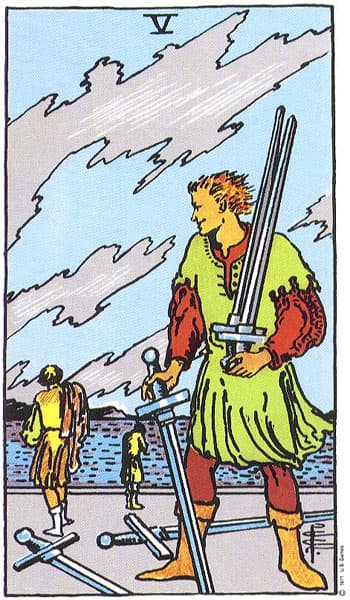
Minor Arcana · Swords
Five of Swords
חמש חרבות
- hollow victory
- conflict
- cost
Card Facts
A victory that leaves a bitter taste and asks you to examine the price. This card invites you to examine how this message is operating within thoughts, communication and decisions.
Message
The Five of Swords asks you to examine the cost of conflict and the difference between winning and truly resolving something. You can be right and still lose trust, connection, or inner peace. Notice whether the struggle still protects an important value or has become a need to prove, punish, or defend a wounded ego. Boundaries do not have to be abandoned, but the response can change. Strength may lie in leaving the fight, repairing harm, or choosing a conversation that respects everyone involved.
The light in the card
Learning through engagement with conflict
The shadow in the card
Winning at the expense of a relationship
Psychological layer
Psychologically, this card reflects a victory that leaves a bitter taste and asks you to examine the price.
Personal growth
Ask whether the victory is worth what it costs
Love & relationships
In Swords, relationship is examined through thought, words, truth, boundaries, and the way fear or interpretation shapes connection. The Five of Swords in love asks about the price of winning. A person can be right and still lose trust, respect, or the possibility of conversation. It marks conflict in which one must ask whether the goal is resolution or defeat of the other. The number 5 disrupts equilibrium and makes the relationship meet pain, difference, or competition. The aim is not to avoid all friction but to understand what it reveals. Swords ask for truth spoken in a form that can be heard, and for a distinction between fact, inner story, and an old wound seeking protection again.
Career
At work, Swords concern decisions, communication, information, conflict, strategy, and the cost of mental overload. At work, it can describe politics, ego conflict, dirty competition, or success purchased at the cost of relationships. Sometimes the intelligent move is refusing a game in which even victory costs too much. The number 5 brings a test, discomfort, or changing conditions; it exposes where the system is weak and what requires a new response. The direction is to sharpen facts and goals without turning the workplace into a battlefield or the mind into a place that no longer knows how to rest.
Money & security
In financial matters, this card reflects a victory that leaves a bitter taste and asks you to examine the price, and recommends choosing with awareness, stability and a long-term view.
Family
Within family life, this card brings forward the theme of a victory that leaves a bitter taste and asks you to examine the price, and invites awareness of roles, needs and patterns within the household.
Spirituality
On a spiritual level, this card teaches: Ask whether the victory is worth what it costs.
Mythic parallel
The quarrel between Achilles and Agamemnon in the Iliad is a strong parallel: two leaders fight over personal honor while an entire army pays the price. The Five of Swords reminds us that ego conflict can feel justified to both sides and still damage the system on which both depend. This is an interpretive parallel intended to deepen the reading, not a claim that the myth is a fixed historical source of the card.
Affirmation: I choose inner peace over being right at any cost
Moment for reflection: Sit quietly and ask: What step today expresses the message “A victory that leaves a bitter taste and asks you to examine the price”?