

Botswana Agate
Botswana agate formed in 180-million-year-old basalt, layer upon layer in shades of gray, pink, and peach. Explore the research that described it, the green coating that surrounds it, and the comfort it offers in times of transition.
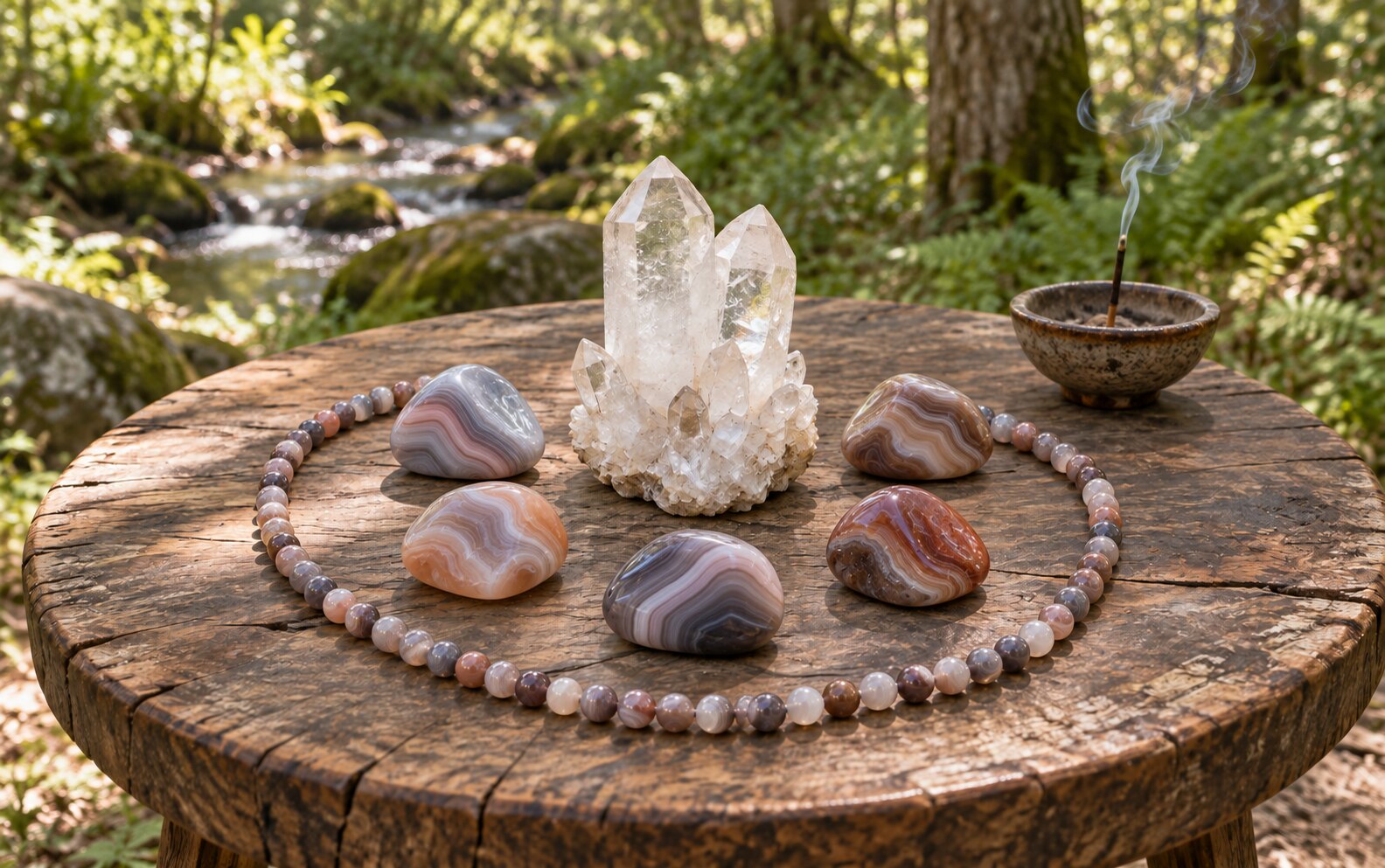
Botswana agate is known for its fine layers in shades of gray, white, brown, pink, peach, and sometimes red. Some stones display eyes, parallel lines, or rounded patterns that evoke smoke and desert landscapes.
Its beauty rests not on vivid color, but on precise transitions between quiet shades. It offers a striking example of how agate turns slow chemical change into an inner painting.
This page focuses on a single variety. For the broader family, its formation, and general uses, see our Agate Overview.
What Is Botswana Agate?
Botswana agate is agate from Botswana in southern Africa, primarily from areas in the northeastern part of the Central District. Mineralogically, it is a fine-crystalline, fibrous chalcedony composed mainly of silica. Its hardness is approximately 6.5 to 7 on the Mohs scale, making it suitable for cabochons, beads, carvings, and pocket stones.
A microscopic study conducted at the University of Botswana described agates from the Bobonong area, the Motloutse River, and Serowe. Their host rock is basalt from the Karoo volcanic group, approximately 180 million years old. Most specimens are agates that grew along the walls of cavities, though vein agates were also found within cracks. After rainy seasons, weathering and erosion release nodules from the basalt, leaving them in fields and along the river.
What the Stone Evokes
Botswana agate feels like a blanket. Not like medicine, not like encouragement, but like something soft laid over your shoulders, quietly saying that you can. Breaths grow longer, shoulders settle, and sadness that has been stuck is given permission simply to be there, without needing to be fixed.
It is not an uplifting stone. Anyone looking to feel better immediately will be disappointed. It is a stone of quiet comfort, of the moments between the old and the new, and of people who feel ashamed to admit they are struggling. Its smoky shades of gray, pink, and peach are the very colors of twilight: neither day nor night, and that is all right too.
Which Chakra Is It Connected To?
The association varies according to the stone’s dominant color. Brown and gray tones connect with the root chakra and grounding; pink and peach with the heart chakra and gentleness; and pale, nearly white bands with the third eye or crown chakra. Most stones contain all these shades together, which is really the point: Botswana agate works along the axis between root and heart, reminding us that we can feel deeply and remain steady at the same time.
In practice, the usual approach is to choose the band that draws your eye and work with its corresponding chakra, rather than impose a single, absolute association.
Energetic Uses
In crystal traditions, Botswana agate is associated with comfort, grounding, and adapting to change. Its many bands offer an image of different periods held within a single structure. This is why it is often used during transitions, separations, moves, changes in role, or any process in which the old is still present and the new has yet to become stable.
Its use can be simple: carry a stone in your pocket and touch it when you feel the urge to slip automatically back into an old habit, or place it beside a journal during a period of change. The stone does not prevent anxiety or withdrawal, but it can serve as a tangible reminder of a choice you have made and the next step to take.
In grids, it is a stone for corners and foundations: on our Three Agate-Based Grids page, it holds the four corners of the Roots Grid and the foundation of the Temple of Quiet Thought Grid.
How It Compares with Other Stones of Comfort and Transition
Rose quartz is about love and gentleness, and less about stability. It softens; Botswana agate holds. During grief, rose quartz helps you feel, while Botswana agate helps you stand.
Smoky quartz offers a heavier kind of grounding and releases what is no longer needed. It suits times when you need to put down a burden; Botswana agate suits times when you need to carry it a little longer, gently.
Lepidolite is the classic stone of transitions and soothes acute anxiety. Botswana agate is gentler and better suited to quiet sadness than to panic.
Rhodonite works actively with emotional wounds and invites forgiveness. Botswana agate asks for nothing. It simply stays beside us, and that is its gift: the quiet friend who sits with us without saying that everything will be all right.
Spiritual Perspective
On a spiritual level, Botswana agate speaks to continuity within change. Each layer marks a different set of conditions, yet no layer cancels out the one before it. It can represent growth that does not require erasing the past, but instead places it within a wider context.
In his book on stones, Robert Simmons presents stones through their archetypal character, keywords, chakras, and spiritual and emotional qualities. In that language, Botswana agate can serve as a teacher of gradual transition: slowing down as identity reshapes itself, holding complexity, and recognizing that a life is built from gray periods as well as peak moments. This is a symbolic interpretation, not a mineralogical fact.
Emotional Perspective
Emotionally, the stone lends itself to work with longing, confusion, and shifts in mood. It does not symbolize the erasure of difficult feelings, but the ability to give them a framework. Looking at the layers, you can ask which feeling belongs to the past, which describes the present, and what need is beginning to emerge beneath them both.
In crystal literature, it is sometimes mentioned in connection with quitting smoking and changing habits. It is important not to turn this into a therapeutic promise. Overcoming dependence requires a plan, support, and sometimes medical treatment. The stone can serve as a behavioral cue: each time your hand reaches for the habit, touch the stone, breathe, and choose an alternative action you have already decided on.
How to Work with the Stone
A transition practice. Choose three bands in the stone. The first represents something that has ended, the second your current situation, and the third your next step. Write one sentence for each band, then choose one practical action that supports the third.
An emotional practice. Hold the stone and identify a sensation in your body. Name it without explaining it, rate its intensity from one to ten, and breathe for one minute. At the end, rate it again. The aim is not to make the feeling disappear, but to create space between the sensation and an automatic reaction.
A Geological and Gemological View
So far, we have explored tradition and experience. From here, we turn to what mineralogy and gemology can tell us about the stone, for those who also want to understand the material itself.
How It Forms
Gas bubbles trapped in lava created cavities. Silica-rich fluids or gel entered them, and chalcedony began to crystallize from the walls inward. At each stage, the silica concentration, water content, and mineral pigments changed, producing layers that differed in composition, transparency, and color.
The study of Botswana agates showed that the bands roughly follow the shape of the cavity in which they grew. In some specimens, the bands become wider toward the center, and in some cases the center of the nodule filled with quartz crystals. Cathodoluminescence testing revealed differences between the white layers and other areas, suggesting a connection among crystallization, chemical separation, diffusion, and the periodic deposition of silica with and without pigment.
Colors and the Green Coating
The gray, white, brown, pink, and red shades arise from differences in the silica structure and inclusions of elements and oxides, especially iron. In some of the banded carnelian examined, iron concentrations varied from band to band.
Unweathered agate nodules sometimes have a green clay coating. The study identified this coating as celadonite. The same mineral was also found in green bands in local material known as “Gorgonzola” or “green moss agate,” but examination showed that this material is granular microcrystalline quartz rather than fibrous agate. This is an important example of the gap between a local or trade name and a mineralogical definition.
Why the Pattern Varies from Stone to Stone
Each cavity in the basalt had a different shape and received fluids of different compositions at different rates. Temperature, pressure, acidity, silica availability, trace elements, and gravity influenced growth. This is why even stones from the same area are not identical. Two slices from opposite sides of the same nodule may look like mirror images, while another nodule tells an entirely different story.
Identification and Buying
Typical Botswana agate displays fine, sharply defined bands in soft, smoky shades. The market also includes stones that have been dyed or are sold as “Botswana” despite having no documented origin. Geographic origin cannot be established with certainty from color alone, so without documentation, a trustworthy seller should present the origin as information from the supplier rather than a scientific guarantee.
When choosing a stone, examine the definition of its bands, the depth of its pattern, the quality of its polish, and any cracks or fractures. Natural eyes, unexpected transitions, and a small quartz-lined cavity can add interest. Strong pink or orange color does not necessarily indicate treatment, but a uniform neon shade or color concentrated in cracks warrants asking whether the stone has been dyed.
Choosing, Caring for, and Cleaning Your Stone
Choose a pattern that catches your eye, regardless of the meaning attributed to it. Lukewarm water, mild soap, and a soft cloth are enough for cleaning. Avoid acids, harsh cleaning agents, steam, and extreme temperature changes. A stone worn in a ring needs a setting that protects its edges.
What Science Says
Research describes the stone’s origin, microstructure, bands, and pigments. There is no clinical evidence that Botswana agate treats depression, addiction, or disease. It can be incorporated into practices of mindful attention, writing, and habit change, but using a stone is no reason to stop treatment or avoid professional help.
Sources and Further Reading
Mineralogy: Jain, Coetzee & Diskin, Optical Features, Microstructure and Microanalysis of Botswana Agates (Botswana Notes and Records, 45) · Götze, Möckel & Pan, Mineralogy, Geochemistry and Genesis of Agate: A Review (Minerals, 2020) · Moxon, A re-examination of water in agate (Mineralogical Magazine, 2017) · Goldbaum, Howard & Rabinovitch, Spatial Chirp of Agate Bands (Minerals, 2019) · Mindat: Agate
Gemology and Buying: International Gem Society: Agate Value, Price, and Jewelry Information
Books: Pabian, Jackson, Tandy & Cromartie, Agates: Treasures of the Earth (Natural History Museum, London) · Zenz, Agates (Bode Verlag, 2005)
Crystal Traditions: Robert Simmons, The Pocket Book of Stones (Destiny Books, 2021) · Judy Hall, The Crystal Bible (Godsfield, 2003) · Michael Gienger, Crystal Power, Crystal Healing (Cassell, 1998)
Placebo Research: Escolà-Gascón et al., Placebo effects in alternative medical treatments for anxiety (CNS Spectrums, 2025)
This page distinguishes research-based geological and gemological knowledge from spiritual interpretations drawn from crystal traditions and literature. Spiritual use of the stone can be part of a personal practice, but it is not a substitute for medical diagnosis or treatment.