

Apatite — A Stone of Clarity, Communication, and Inspiration
Explore apatite's mineral properties and origins, its symbolism of clarity and communication, and ways to use it in reflection and crystal practice.
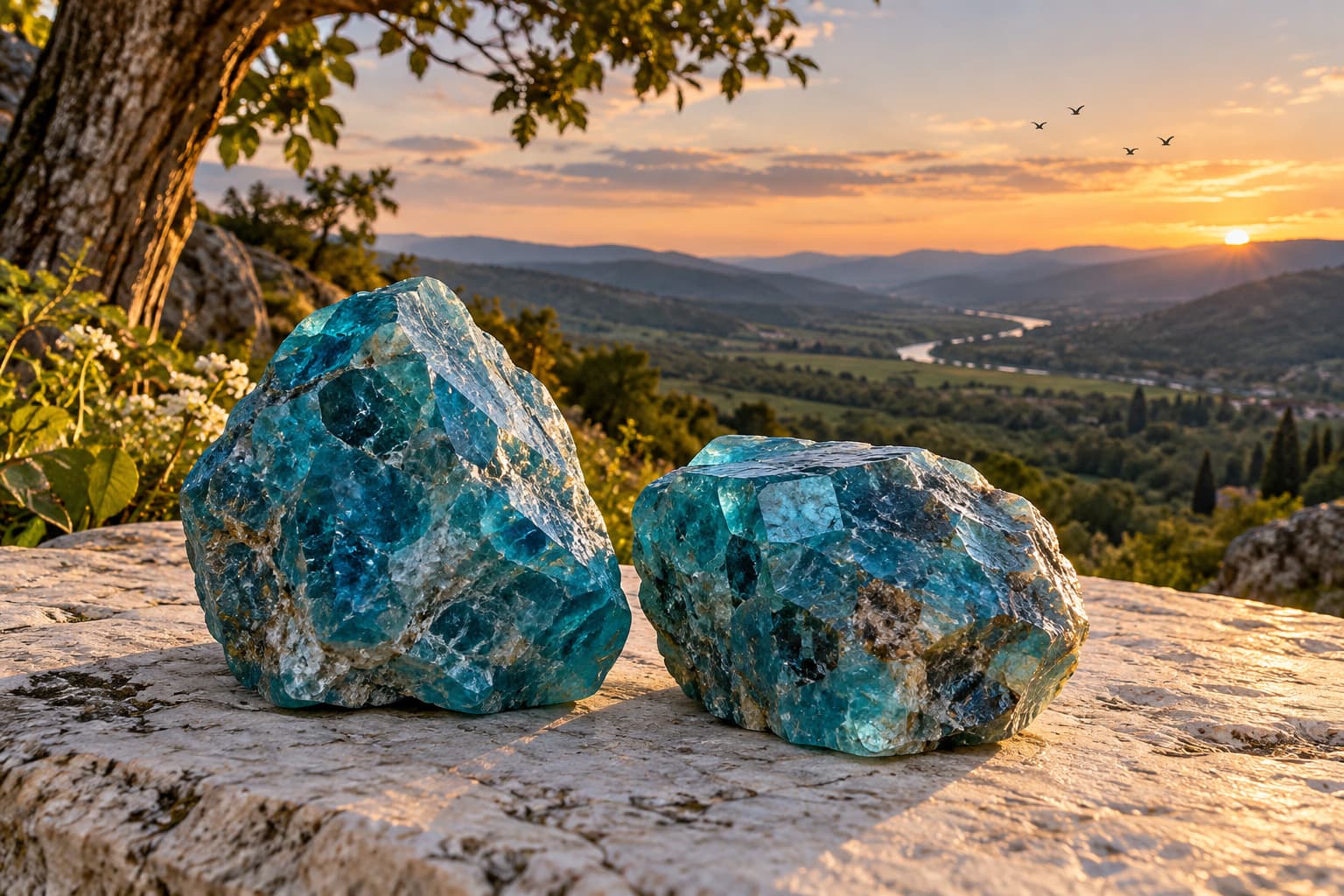
Apatite catches the eye with vivid shades of blue and turquoise, but its color range is much broader: green, yellow, gold, pink, purple, and even colorless. It may occur as a delicate, transparent crystal, a cluster, or a mottled mass used for beads and decorative objects.
In mineralogy, apatite is the name for a group of closely related phosphate minerals. In the world of crystals, it is associated with clarity, communication, inspiration, and bringing ideas to fruition. Exploring these perspectives invites us to get to know both the material and its symbolism, while distinguishing scientific knowledge from spiritual traditions.
Apatite at a Glance
| Property | Details |
|---|---|
| English name | Apatite |
| Family | Phosphate minerals |
| General composition of calcium apatite | Ca₅(PO₄)₃(F,Cl,OH) |
| Main species | Fluorapatite, hydroxylapatite, and chlorapatite |
| Typical crystal system | Hexagonal |
| Colors | Blue, green, yellow, gold, pink, purple, brown, white, and colorless |
| Luster | Vitreous |
| Transparency | Transparent to opaque |
| Hardness | 5 on the Mohs scale |
| Typical specific gravity | Around 3.2, depending on composition |
| Durability | Brittle and sensitive to scratches, impacts, heat, and acids |
| Common spiritual themes | Expression, focus, creativity, compassion, and putting ideas into practice |
What Is Apatite?
“Apatite” is not the name of a stone with a single, fixed composition. In common usage, it refers to closely related calcium phosphate minerals that differ, among other things, in the ion occupying a particular site within the crystal structure.
Fluorapatite: Its ideal formula is Ca₅(PO₄)₃F. It is the most common of the three main species in natural specimens, and many gemstones sold as apatite belong to this species.
Hydroxylapatite: Its ideal formula is Ca₅(PO₄)₃OH. This structure is particularly important for understanding the mineral component of bones and teeth and for developing medical materials.
Chlorapatite: Its formula is Ca₅(PO₄)₃Cl. It is relatively rare compared with the other two.
Natural specimens may contain chemical substitutions and intermediate compositions. Color alone is not enough to determine the species: “blue apatite” is a visual and commercial description, not a complete chemical identification.
The Origin of the Name: The Deceptive Stone
The name apatite is related to a Greek verb meaning “to deceive.” Mineralogist Abraham Gottlob Werner introduced the name in the 1780s because of the difficulty of distinguishing it from similar minerals.
There is no etymological connection between “apatite” and the English word “appetite,” meaning a desire for food. Their similar spelling does not indicate any effect on the body.
Mineralogical and Gemological Properties
Apatite usually crystallizes in the hexagonal system. Crystals may be elongated, short, or tabular; other forms are granular or massive. Some crystals display striations along their faces.
Its hardness is 5, and it is the reference mineral for that level on the Mohs scale. It is softer than quartz and tourmaline, so it scratches relatively easily. Its brittleness also matters: corners, crystal tips, and cracked beads may break on impact.
In commonly encountered gemstones, the refractive index is approximately 1.63–1.65, though values vary with composition. Some stones show different colors when viewed from different directions. Certain specimens fluoresce under ultraviolet light, but this response is not consistent and is not sufficient for identification.
Colors and Forms
Apatite’s colors may be related to trace elements and defects in the crystal structure. Natural processes and artificial treatments can affect its color, so each shade should not be attributed to a single, simple composition.
Blue and Turquoise Apatite
This is the form most closely associated with apatite in crystal shops. Its shades range from light to dark blue, including turquoise and blue-green. Some transparent crystals are suitable for faceting, while mottled or opaque material is used for tumbled stones, beads, and figurines.
Some of the vivid blue material on the market has been heat-treated. Saturated color does not prove that a stone has been treated, but neither does it guarantee that the stone is untreated.
Green Apatite
It occurs in light green, sea green, dark green, and yellowish shades. Its color can resemble that of other stones, so a definite identification requires more than visual inspection.
Yellow and Golden Apatite
Its colors range from pale yellow or greenish yellow to a deep golden hue. Durango, Mexico, is a well-known source of yellow crystal specimens.
Pink, Purple, and Colorless Apatite
These forms do occur, though they are less familiar to the general public. Availability and quality vary by deposit and specimen. A less familiar color does not automatically make every stone rare or expensive.
Cat’s-Eye Apatite
In certain specimens, aligned inclusions create a moving band of light. A properly oriented cabochon cut can bring out this effect. It is an optical phenomenon, not a separate mineral species.
Raw Crystals Versus Polished Stones
A polished wand, sphere, or egg shape does not necessarily reflect a natural crystal form. These may be shapes fashioned from natural material. Special trade names likewise do not necessarily indicate a new mineralogical variety.
How Does Apatite Form?
Apatite occurs in igneous, metamorphic, and sedimentary rocks. It can crystallize in pegmatites, hydrothermal veins, and other geological settings. In many cases, it is present as small grains within rock.
Large, transparent, intact crystals are rarer than apatite’s overall occurrence in nature might suggest. There is therefore a distinction between a relatively common mineral and a high-quality, sought-after gemstone.
Apatite minerals are also found in phosphate rocks used in industry. Such rock does not necessarily resemble the blue apatite displayed in a shop.
Sources of Apatite Around the World
| Region | Significance and forms |
|---|---|
| Madagascar | A well-known source of gem-quality apatite, including blue and blue-green material |
| Brazil | An important source of gemstones and collector specimens |
| Mexico | Well-known specimens from Durango, including yellow crystals |
| Myanmar | One of the documented sources of gem-quality apatite |
| Ontario, Canada | Known occurrences in and around the Bancroft area |
| Germany and Russia | Documented mineral localities and collecting sites |
These are examples, not a complete account of its distribution. Apatite occurs in many parts of the world, sometimes as tiny inclusions within other gemstones. Blue apatite, for example, has been documented inside garnet from Tanzania and Madagascar.
It is important to distinguish between a source of gemstones, a locality yielding collectible crystals, and an industrial phosphate deposit. Even a well-known source does not guarantee that every specimen from it is of high quality.
History and Uses
Apatite has a documented mineralogical and industrial history. By contrast, there is no firm basis for a single, consistent account of a distinctive spiritual use for it in ancient cultures. Most of the energetic meanings associated with it today are documented in modern crystal literature.
Agriculture and Industry
Apatite minerals are an important source of phosphorus. Phosphate materials are used to manufacture fertilizers and compounds for industrial processes. Their agricultural importance comes from the role phosphorus plays in plant nutrition, not from placing a decorative crystal beside a potted plant.
Geological Research
Apatite is used in dating and in studying the thermal history of rocks. Methods such as fission-track dating allow researchers to investigate how rocks have cooled and become exposed at the surface.
Jewelry and Collecting
Transparency and rich color can make for spectacular gemstones. Because apatite is delicate, pendants and earrings are sometimes preferable to rings and bracelets for everyday wear. Intact crystals, clusters, and specimens with documented origins are also of interest to collectors.
The Connection to Bones and Teeth
The mineral in bones and teeth is primarily biological apatite based on hydroxylapatite, with variations in composition and structure. This is a genuine scientific connection, but biological material should not be confused with a blue crystal mined from the earth.
Synthetic and processed hydroxylapatite is used and studied in dental products, implant coatings, and bone-repair materials. Its use depends on composition, purity, particle size, structure, and the medical application.
This chemical connection does not prove that wearing apatite strengthens bones, heals fractures, or repairs teeth. A natural specimen is not a substitute for a medical material that has undergone manufacturing and quality control.
Energetic Properties in Crystal Traditions
In contemporary traditions, apatite is associated with clarity, curiosity, communication, creativity, and putting ideas into practice. A recurring theme is the shift from mental overload or scattered attention toward understanding that can be expressed and applied.
These are spiritual and experiential associations, not proven physical or medical effects.
| Color | Common symbolic themes | Associated chakras |
|---|---|---|
| Blue | Expression, listening, clarity, and inspiration | Throat and third eye |
| Green | Connecting thought and feeling, growth, and compassion | Heart |
| Yellow and gold | Will, confidence, initiative, and bringing intentions to fruition | Solar plexus; sometimes also the abdominal energy centers |
Blue Apatite: Thought and Voice
Blue apatite is associated with understanding what you want to say and finding a way to express it. It can serve as an anchor before a conversation, a writing session, or a presentation of an idea: What is the central message, and what can be left out?
Some traditions also associate it with cleansing on a mental level. This can be understood as a symbolic practice of setting repetitive thoughts aside and returning to the question that matters now.
Green Apatite: Connecting Head and Heart
Green apatite is associated with bridging intellectual understanding and emotional experience. A question it can accompany is how to choose an action that honors both reality and what you feel.
Yellow Apatite: From Idea to Initiative
Yellow and golden apatite are associated with will, optimism, and confidence. In personal practice, they can be linked to a small, manageable step rather than simply enjoying the excitement of an idea.
The Spiritual Dimension
In crystal literature, apatite appears in discussions of meditation, intuition, dreams, and past-life exploration. Some writers also associate it with extrasensory perception and communication with entities. These are beliefs and descriptions within spiritual systems, not demonstrated abilities.
For personal practice, you might choose an open-ended exploration: write down a dream, reflect on an image that arises, and ask what it brings to mind in your present life. There is no need to treat an inner experience as proof of external information.
The Emotional and Mental Dimension
Michal Bial’s writing emphasizes compassion, self-acceptance, meditation, creativity, and clarity. StoneAge emphasizes focused expression, listening to the body, and clearing mental overload. These ideas can be translated into reflection on the following questions:
- What am I feeling before I try to explain or solve anything?
- Which of my needs is asking to be expressed?
- Am I listening to the other person, or immediately preparing a response?
- What is useful information, and what is a recurring thought that does not help me move forward?
- How can I bring compassion together with practical action?
The stone can serve as a reminder to practice. This does not promise improvements in memory, intelligence, or motor skills.
Energetic Uses and Personal Practice
Before an Important Conversation
Place the stone somewhere convenient and write one sentence expressing your need. Read it and consider whether it is clear, direct, and respectful.
In Learning and Creative Work
Choose one question to research or one task to work on. You can place apatite beside your notebook as a reminder to return to your focus, without attributing to it the ability to improve performance simply by being present.
In Meditation
You can observe its color and texture, breathe comfortably, and notice your thoughts without pursuing them. There is no need to place a stone on your body.
Personal and Space Cleansing
As part of a symbolic ritual, you can place apatite in a quiet spot, tidy your workspace, and put into words what you want to release and what you want to cultivate. Cleansing here refers to intention and the atmosphere you experience, not to air filtration, disinfection, or the removal of harmful substances.
The Physical Dimension: Appetite, Vitality, and the Skeletal System
Crystal sources include claims about appetite, weight, vitality, bones, and joints. Some authors emphasize listening to the body and the emotional aspects of eating, rather than weight loss alone.
The sources reviewed offered no reliable clinical evidence that holding or wearing apatite regulates appetite, reduces weight, increases metabolism, heals fractures, or treats infections. The stone should therefore not be presented as a treatment for these conditions.
Anyone who chooses to incorporate it into a practice can use it as a reminder to pause and listen to bodily sensations, without ignoring hunger or replacing appropriate advice and care.
Chakras, Zodiac Signs, and Frequencies
Chakra associations vary by color and school of thought. Astrological associations are not consistent either: some sources connect apatite with Gemini, while others note that it has no agreed-upon zodiac association.
There is no agreed-upon basis for a single number in hertz that can be presented as apatite’s “healing frequency.” A description such as “stimulating” or “calming” in spiritual language is different from a physical measurement of a material under defined conditions.
Identification, Treatments, and Buying
Apatite can resemble tourmaline, topaz, and other stones. Color and crystal shape may help, but a definite identification may require gemological equipment. Scratch testing is not recommended for a stone you want to preserve.
When buying, it is worth asking whether the material is natural, whether it has been heated or otherwise treated, and whether its geographic origin is documented. Also check for cracks, damaged edges, and suitability for the intended use. A beautiful display stone is not necessarily a durable choice for an everyday bracelet.
Cleaning, Storage, and Care
- Remove dust with a soft cloth.
- When cleaning is needed, opt for a brief, gentle wash in lukewarm water with a little mild soap, then dry.
- Avoid steam, ultrasonic cleaning, acids, and harsh cleaning products.
- Protect it from heat, sudden temperature changes, and impacts.
- Store it separately from harder stones that could scratch it.
- Do not swallow or grind the stone, or use it to prepare drinking water.
For a specimen with host rock, accompanying minerals, or an unknown treatment, the cleaning method should suit the entire piece. A symbolic ritual can be carried out through observation and intention, without salt, strong sunlight, or soaking.
Frequently Asked Questions
Is Blue Apatite a Separate Type?
It is a color-based name. Precise mineralogical identification requires consideration of composition, not color alone.
Is Apatite Tourmaline?
No. They belong to different mineral families, even when their colors are similar.
Is Apatite Suitable for a Ring?
It can be set in a ring, but it is relatively delicate. A protective setting and occasional wear are preferable; pendants and earrings are generally less exposed to impacts.
Is Blue Apatite’s Color Always Natural?
Not necessarily. Some material is heated, so it is worth asking for disclosure of any treatments.
Does Apatite Help with Weight Loss?
This is a claim found in certain crystal traditions, not a proven effect of wearing or holding the stone.
Can It Be Used to Strengthen Teeth?
A natural stone is not a dental-care product. Processed hydroxylapatite in a purpose-made product is a different matter, depending on the composition and use that have been tested.
What Is Apatite’s Symbolic Message?
It can be seen as an invitation to connect curiosity, clarity, and expression: understand what matters, listen to what you feel, and choose a step that brings the idea to life.