

Green Moss Agate
Moss agate's mineral inclusions resemble a tiny forest. Discover how its patterns form, its symbolism of gradual growth, and how it differs from tree and dendritic agate.
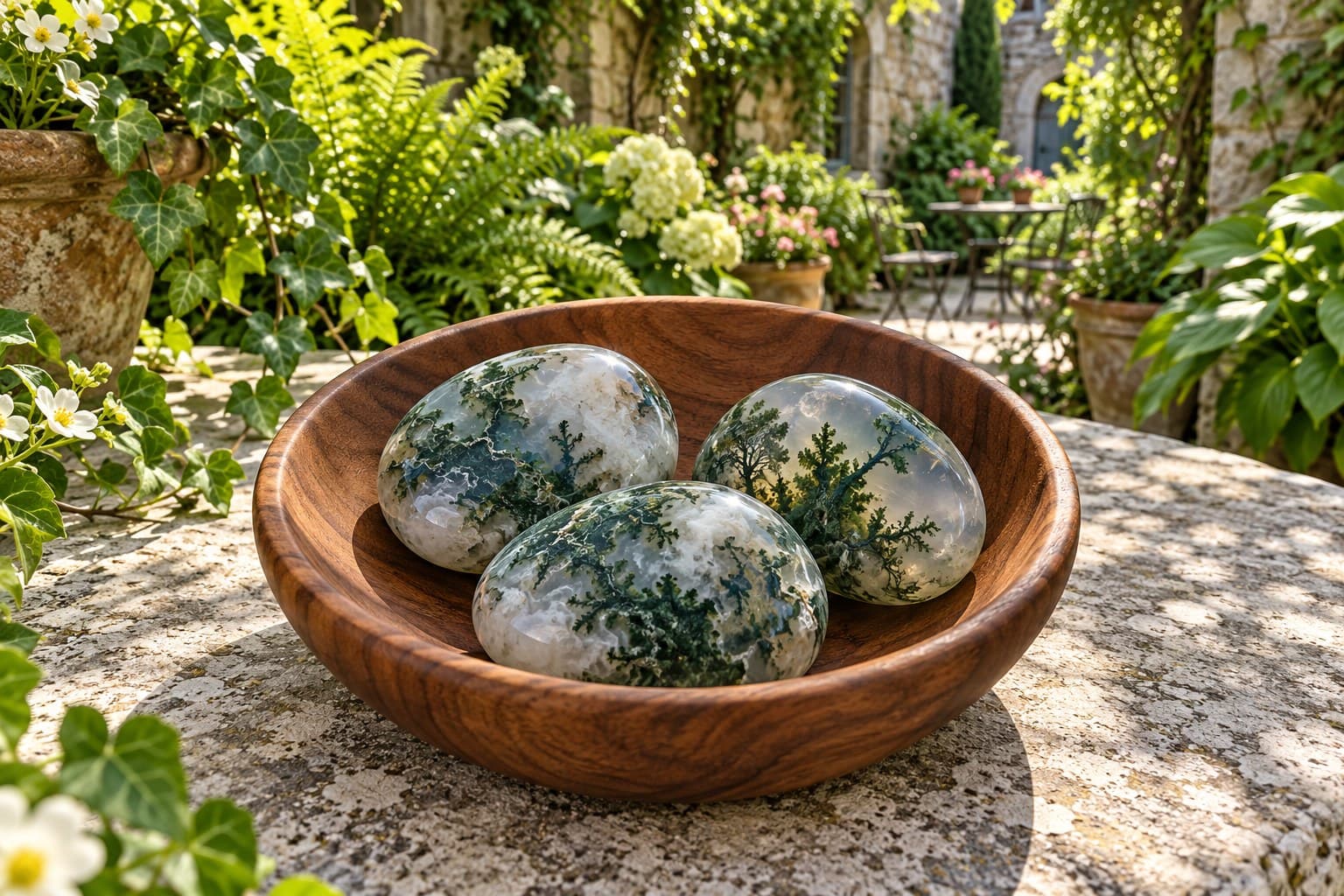
Moss agate looks as though moss, ferns, algae, roots, or a miniature forest have been preserved inside it. Despite its name, it contains no fossilized plant matter. The green, brown, black, and sometimes reddish shapes are mineral inclusions that developed within transparent or milky chalcedony.
Its organic appearance has made it a stone associated with nature, growth, and beginnings. Yet the geological explanation makes its beauty all the more striking: lifeless minerals happened to form patterns that the human eye reads as a living landscape.
This page focuses on moss agate in its classic green form. The orange variety has its own page, Orange Moss Agate, and we explore the broader family on our Agate: An Overview page.
What Is Moss Agate?
Moss agate is chalcedony, a finely crystalline form of silica composed mainly of quartz and sometimes moganite. Its hardness is approximately 6.5 to 7 on the Mohs scale. It ranges from translucent to opaque, and its defining feature is its mosslike or branching inclusions.
Under a strict mineralogical definition, agate is banded chalcedony. In moss agate, the bands may be faint or entirely absent, so some gemologists consider it mossy chalcedony rather than true agate. The trade name is longstanding and widely accepted, but it is worth understanding the distinction between gemological terminology and commercial names.
What the Stone Evokes
Moss agate evokes what a forest does after rain: the scent of wet earth, a pleasant coolness, and the feeling that there is time. Its grounding quality is gentle rather than heavy. People describe a sense of ease in the chest rather than the belly, and a simple desire to go outside, touch leaves, or water a plant.
It does not open the heart dramatically, like rose quartz or rhodochrosite. It opens it the way a bud opens: slowly, and only when conditions are right. This makes it a stone of patience and trust in the process, and a companion for people who need to remember that not everything has to happen right now.
Which Chakra Is It Associated With?
Moss agate is associated primarily with the heart chakra, Anahata, because of its green color, and sometimes with the root chakra because of its symbolic connection to the earth. Its strength lies along the axis between the two: a heart drawing nourishment from the earth. Belonging and security below, connection and growth above, and roots that allow the branches to spread.
In practice, people commonly place it on the chest while lying down, or hold it in both hands at heart level while breathing slowly. These correspondences vary among systems and are not scientific findings.
Energy Work
In crystal traditions, moss agate is considered a stone of growth, fertility, abundance, and connection to the earth. It is used by people who work with plants, gardens, and creative processes, as well as during periods when they want to build a new habit at a natural pace. The energy attributed to it is generally described as nourishing and gentle: less a force that pushes, more an environment that allows roots to develop.
You can place it beside a potted plant, carry it on a walk in nature, or use it as an anchor for a long-term project. This does not mean that the stone makes a plant grow or guarantees abundance. Rather, it can be a reminder to tend to the conditions: water, light, time, boundaries, and consistency.
Compared with Other Green Stones
Green aventurine is light and quick: luck, optimism, and the courage to try. It is a stone of new beginnings. Moss agate is a stone of continuation, of the weeks and months after the beginning.
Malachite is powerful and revealing. It brings what is hidden to the surface and pushes toward transformation, and not everyone is ready for it. Moss agate reveals nothing; it nourishes what is already there.
Tree agate is very similar in appearance, but more opaque and steady, with less of a sense of “movement.” Tree agate suits the times when you need a trunk; moss agate, when you need growth.
Jade carries wisdom, abundance, and tradition, and feels more regal and distant. Moss agate is the gardener among them: hands in the soil, without pretension.
Spiritual Perspective
Moss agate teaches us to see spirit within everyday matter. There is no actual moss inside it, yet the mind recognizes a forest, a branch, or a landscape. On a spiritual level, this invites reflection on the relationship between people and nature, and on our ability to find meaning without claiming that an image is a fact.
In his book on stones, Robert Simmons suggests approaching stones as having archetypal qualities and using keywords and spiritual correspondences as a map for inner work. In that spirit, moss agate can serve as an archetype of living earth: growth inseparable from its surroundings, renewal sustained by roots, and the understanding that every change needs a system to support it. This is spiritual language, not a scientific account of energetic activity.
Emotional Perspective
Emotionally, moss agate is associated with patience and the ability to let a process unfold without constantly checking whether it has produced a result. It is suited to periods of recovery, transition, or beginnings, when there is not yet any outward evidence of progress. Like a seed beneath the soil, some change happens before it becomes visible.
The stone can also be used when working with a sense of disconnection. Looking at its mosslike pattern is a reminder that we are part of a web of relationships, rhythms, and seasons. A simple practice is to ask: What nourishes me, what drains me, and what small condition could I change to support growth?
How to Work with the Stone
Choose one area to nurture for a month. Hold the stone and write down what the seed is, what conditions it needs, and one small action you can repeat. Place the stone where you carry out that action, not where you merely think about it.
In meditation. Look at the pattern and identify a single shape. After a few breaths, notice how the shape changes as you turn the stone. This practice develops flexibility: the same situation can look like a thicket, a branch, or a path, depending on your angle and distance.
A Geological and Gemological Perspective
So far, we have explored tradition and experience. What follows is what mineralogy and gemology can tell us about the stone, for those who also want to understand the material itself.
What Creates the Moss Pattern?
The inclusions are not plant matter. Mineralogical sources describe a range of possible minerals, including chlorite, hornblende, celadonite, and iron or manganese oxides. The identity of an inclusion depends on the stone’s source and the chemistry of the fluids that acted within it. Green material can appear as clouds, fibers, tubes, or soft-looking masses; iron and manganese oxides form dark branches or brown and red patches.
A study of material from Botswana, known locally as “green moss agate” or “Gorgonzola,” found that the white material was actually granular microcrystalline quartz rather than fibrous agate. The green bands, as well as the green coating on local agates, were identified as celadonite, a clay mineral rich in potassium, magnesium, aluminum, and iron. The finding illustrates why we should not assume that every stone with a plantlike pattern belongs to the same variety or contains the same minerals.
How It Forms
Chalcedony forms when silica-rich fluids fill cavities and fractures in rock and gradually deposit silica. If other minerals enter the cavity, disperse within the silica gel, or crystallize along tiny fractures, they can remain trapped as the chalcedony hardens. The result is a three-dimensional pattern that seems to float within the stone.
Dendrites form when metal-rich solutions spread along planes and fractures and crystallize into branching shapes. A sharply defined dendritic pattern sometimes resembles a tree or fern; a mossy pattern is generally softer, denser, and more cloudlike. The boundaries between moss agate, dendritic agate, and plume agate are not always clear, and a single stone can display more than one type of inclusion.
Sources and Colors
Moss agate is found in many places, including India, Brazil, the United States, Madagascar, and other countries where chalcedony forms. Transparent Indian material with green and red inclusions is especially common on the market. The background can be colorless, milky white, gray, or slightly blue; the inclusions can be green, brown, black, orange, or red.
No two stones are identical. Value depends on the quality of the pattern, the depth of the inclusions, the transparency of the background, contrast, composition, the quality of the polish, and how the cut reveals the inner landscape. A small cabochon with a balanced pattern can be more interesting than a large, crowded slice.
Identification and Buying
Look for inclusions that appear at different depths, rather than a flat print on the stone’s surface. Examine the stone with light behind it to see whether the pattern is inside the material. Natural fractures are not necessarily a flaw, but a heavily fractured stone is more vulnerable to impact. It is worth asking whether the stone has been dyed or filled.
Distinguish moss agate from tree agate. In commercial usage, tree agate is usually a whiter, more opaque stone with green patterns, while moss agate is more transparent and gives the impression that its inclusions are floating inside it. Shops do not apply these names consistently.
Choosing, Caring for, and Cleaning Your Stone
Choose a stone whose pattern sparks your curiosity even without a marketing story. Good transparency and a clean polish emphasize depth, but milky material can be beautiful too. Lukewarm water, a little soap, and a soft cloth are enough for cleaning. Avoid acids, extreme heat, steam, and direct impact. For a fractured stone, it is best to avoid ultrasonic cleaners.
What Science Says
Science can identify the chalcedony and the minerals that form its inclusions, but there is no clinical evidence that moss agate heals the body, improves fertility, or brings abundance. Its spiritual and emotional value lies in meaning, practice, and contemplation. Using the stone should not replace professional medical, mental health, or agricultural care.
This page distinguishes research-based geological and gemological knowledge from spiritual interpretations drawn from crystal traditions and literature. Spiritual use of the stone can be part of a personal practice, but it is not a substitute for medical diagnosis or treatment.