

Larimar / Pectolite
Larimar is a blue pectolite from the Dominican Republic that looks like the sea held within a stone. On a long exhale and permission to let go, the flow between throat and heart, how it differs from Blue Lace Agate and Amazonite, and a color that fades in sunlight.
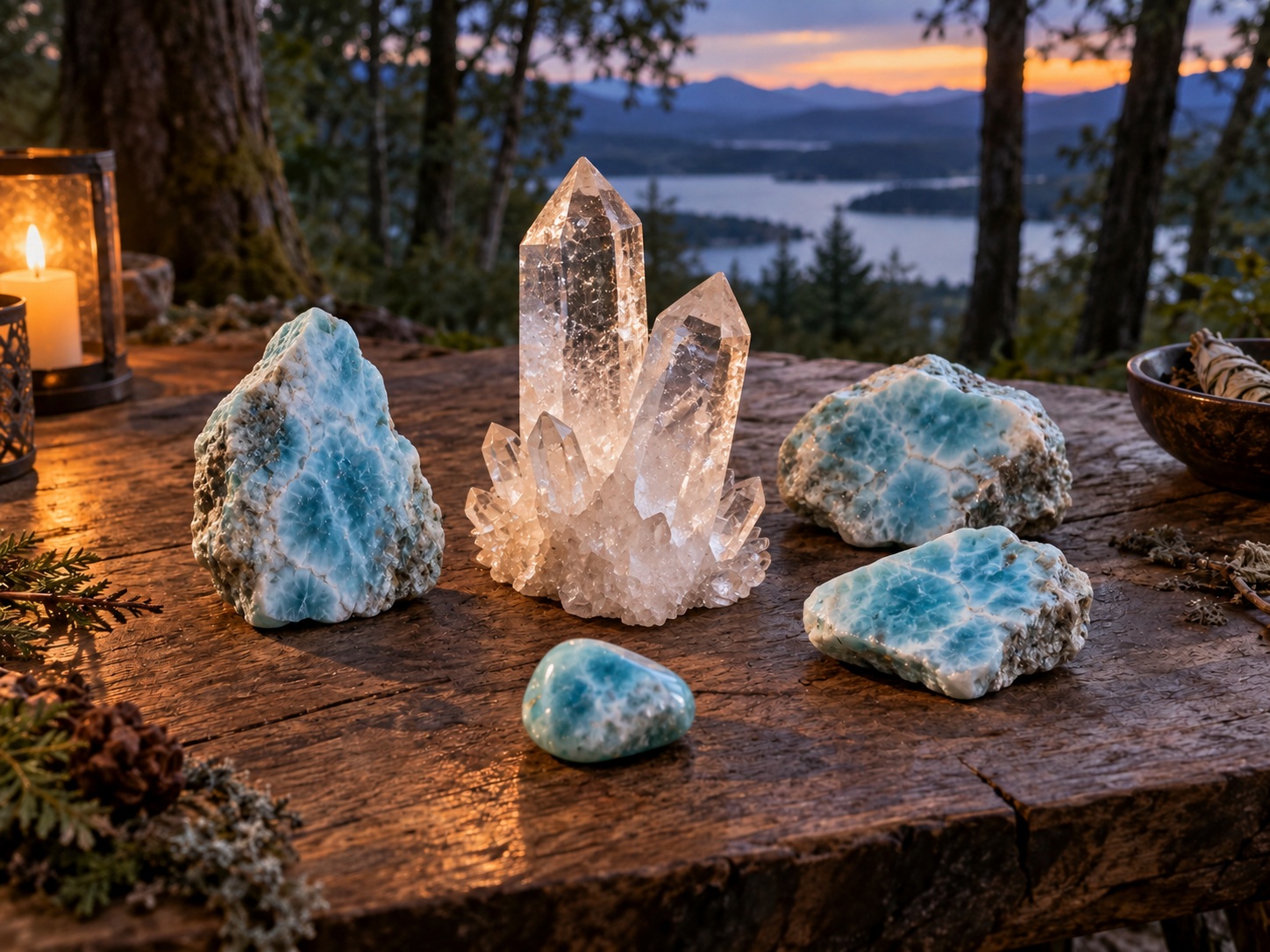
Larimar looks like a tropical sea captured in stone: blue, white, and turquoise in cloudlike, rippling patterns. Despite its ocean imagery, it forms in volcanic rocks in the mountains of the Dominican Republic. The name “larimar” is not the name of a mineral species but a trade name for a blue variety of pectolite.
In crystal traditions, it is a stone of calm within movement: waves, breath, and release. Its rarity, distinctive patterning, and relatively delicate nature make knowledge of its origins, imitations, and care especially important.
In this library, it also appears as a companion stone: it sits just above the center of the Blue Breath Grid, alongside Blue Lace Agate and Amazonite.
What Is Larimar?
Larimar is massive pectolite in shades ranging from blue to greenish, with the formula NaCa₂Si₃O₈(OH). Ordinary pectolite is found in many places around the world, usually as white, needlelike crystals; the name larimar is reserved for the gem-quality blue material from the Dominican Republic. It crystallizes in the triclinic system, but in polished pieces, what you see is a dense, fibrous mass rather than individual crystals.
Its hardness is approximately 4.5 to 5 on the Mohs scale. It has good to perfect cleavage and a structure that can be brittle. It is better suited to pendants, earrings, and decorative objects than to rings, unless the setting offers substantial protection.
What the Stone Evokes
For many people, the cool colors and cloudlike patterns evoke a sense of spaciousness and softness, as though a window has opened onto the sea. A polished surface gradually warms in the hand, serving as a sensory anchor. In contrast to Blue Lace Agate, which quiets thoughts, larimar softens emotions: it is not the mind that settles, but the chest.
People describe a long exhale when holding it, and a feeling that “it’s okay to let go.” It is a stone for afterward: after an argument, after tears, after a day that asked too much.
Which Chakra Is It Associated With?
Its most common association is with the throat chakra, because of its blue color, and sometimes with the heart, because of its softness. Some traditions connect it with the water element, an association that most closely captures its feel: not a single center, but a flow between throat and heart, like a wave rising and falling.
In practice, it is often placed on the upper breastbone while lying down, between the two centers, or worn as a short pendant. These associations are symbolic and vary among traditions.
Energetic Use
In crystal traditions, larimar is associated with calm, flow, gentle communication, and easing inner conflict. Its ocean imagery gives it a language of waves, breath, and release. Working with it is an invitation to pause, lengthen the exhale, and choose a less sharp response.
In the Blue Breath Grid, it sits above Blue Lace Agate, and its role there is precisely this: softness and emotional space, while the Amazonite below maintains the boundary. On its own, larimar can be too soft; with Amazonite, it has a shore.
Compared with Related Stones
Blue Lace Agate quiets the mind; larimar softens the heart. Blue Lace Agate before a conversation, larimar after an argument.
Amazonite provides the boundary larimar needs. Both are blue-green, but Amazonite says “this far, and no further,” while larimar says “it’s okay.” Together, they form a complete pair.
Aquamarine is also a sea stone, but its sea is open and clear: courage and clarity. Larimar is a lagoon: shallow, warm, and safe.
Turquoise is strong and outward-facing, a stone of protection and journeys. Larimar is inward and gentle, a stone of rest. Those seeking strength may turn to Turquoise; those seeking comfort may find it in larimar.
Spiritual Perspective
In crystal literature, larimar is described as having a feminine, watery, soothing quality. This can be read as a metaphor for openness that is not weakness: the ability to move with reality without giving up boundaries. Stories about the “Atlantis stone” and dolphins are modern myths used in marketing; they can be enjoyed as imagery without being accepted as fact.
Emotional Perspective
Larimar can serve as an anchor before an emotionally charged conversation. Holding it offers a reminder to distinguish between feeling and action: “I’m angry” does not require shouting, and “I’m afraid” does not require avoidance. It can also be used in a self-compassion practice: describe aloud what is difficult, what is needed, and what can be done today. Significant distress calls for professional support; the stone is a companion, not a treatment.
How to Work with Larimar
Breathing. Hold the stone while breathing in for four seconds and out for six, for a minute or two. Then form a sentence that includes a fact, a feeling, and a request.
Daily reminder. Place it beside a glass of water as a reminder to drink, but do not put it in the water or drink “larimar water.”
Creative practice. Look at its pattern and write about which areas of your life currently need flow, and which need a clearly defined shore.
Using It in a Grid
Larimar can be placed at the center of a circle of white stones or river pebbles to represent stillness within movement. A grid beside a table where conversations take place serves as a reminder to listen. In the Blue Breath Grid, it is the stone above Blue Lace Agate. Do not leave it in the sun, near water that might spill, or anywhere it could fall.
Use in Therapy and Supportive Work
A practitioner can use larimar as a symbolic object when working with a calm voice, regulation, and pacing, asking the client what associations the stone evokes rather than prescribing a meaning. Do not place it on a wound, make it into a powder or elixir, or present it as a medical treatment.
A Geological and Gemological View
So far, we have explored tradition and experience. What follows is what mineralogy and gemology can tell us about the stone, for those who also want to understand the material itself.
How It Forms
Larimar is found in Barahona Province, in the Sierra de Bahoruco region. Pectolite filled cavities and fractures in basaltic rocks through hot fluids moving through the rock. A 2024 geochemical study describes blue, green, and white bodies within the volcanic rock and emphasizes the relationship among mineral-bearing fluids, changing conditions, and trace elements. Mining follows narrow veins, so attractive, uniform material is uncommon.
The Source of Its Color and Pattern
The blue is generally attributed to trace amounts of copper. However, newer studies show that the geochemical picture is complex, also involving manganese, iron, and changes in formation conditions. The white pattern comes from areas that differ in composition and texture, and is a natural part of its appearance. Deep, even blue with clearly defined “clouds” is considered more desirable.
The Name and Commercial Discovery
The name larimar was coined in the 1970s by combining Larissa, the name of Miguel Méndez’s daughter, with the Spanish word mar, meaning sea. Local residents were familiar with the material before then, but modern commercialization made it a stone closely identified with the Dominican Republic.
Identification and Buying
Natural larimar displays an irregular pattern of blue, white, and sometimes greenish tones, with subtle depth rather than flat, plastic-looking color. Imitations include glass, resin, ceramic, dyed howlite or magnesite, and composite material made from powder and resin. Genuine material is sometimes stabilized or coated to improve durability and luster.
Do not perform scratch, acid, or hot-needle tests on jewelry. A magnifying glass may reveal round bubbles in resin or concentrations of dye in cracks. Ask for a statement confirming that the material is natural pectolite from the Dominican Republic, along with disclosure of any stabilization, dyeing, or coating. For an expensive piece, obtain laboratory testing.
Color Stability
Larimar may fade with prolonged exposure to strong light and heat. It is best not to leave it on a windowsill, in a hot car, or beneath a display lamp. Steam, temperature changes, and chemicals can also damage its structure or polish.
Cleaning and Care
Wipe with a soft, damp cloth. If needed, clean briefly with lukewarm water and a little mild soap, then dry thoroughly. Avoid soaking, salt, acids, cleaning products, perfume, steam, and ultrasonic cleaners. Keep it away from heat and direct sunlight. Store it in a soft pouch, separately from quartz, tourmaline, and other harder stones that could scratch it.
What Science Says
Science identifies larimar as blue pectolite from the Dominican Republic and studies its formation and trace elements. No clinical research shows that holding larimar treats stress, thyroid conditions, or other illnesses. It can be a soothing object within a personal ritual. A controlled 2025 study of crystals and anxiety found that the reported improvement was related to expectations and prior belief, rather than to the stone itself.
Sources and Further Reading
Mineralogy: Mindat: Larimar · Mindat: Pectolite · Dumańska-Słowik et al., Origin of bluish pectolite aka larimar from the Dominican Republic (Journal of South American Earth Sciences, 2024) · Woodruff & Fritsch, Blue Pectolite from the Dominican Republic (Gems & Gemology, 1989)
Crystal traditions: Robert Simmons, The Pocket Book of Stones (Destiny Books, 2021) · Judy Hall, The Crystal Bible (Godsfield, 2003)
Placebo research: Escolà-Gascón et al., Placebo effects in alternative medical treatments for anxiety (CNS Spectrums, 2025)
This page distinguishes research-based geological and gemological knowledge from spiritual interpretations rooted in crystal traditions and literature. Spiritual use of the stone can be part of a personal practice, but it is not a substitute for medical diagnosis or treatment.