How to Read a Tarot Card in Depth: Light, Shadow, Lesson, and Context
Read tarot cards through their core meaning, light, shadow, imagery, and symbolism—and see how the question, position, and surrounding cards shape each interpretation.
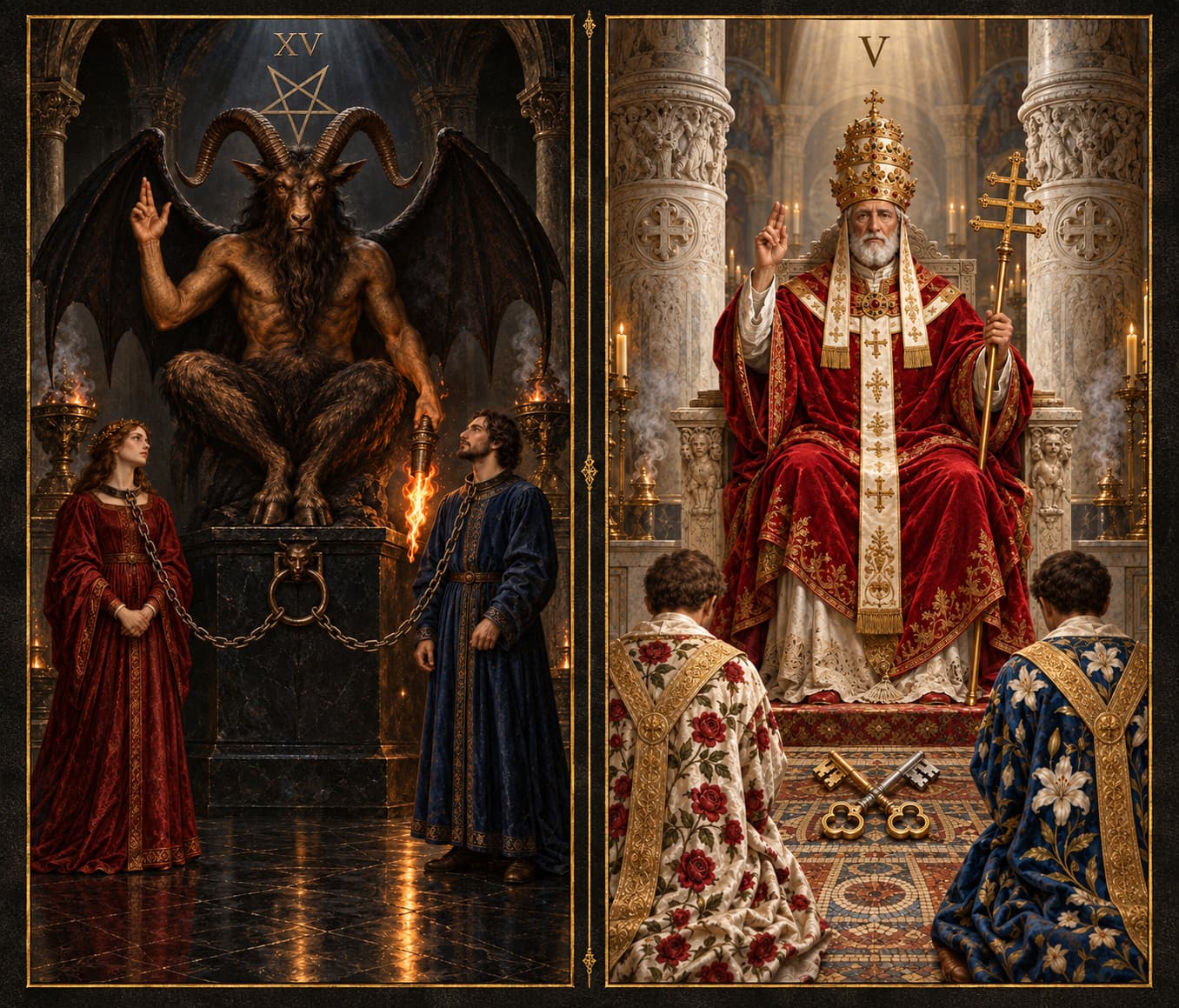
A Tarot Card Is Not a Word in a Dictionary
One of the most common mistakes when starting out is trying to learn a single, fixed meaning for each card: The Sun means success, The Tower means crisis, The Emperor means authority, and the Four of Cups means apathy. These are good starting points, but they are still only starting points.
A tarot card is a living symbol. It can describe a person, a situation, a movement, a need, a fear, a potential, a pattern, or a lesson—and its precise meaning changes with the question asked, its position in the spread, and the cards beside it.
That is why, in an in-depth reading, I do not ask only, “What does this card mean?” I also ask, “Which layer of this card is active here?”
We can think of a card as a meeting place for several layers: its core meaning, light expression, shadow expression, lesson, archetype, number, element, color, symbols, figures, direction of movement, mythology, and sometimes esoteric systems such as astrology or Hebrew letters. Not every deck gives all these layers equal emphasis, and not every method uses them all.
The Core Meaning—the Heart of the Card
Every card has a central idea, a kind of axis around which its interpretations revolve.
The Emperor, for example, is associated with structure, boundaries, authority, responsibility, and the ability to create order. The Four of Cups relates to an emotional pause, dissatisfaction, withdrawal, or difficulty seeing what is being offered. The Eight of Wands relates to movement, acceleration, news, and things progressing quickly.
This core helps us recognize the card’s language, but it does not yet tell us whether that energy is operating in a healthy, excessive, insufficient, or challenging way. For that, we need to look at other layers.
The Light Expression—When the Card’s Quality Works in a Healthy Way
A card’s light expression is where its central quality operates in a balanced, constructive way that helps us move forward.
This does not mean the card always promises a “good” outcome. A light interpretation is, first and foremost, a healthy way of expressing the card’s energy.
For The Emperor, the light expression might be leadership, stability, clear boundaries, taking responsibility, and the ability to maintain structure even under pressure.
For the Queen of Cups, the light might be empathy, sensitivity, intuition, and the ability to sense what another person is feeling without losing ourselves in their experience.
For the Knight of Swords, the light might be mental clarity, the courage to speak the truth, decisiveness, and the ability to act quickly when we need to cut through confusion.
When a card appears as potential, advice, or a resource, it is often worth exploring its light expression first: What quality is the card inviting us to develop or consciously put into practice?
The Shadow Expression—the Same Quality Out of Balance
The shadow is not the card’s “bad meaning.” It is the expression of that same energy when it operates in excess, is lacking, arises from fear, or does not fit the situation.
The Emperor, whose light expression represents structure and boundaries, can become rigidity, a need for control, difficulty listening, or an attempt to manage every detail in its shadow expression.
The Queen of Cups can shift from healthy empathy to emotional overwhelm, blurred boundaries, or taking responsibility for other people’s feelings.
The Knight of Swords can move from decisiveness to impulsiveness, from necessary confrontation to aggression, or from direct truth to hurtful speech that comes from not pausing to consider the feelings of the person in front of them.
Even cards considered “positive” can appear through their shadow. The Sun can mean clarity and joy, but in a particular context it can point to overexposure, a need for approval, or confidence that overlooks complexity. The Star can speak of hope and trust, but sometimes also of relying on hope without taking practical action.
Conversely, cards considered threatening are not all shadow. The Tower can mean release from a structure that can no longer hold. Death can mean a willingness to end a chapter and make room for something new. The Eight of Cups can be the courage to step away from something that no longer nourishes us.
The Archetype—the Human Story Behind the Card
Especially in the Major Arcana, we can also read the cards as archetypes—broad human patterns that recur across cultures, stories, and our own lives.
The Emperor is not simply “a man in authority.” It is the archetype of structure, law, boundaries, and the father or ruler. The Hermit is the archetype of the sage who steps away from the noise of society to find inner truth. The Magician takes ability, will, and tools and translates them into action. Death is the archetype of an ending we cannot bypass and a transformation that requires us to let go of an old form.
We can use Jungian language to think about archetypes, but it is important to remember that Jung did not create tarot. This is a modern lens that allows us to read the imagery as a broad psychological language.
When we read a card as an archetype, the question shifts from “Who is this person?” to “What human force or pattern is at work here?”
Mythology—Figures and Stories That Deepen the Symbol
Tarot cards often invite connections with mythological stories. The Empress may evoke figures associated with motherhood, the earth, and fertility, such as Demeter; Justice may bring to mind scales, law, and cosmic order; The Hermit may connect with the figure of the solitary sage or teacher; and Death with stories of descent into the underworld, dissolution, and rebirth.
Here, however, we need to be careful not to turn a mythological association into a historical fact. In most cases, this does not mean that “the card is Demeter” or that “The Hermit is a particular god.” Often, it is an interpretive parallel—an ancient story that helps us understand a quality the card carries.
In some decks, the creator deliberately chose a particular mythological figure, making the connection an explicit part of the deck. In others, the connection comes from the reader and the tradition they work within.
Hebrew Letters and Kabbalah—an Esoteric Layer, Not a Universal One
In Western esoteric traditions, particularly systems that developed around the Golden Dawn in the 19th century, correspondences were established between the 22 Major Arcana cards and the 22 letters of the Hebrew alphabet. These correspondences also connect the cards with the Kabbalistic Tree of Life, astrology, and other systems. The system itself—the letters, sephiroth, and decans—is explored in detail in The Tree of Life in Tarot.
This can be a richly rewarding layer of study: a letter is not merely “another name” for a card. It can open up ideas about movement, paths, elements, planets or zodiac signs, and connections between different cards.
Still, it is important to be clear: correspondences with Hebrew letters were not part of the original historical European tarot, and not every tradition accepts exactly the same correspondences.
There are differences even within the esoteric tradition. For example, in his Thoth deck, Aleister Crowley changed some of the correspondences he inherited from the Golden Dawn tradition—the best-known example being the reassignment of The Emperor and The Star in relation to the letters Heh and Tzaddi. When using Hebrew letters, it is therefore important to know which system you are working within, rather than mixing tables from different traditions as though they formed a single system.
Color—Meaning Before Words
Color can be one of the first layers the eye takes in, even before we interpret the figure.
Red can emphasize action, passion, power, or danger. Blue may evoke depth, emotion, calm, or a spiritual quality. Yellow and gold can draw the eye toward consciousness, clarity, vitality, or light. Black can create a sense of mystery, endings, fear, or a void from which something new can be born.
Here, too, there is no single dictionary of color that applies to every deck. Meaning emerges from relationships within the image: which color dominates, where it appears, what it emphasizes, and what changes compared with other cards in the same deck.
In certain esoteric decks, especially Thoth, color also follows a carefully designed, highly codified system. In other decks, color serves more as an artistic and intuitive medium. It is therefore worth first learning the language of the deck we are using.
The Image Itself—Figure, Gaze, Direction, and Space
When reading illustrated decks, the image is not decoration. It is part of the card’s text.
I look at the figure: Are they standing, sitting, moving, or stopping? Where are they looking? Are they facing another card in the spread or turning their back on it? Are their hands open or closed? Is there a mountain, a river, a gateway, a wall, an open sky, or an enclosed space?
I also examine what is in the foreground and what is behind it. Sometimes a small detail—an object left behind, a road continuing toward the horizon, a cloud, an animal, a crown, or an implement held in a hand—changes how we read the card.
In a sequence of several cards, directions become a conversation. Two figures looking at each other can create a connection; a figure facing outward can suggest withdrawal; a static card between two cards full of movement can feel like a pause or a blockage.
But What Happens When You Change Decks?
This brings us to one of the most important things to understand about tarot: meaning does not depend on a single famous image.
In the Rider–Waite–Smith deck, illustrated by Pamela Colman Smith under the direction of Arthur Edward Waite, the numbered cards of the Minor Arcana were also given illustrated scenes. The Three of Swords, Five of Cups, and Seven of Swords became images that are easy to read as stories.
In traditional Tarot de Marseille decks, by contrast, many of the numbered Minor Arcana cards are “pip” cards: they display the corresponding number of suit symbols—Swords, Cups, Wands, or Pentacles—but not a complete human scene that tells us the story.
For the Thoth deck, Aleister Crowley designed the symbolic and esoteric system, but the artist who actually painted the cards was Lady Frieda Harris. The imagery, colors, names of some cards, and astrological and Kabbalistic correspondences differ in certain respects from Rider–Waite–Smith. Someone reading Thoth is not simply “reading the same picture in a different design”—they are working within a different visual and symbolic language.
Finally, if we move to ordinary playing cards—for example, a 52-card poker deck—most of the visual layer disappears almost entirely. The Seven of Hearts shows seven heart symbols, not a scene with a figure, landscape, and action. There are also no 22 Major Arcana cards, and the structure of the court cards is not quite the same as in tarot.
Yet we can still read a deck of playing cards. In that case, the emphasis shifts to the number, suit, element, patterns between cards, position in the spread, and the cartomantic tradition being used. This teaches us something important: imagery can greatly deepen a reading, but it is not the only source of meaning.
Number and Suit—Layers That Remain Even When the Image Disappears
Number is one of the most consistent anchors across different decks.
Three can speak of creation, development, or a meeting of forces; four of structure, pause, or stabilization; five of change, friction, or a loss of balance; and ten of a peak, completion, or an excess of the suit’s quality.
The suit adds the domain in which the number operates: Wands are generally associated with fire, will, action, and creativity; Cups with water, emotion, and connection; Swords with air, thought, language, and conflict; and Pentacles with earth, the body, the material world, work, and stability.
So even if the image changes completely, the combination of number and suit still gives the reader a meaningful framework to work with.
The Lesson—What the Card Asks Us to Understand or Develop
The lesson layer asks a different question: What is this card teaching me here?
Sometimes a card does not describe what is happening right now, but rather the quality that is missing and needed to move forward.
If The Emperor appears in the lesson position for someone who struggles to say no, the message may not be “there is a controlling person here.” Instead, it may be that the time has come to establish boundaries, make a decision, and stop handing authority over their life to others.
If the Four of Cups appears as a lesson, it can invite us to examine where disappointment has made us indifferent, where we are rejecting a new possibility because it does not look exactly as we expected, and where we need a genuine pause to understand what we feel.
If Strength appears as a lesson, it sometimes asks us not to “be stronger,” but to learn a different kind of strength: emotional regulation, patience, and the ability to hold a powerful feeling without fighting it or letting it run our lives.
The lesson is where a reading stops being merely a description of reality and becomes a tool for reflection and growth.
The Card’s Position in the Spread Changes Its Meaning
The same card takes on a different meaning in a different position.
A card in the “current situation” position usually describes an energy already at work. The same card in “what is holding you back” may reveal its stuck or excessive side. In “what supports you,” it may point to a resource. In “potential,” it can show what might develop, and in the “lesson” position, what the person is being asked to learn.
That is why saying “I drew The Emperor” tells us little unless we know where it appeared and what we asked that position in the spread to describe.
The Question Changes the Card’s Language
The question also determines which layer of the card is relevant.
In a relationship question, The Emperor can speak of boundaries, commitment, a dominant person, or a need for security. In a career question, it might represent a manager, responsibility, organization, or building a system. In a question about our inner life, it can speak to our relationship with authority, control, and self-discipline.
The card remains the same, but the area of life in which we encounter it changes.
The Surrounding Cards Form a Sentence
A single card is a word; a spread is a sentence.
The Emperor beside the Four of Pentacles can reinforce a story of holding on, control, and preserving what already exists. The same Emperor beside the Three of Pentacles can look like a manager building a system with others. Beside The Star, it can speak of the need to give structure to a vision. Beside The Tower, it can describe a rigid system reaching its breaking point.
That is why, in an in-depth reading, we examine not only each card individually, but also what happens between them: repeated numbers, elements, colors, and archetypes; figures facing one another; a sequence of movement; or a shift between the Major and Minor Arcana.
So Where Do You Begin When Reading a Card in Depth?
You can work in layers rather than trying to bring all your knowledge into play at once.
First, identify the core: What does the card mean at its most basic level?
Then explore light and shadow: Is this quality operating in a balanced way, or is it out of balance?
Next, ask about the archetype or the larger story. If the deck and tradition you are working with invite it, you can add number, element, astrology, a Hebrew letter, Kabbalah, mythology, and color.
Then return to the image: What do I actually see on this particular card in front of me? Who is looking where? What is moving? What has stopped? Which detail catches my eye?
Finally, connect everything to the context: What was the question, what is the card’s position, and what are the cards beside it saying?
The goal is not to demonstrate how many meanings we know. It is to choose, from all these layers, the meaning that best explains the story now unfolding on the table.
An In-Depth Reading Is a Conversation Between Tradition, Image, and Context
The more we study tarot, the more we discover that a card’s meaning does not narrow—it expands.
Tradition gives us anchors. Archetypes and mythology give us stories. Number and element give us structure. Color and symbol give us feeling and direction. Systems such as astrology and Kabbalah can add further layers. The image gives us a living scene. And the question and spread determine which of these possibilities is relevant now.
This is why two readers can know the same card well and still emphasize different aspects of it—and why that same card can speak differently in two different readings.
Meaning does not disappear when we change decks; it changes the way it reveals itself to us.