Symbols and Mythology in Tarot — Archetypes, Layers of Consciousness, and the Language Behind the Cards
How do symbols, myths, astrology, and archetypes add depth to tarot? From ego and the collective unconscious through Demeter, Persephone, Hermes, Cupid and Psyche, to the four creatures in Wheel of Fortune and the World.
Why Do Symbols and Mythology Matter in Tarot?
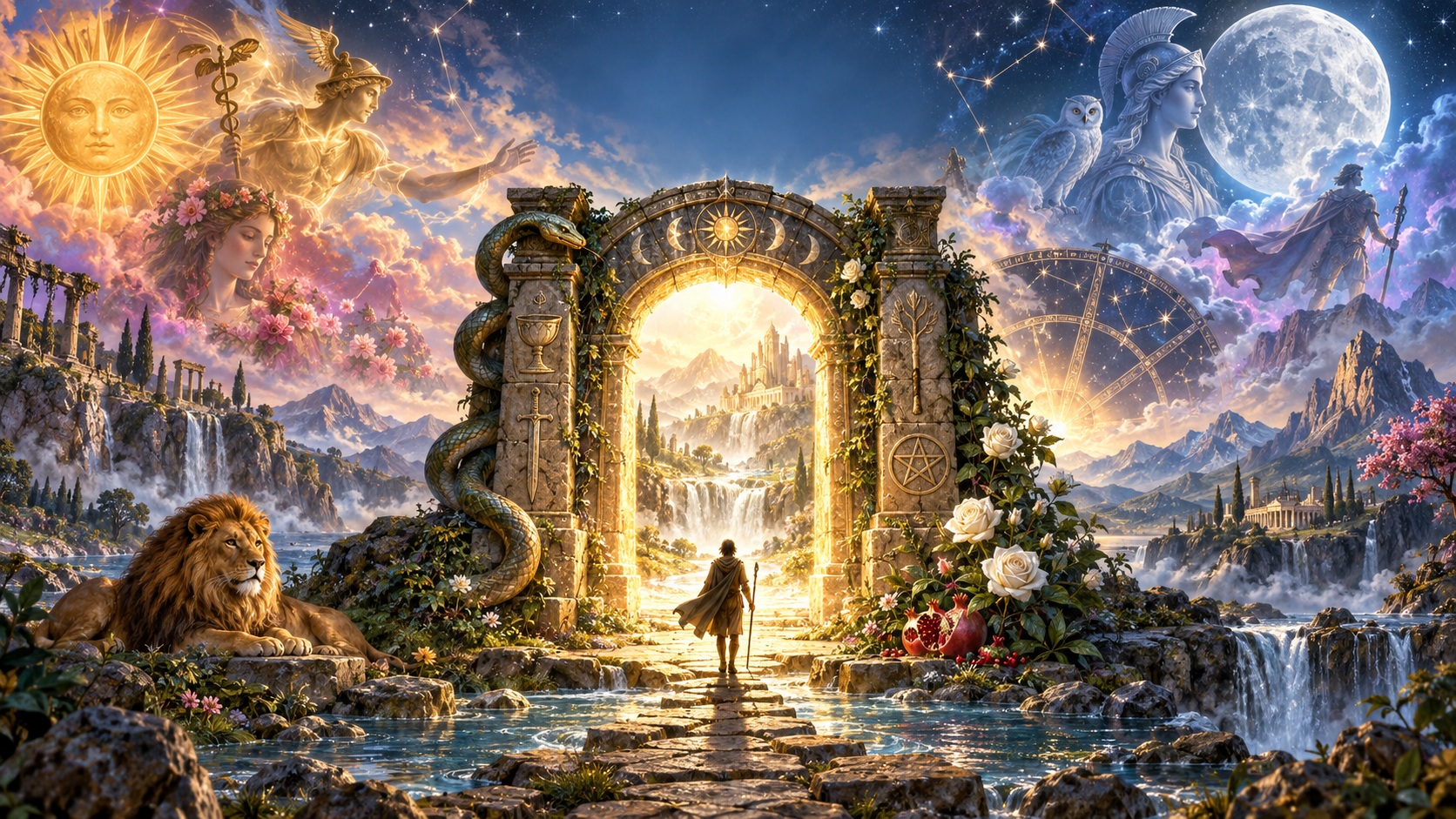
A card can be read at the simplest level: we see a figure, an object, a number, and a situation, and describe what is happening in the picture. Tarot becomes deeper when we understand that the image is not merely an illustration. It is a language of symbols.
A symbol can hold several meanings at once. The Moon can suggest night, intuition, cycles, motherhood, mystery, or fear of the unknown. Water can evoke emotion, the unconscious, flow, memory, or purification. A lion can represent courage, instinct, royalty, life force, or ego. Meaning does not live in the symbol alone. It emerges from the symbol's meeting with the question, its position in the spread, the cards around it, and the person reading.
Mythology gives the symbol a story. Instead of seeing only a woman seated between pillars, we can imagine a threshold keeper between worlds. Instead of seeing only a fertile mother, we can encounter Demeter — the nourishing mother who also knows loss. Instead of seeing a person with tools on a table, we can meet Hermes — messenger, mediator, trickster, and traveller between worlds.
The symbol becomes a story, and the story becomes a mirror.
The Card as a Mirror — Outer World and Inner World
One idea that helps explain tarot is that the outer world can reflect an inner movement. In the Hermetic tradition this is often summarised as “As above, so below.” Modern esoteric language sometimes adds “as within, so without.”
This does not mean that everything outside us is created by us. It means our experience passes through an inner system of memories, fears, beliefs, desires, and patterns. The same image can therefore speak differently to two people.
When a card appears, we meet two things at once: what is pictured and what it awakens in us. A reading is created in that meeting.
Ego, Consciousness, and the Unconscious
Carl Gustav Jung gives us useful language for understanding why symbols can carry such force.
The ego is the centre of conscious awareness — the “I” that thinks, chooses, remembers, and decides. But the ego is not the whole psyche.
Beneath conscious awareness lies the personal unconscious: memories, emotions, repressed material, unprocessed experiences, automatic reactions, and patterns we do not always recognise while they operate.
At a deeper level Jung proposed the collective unconscious — a layer containing fundamental patterns of human experience. Within it he described archetypes: deep patterns recurring in dreams, myths, fairy tales, religions, and stories across cultures.
Mother, father, child, king, trickster, warrior, wise elder, threshold keeper, lovers, death and rebirth — these are not single characters. They are families of human experience.
An Archetype Is Not One Character
When we say the Empress relates to the Great Mother archetype, we do not mean “she is Demeter, full stop.” Demeter is one story through which the archetype can be told. Isis, fertile-earth figures, other mother deities, and our own experience of motherhood can illuminate different aspects.
The same is true of the Magician. He can be read through Hermes or Mercury, but also through the trickster, alchemist, healer, or person discovering that tools are already available to create change.
The archetype is the pattern. Myth is one story through which the pattern receives a face.
Persona, Shadow, and Self
The persona is the face we present to the world — role, image, and the way we want to be seen. It can be necessary and healthy. Difficulty begins when we believe the mask is everything we are.
The shadow contains traits, emotions, and impulses the ego does not want to recognise as its own. It is not necessarily “bad.” It may contain repressed anger, but also power, sexuality, creativity, assertiveness, or freedom we have not allowed ourselves to live.
The Self, in Jung's vocabulary, is broader than the ego. It symbolises the wholeness of the psyche and the process through which different parts of a person begin to organise around a deeper centre.
Cards such as the Moon, Devil, Tower, or Death can sometimes be read as encounters between the ego and something it cannot fully control. The World, Sun, or Temperance can sometimes be read through movements of integration.
The Four Suits as Four Mythic Families
Cups — Water, Emotion, Love, and the Journey of the Soul
Cups belong to Water: love, connection, longing, intuition, loss, belonging, and opening the heart.
One myth that illuminates Cups beautifully is Eros and Psyche — Cupid and Psyche. Psyche falls in love with Eros but is forbidden to see him. Fear and doubt lead her to break the condition, lose him, and undergo a series of tasks before the relationship can be reborn in a more mature form.
It is a story of love, trust, idealisation, curiosity, crisis, separation, and emotional maturation — themes that recur throughout Cups.
The myth is not literally illustrated in Rider–Waite–Smith, so it is best used as a mythological lens rather than claimed as a direct source. But Two, Six, Seven, or Eight of Cups can gain depth when we remember that love is not only a meeting; it can also be a journey of the psyche.
Wands — Fire, Life Force, and the Fire Stolen from the Gods
Wands belong to Fire: passion, initiative, creativity, drive, courage, and will.
Here we can think of Prometheus, who stole fire from the gods and brought it to humanity. Fire is a gift of consciousness, technology, and creation, but also a power demanding responsibility.
That tension belongs naturally to Wands: when does my fire animate me, and when does it burn me? When does desire become vision, and when does it become endless struggle?
Swords — Air, Thought, Truth, and Conflict
Swords belong to Air: thought, communication, truth, discrimination, decision, and conflict.
Athena, goddess of wisdom, strategy, and disciplined warfare, illuminates the suit. She represents not simply force but the capacity to see structure, think ahead, and distinguish emotional reaction from considered action.
But a sword can wound. The same intellect that lets us recognise truth can generate anxiety, rigidity, self-judgement, and stories we mistake for reality.
Pentacles — Earth, Body, Fertility, and Cycles
Pentacles belong to Earth: body, work, money, home, resources, health, time, and manifestation.
The myth of Demeter and Persephone is especially meaningful here. Demeter is goddess of grain and fertility. When Persephone is taken to the underworld, the earth becomes barren; when she returns, life returns.
The myth connects matter and spirit, abundance and loss, fertility and rest, summer and winter. Healthy earth is not always growing. There are seasons of sowing, waiting, harvest, and times when something must descend below the surface.
The Magician — Hermes Between Worlds
One of the strongest traditional correspondences is between the Magician and Mercury/Hermes.
Hermes is messenger of the gods, god of roads, commerce, language, cunning, and passage between worlds. He can move among Olympus, the human world, and the underworld.
That makes him fitting for the Magician: one who joins above and below, idea and action, spirit and matter.
In Rider–Waite–Smith, one hand points upward and the other downward. On the table lie the four suit emblems, as though the materials are already present and the question is how they will be used.
Psychologically, the Magician can ask whether the ego is trying to control everything, or becoming an instrument through which something deeper can be expressed.
The Empress — Venus, Demeter, and the Great Mother
In the Golden Dawn system the Empress corresponds to Venus — love, attraction, beauty, fertility, and relationship.
As an archetype, she can also be read through Demeter. Demeter gives nourishment and life, but her myth reminds us that motherhood is not endless feeding. It also contains loss, boundaries, cycles, and the ability to let go.
The Empress is therefore more than “pregnancy and abundance.” She can speak of creativity, body, sensuality, nurturing, and the ability to sustain life — but in shadow, also over-nurturing, dependency, difficulty releasing, or an identity built entirely around caring for others.
The High Priestess — the Moon, Persephone, and the Threshold Keeper
The traditional correspondence of the High Priestess is the Moon. She sits between two pillars, behind a veil, on the boundary between what can be known and what remains concealed.
Persephone is an evocative mythological lens: she belongs both to the upper world and to the underworld. She knows something about life because she also knows what exists beneath its visible surface.
This is not a claim that Persephone is the historical source of the High Priestess. It is an archetypal comparison illuminating her role between worlds — conscious and unconscious, light and darkness, direct knowledge and intuitive knowing.
Astrology — Another Layer Inside the Image
Much of modern esoteric tarot rests on astrological correspondences.
The Magician corresponds to Mercury, the High Priestess to the Moon, the Empress to Venus, the Emperor to Aries, Strength to Leo, the Hermit to Virgo, Justice to Libra, Death to Scorpio, the Star to Aquarius, and the Moon to Pisces.
These are not simply extra facts to memorise. They describe the quality of a card's movement. Leo adds heart, vitality, and expression to Strength; Libra adds weighing and equilibrium to Justice; Scorpio adds depth, dissolution, and renewal to Death.
The Golden Dawn also assigned the numbered Minor Arcana to astrological decans. A small card can therefore carry an element, a number, and a precise astrological signature.
For the complete system — card by card, Sephirah by Sephirah — see The Tree of Life in Tarot.
The Four Creatures in Wheel of Fortune — Bible, Christianity, and Astrology in One Image
In the four corners of Wheel of Fortune in Rider–Waite–Smith appear four winged figures: human or angel, eagle, lion, and bull.
An ancient source for this combination is the chariot vision in the Book of Ezekiel, with its four faces — human, lion, ox, and eagle. Related imagery appears in the Christian Book of Revelation and later became associated with the four Evangelists.
Within Western esotericism another layer was added: the creatures were connected with the four fixed signs — Aquarius as human, Scorpio through the eagle, Leo as lion, and Taurus as bull.
The symbol therefore develops across traditions: a biblical vision becomes Christian symbolism and later receives an astrological reading within tarot.
At the centre, the wheel moves; the four figures at the corners remain stable. The image can be read as a tension between constant change and deeper principles that remain present within change.
The Sphinx, Serpent, and Jackal-Headed Figure on the Wheel
Wheel of Fortune contains still more layers. A sphinx sits above the wheel. A serpent descends on one side, and on the other rises a jackal-headed figure often interpreted through Anubis in occult commentary.
The sphinx brings the riddle, knowledge, and the challenge of interpretation. Anubis belongs to ancient Egyptian traditions of death, passage, and the world of the dead. The serpent can evoke descent, transformation, knowledge, danger, or renewal.
There is no need to force these into one “correct mythology.” The card is deliberately close to a collage of traditions, and meaning emerges from their encounter.
The Four Creatures Return in the World
The same four figures — human, eagle, lion, and bull — return in the corners of the World.
But while they surround a mechanism in motion in Wheel of Fortune, in the World they surround a central figure enclosed by a wreath — an image of completion, integration, and a cycle reaching maturity.
Archetypally, this can be read through the Self: not an ego that has successfully controlled everything, but a system in which different forces can coexist around a centre.
The four fixed signs can represent stable directions of reality while the central figure remains free to move. The outer world is ordered; the inner centre is not frozen.
Ancient Egypt in Tarot
Historical tarot did not originate in ancient Egypt, but Egypt became an important layer in nineteenth- and twentieth-century occult tarot.
In Rider–Waite–Smith we encounter sphinxes in the Chariot, a sphinx on Wheel of Fortune, and the jackal-headed figure often read through Anubis. These are not secret remnants of a pharaonic tarot deck. They reflect European Egyptomania and the esoteric language that developed around tarot.
In Aleister Crowley and Lady Frieda Harris's Thoth Tarot, Egyptian references are much more explicit. The name Thoth itself invokes the Egyptian god of wisdom and writing; The Aeon uses imagery connected with Nuit, Horus, and the Stele of Revealing; and Adjustment can be read through Maat, goddess of truth and balance.
The important point is not to “prove that tarot is Egyptian,” but to understand how both genuine Egyptian traditions and European ideas about Egypt were absorbed into later tarot symbolism.
Hebrew, Biblical, and Qabalistic Symbols
The Bible and Qabalah also enter the visual language of modern tarot.
The High Priestess sits between pillars marked B and J, pointing toward Boaz and Jachin, the pillars of Solomon's Temple, and holds a scroll marked TORA. Wheel of Fortune includes Hebrew letters beside alchemical and Latin signs.
In the Golden Dawn tradition, the 22 Major Arcana received correspondences with the 22 Hebrew letters and the paths of the Tree of Life.
Again, source and interpretation must be distinguished. Tarot was not created as part of Jewish Kabbalah. These correspondences belong mainly to Hermetic Qabalah, in which Western occultists combined Jewish concepts with astrology, alchemy, mystical Christianity, and ceremonial magic.
For the full structure, see The Tree of Life in Tarot.
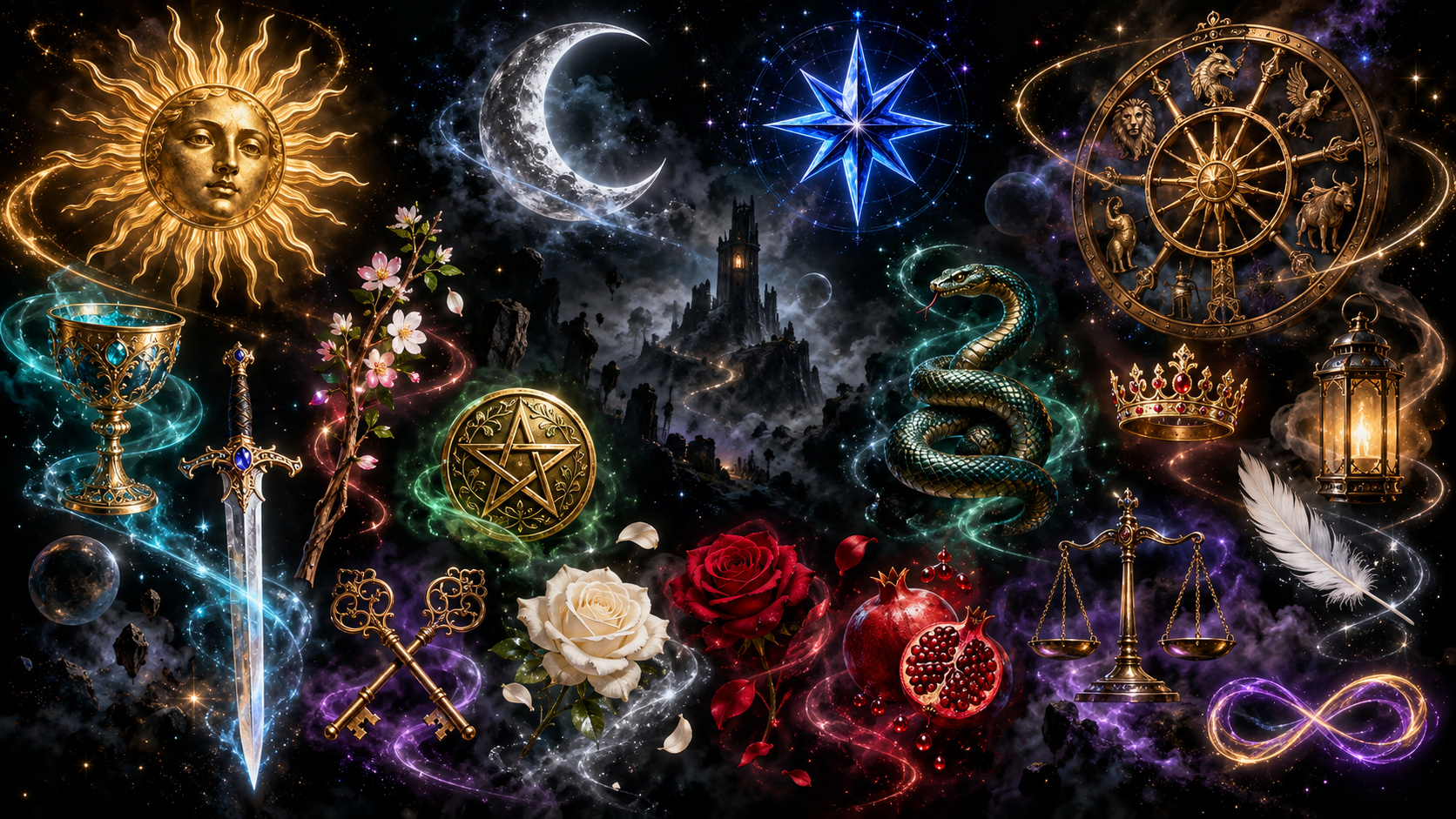
One Symbol, Many Layers
A lion can be read as an animal, instinct, royalty, an archetype of power, the zodiac sign Leo, or part of a myth.
The Moon can evoke cycles, motherhood, body, intuition, dreams, fear, or an astrological force.
Water can signify emotion, the unconscious, purification, life, or memory.
Depth does not come from finding the single “most correct” interpretation. It comes from recognising which layer is relevant now.
Using Mythology in a Reading Without Getting Lost
Mythology should not replace the card. It should open it.
Begin with a simple question: what do I see? Then ask what the symbol means personally. Only afterward add traditional layers — element, number, astrology, Qabalah, or myth.
If the Empress appears in a career reading, Demeter may raise a question about what is being cultivated. In a reading about a child, the same myth can open questions of nurturing and release. In a question about the body, we may return to earth, fertility, rhythm, and cycles.
Myth does not impose an answer. It expands the question.
Why Symbols Work Even When We Do Not Know the Story
This may be the most interesting point.
We can be moved by Death without knowing a single myth of descent into the underworld. We can feel the High Priestess without knowing Persephone. We can sense that something in the Empress nourishes before learning about Venus or Demeter.
From a Jungian perspective, the archetypal pattern precedes our explanation. We meet it through an image, dream, feeling, or story, and only later give it a name.
This is one reason tarot can connect material from different cultures. Not because every mythology tells exactly the same story, but because human beings repeatedly face the same fundamental themes: birth, love, separation, power, fear, choice, loss, death, hope, and renewal.
The cards give those themes a face.
In a Reading, the Symbol Meets a Living Person
Ultimately, a tarot card is not a museum of symbols.
The Magician is not only Mercury. The Empress is not only Demeter. The High Priestess is not only Persephone. The four creatures are not only zodiac signs, and the sphinx is not only Egypt.
All of these are layers.
A reading begins when those layers meet life: a real person, a real question, a relationship, fear, decision, or period of change.
That is where the ego meets something it may not have wanted to see. Where the shadow receives a figure. Where an ancient archetype puts on today's story. And where an old image can become, for a moment, a mirror of what is happening now.