Aleister Crowley: His Life, Family, Worldview, and Thoth Tarot
A journey through Aleister Crowley’s life, family, and controversies, the teachings of Thelema, Hermetic Qabalah, and the creation of the Thoth Tarot with Frieda Harris.

Aleister Crowley (1875–1947) was a mystic, writer, poet, and mountaineer, one of the founders of Thelema, and an influential figure in modern esoteric tarot. The Thoth Tarot, which he created with Frieda Harris, brings together Hermetic Qabalah, astrology, alchemy, and mythology.
Childhood, Parents, and Adolescence
Crowley was born Edward Alexander Crowley on October 12, 1875, in England. His father, Edward, was a businessman and preacher in the Plymouth Brethren movement, and his mother, Emily Bertha Bishop, was deeply religious. His father died in 1887, when Crowley was eleven. Crowley later distanced himself from his strict Christian upbringing. According to biographies, his mother sometimes called him “the Beast”; as an adult, he adopted the name and the number 666 as part of his public persona.
In 1895, he studied at Cambridge, developed an interest in poetry and chess, and pursued mountaineering. He took part in expeditions to K2 in 1902 and Kangchenjunga in 1905, and also traveled to Egypt and India. His travels introduced him to yoga and meditation, which he incorporated into his personal practice.
The Golden Dawn and His Introduction to Tarot
In 1898, he joined the Hermetic Order of the Golden Dawn, where he studied Hermetic Qabalah, astrology, alchemy, ceremonial magic, and tarot. Allan Bennett and Samuel Liddell MacGregor Mathers were among his teachers. Although he fell out with members of the order, its system of correspondences linking cards, Hebrew letters, planets, and the Tree of Life profoundly influenced his work.
Rose Kelly, Family Life, and The Book of the Law
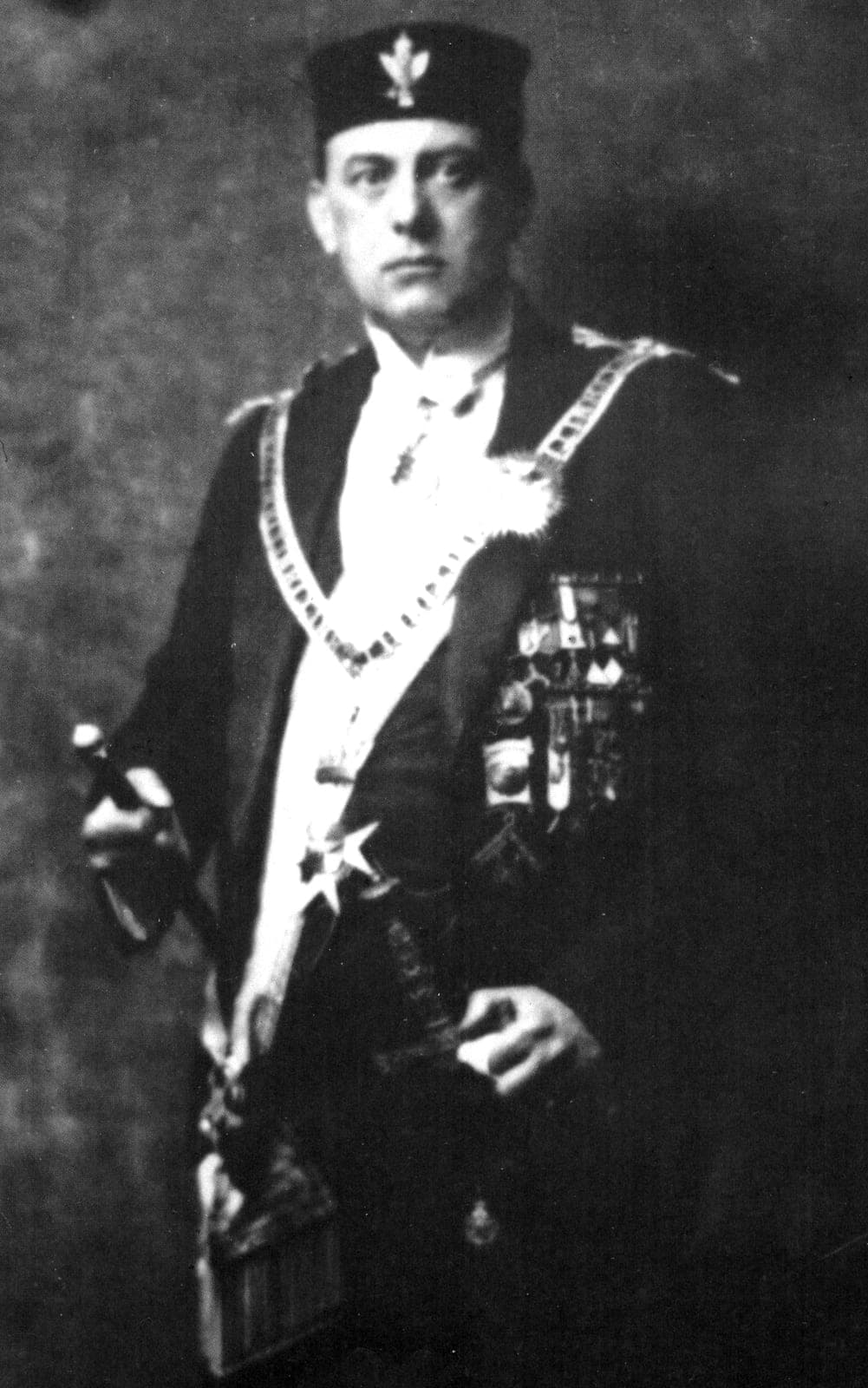
In 1903, he married Rose Edith Kelly. According to Crowley’s account, while they were in Cairo in 1904, Rose received messages associated with Horus, which led to an entity named Aiwass dictating The Book of the Law (Liber AL vel Legis) to him. The writing of the book is a historical fact; its alleged supernatural origin is a matter of belief that cannot be verified.
The couple had two daughters: Lilith, who died in childhood, and Lola Zaza. They divorced in 1909. Leah Hirsig later became his romantic and spiritual partner, taking on the role of the “Scarlet Woman”; their daughter, Anne Leah, died in infancy. In 1929, he married Maria Teresa Ferrari de Miramar. He also had children from other relationships. His family life was marked by loss, conflict, and instability.
Thelema and True Will
Thelema (theh-LEE-mah), Greek for “will,” places True Will at its center. “Do what thou wilt shall be the whole of the Law” is not necessarily a call to indulge every impulse, but an invitation to distinguish fear, habit, and passing desire from a deeper path through life. Its complementary statement is “Love is the law, love under will.”
Crowley defined magick as bringing about change in accordance with will, and practiced ritual, yoga, meditation, and ritual sexuality. These are spiritual ideas and practices, not evidence of supernatural effects. He also described the Aeon of Horus as an age of spiritual responsibility and independence.
The Controversies Surrounding Crowley
Crowley cultivated a provocative public image, but some of the controversies surrounding him concerned actual behavior, not merely religious opposition. Biographies document his use of heroin and other substances, as well as complicated relationships with students and partners, financial dependence on others, and extreme experiments at the Thelema commune he founded in Cefalù, Sicily, in 1920. In 1923, he was expelled from Italy.
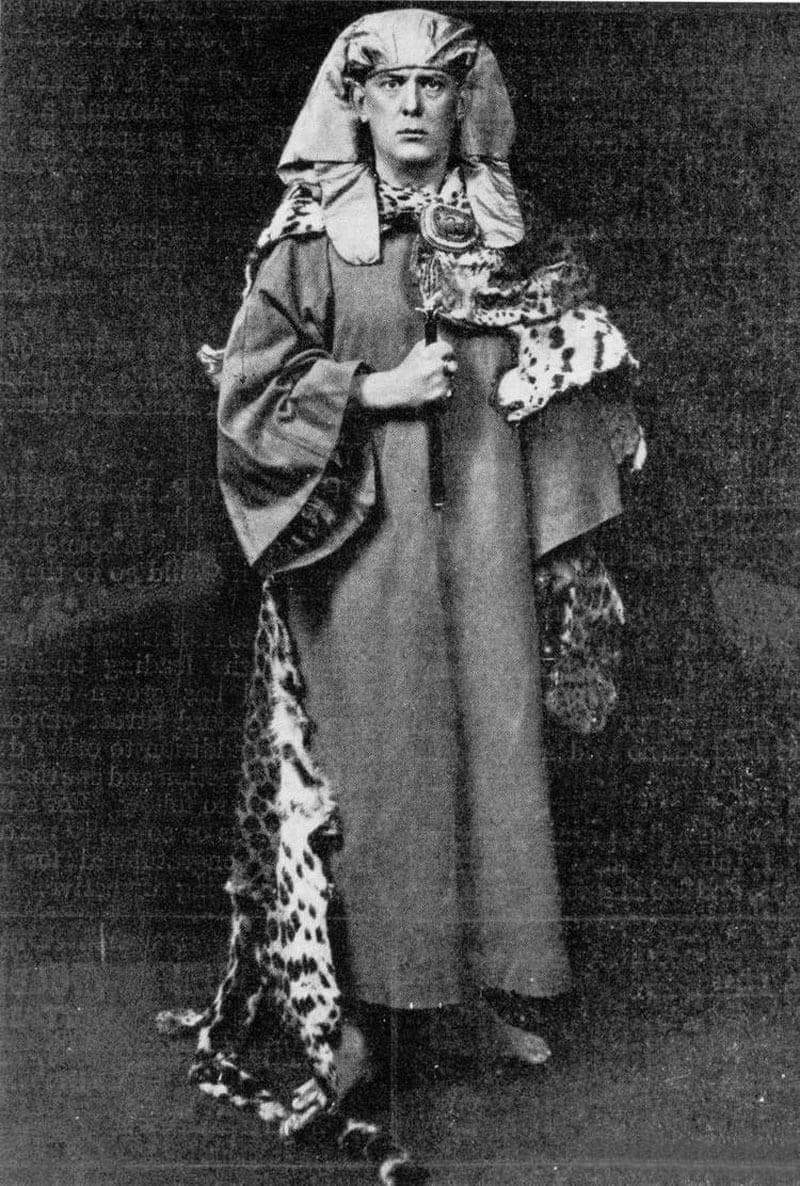
At the same time, the press sometimes portrayed him sensationally. It is important to distinguish documented actions from his opponents’ claims and the mythology he cultivated around himself. His enormous influence on Western esotericism can be acknowledged without justifying his personal conduct.
Frieda Harris and the Thoth Tarot
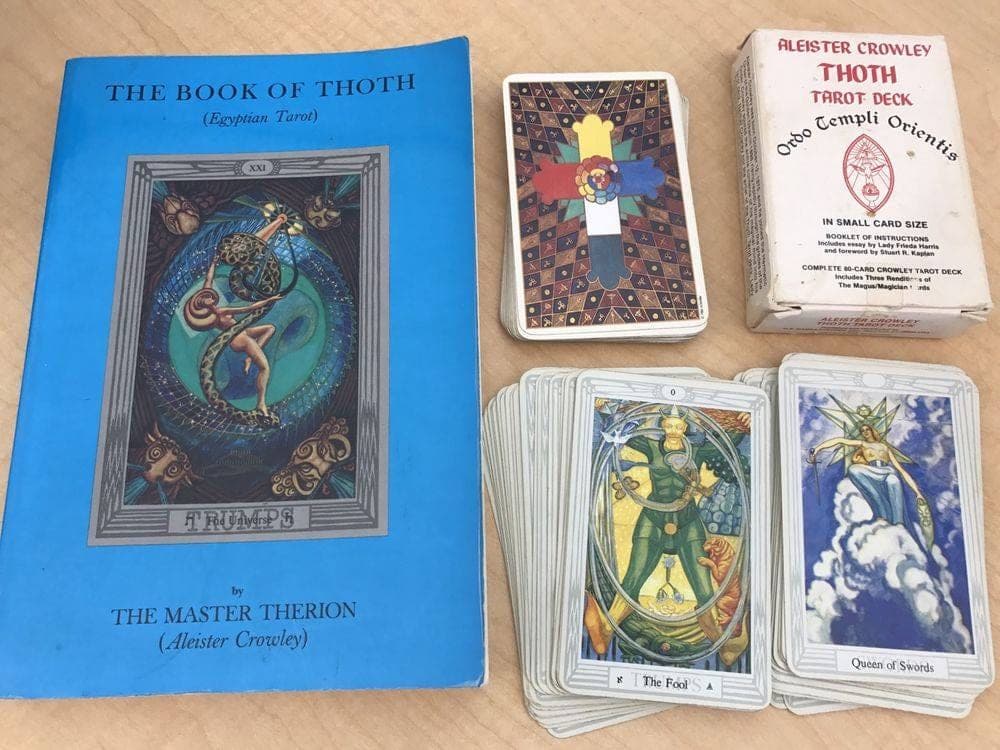
Crowley met Lady Frieda Harris in 1937. Between 1938 and 1943, they worked on the Thoth Tarot. Harris was a central creative partner, not merely an illustrator: she developed a visual language of color, geometry, and movement. Crowley provided the esoteric and interpretive framework. The Book of Thoth was published in 1944, and the complete deck was not printed until after both had died.
The Innovations of the Thoth Tarot
The Thoth Tarot did more than rename cards. Crowley and Harris created a deck in which each card carries the keys to its interpretation on its face.
A title and astrological correspondence for every numbered card. In earlier decks, the numbered cards of the Minor Arcana generally displayed only the suit symbols themselves. In the Thoth Tarot, every card from Two through Ten has a title, such as Dominion for the Two of Wands, Luxury for the Four of Cups, or Ruin for the Ten of Swords, alongside symbols indicating a planet in a zodiac sign. These correspondences draw on the 36 decans, the division of the zodiac into ten-degree segments described in Golden Dawn teachings. The Thoth Tarot was among the first decks to display them on the cards themselves.
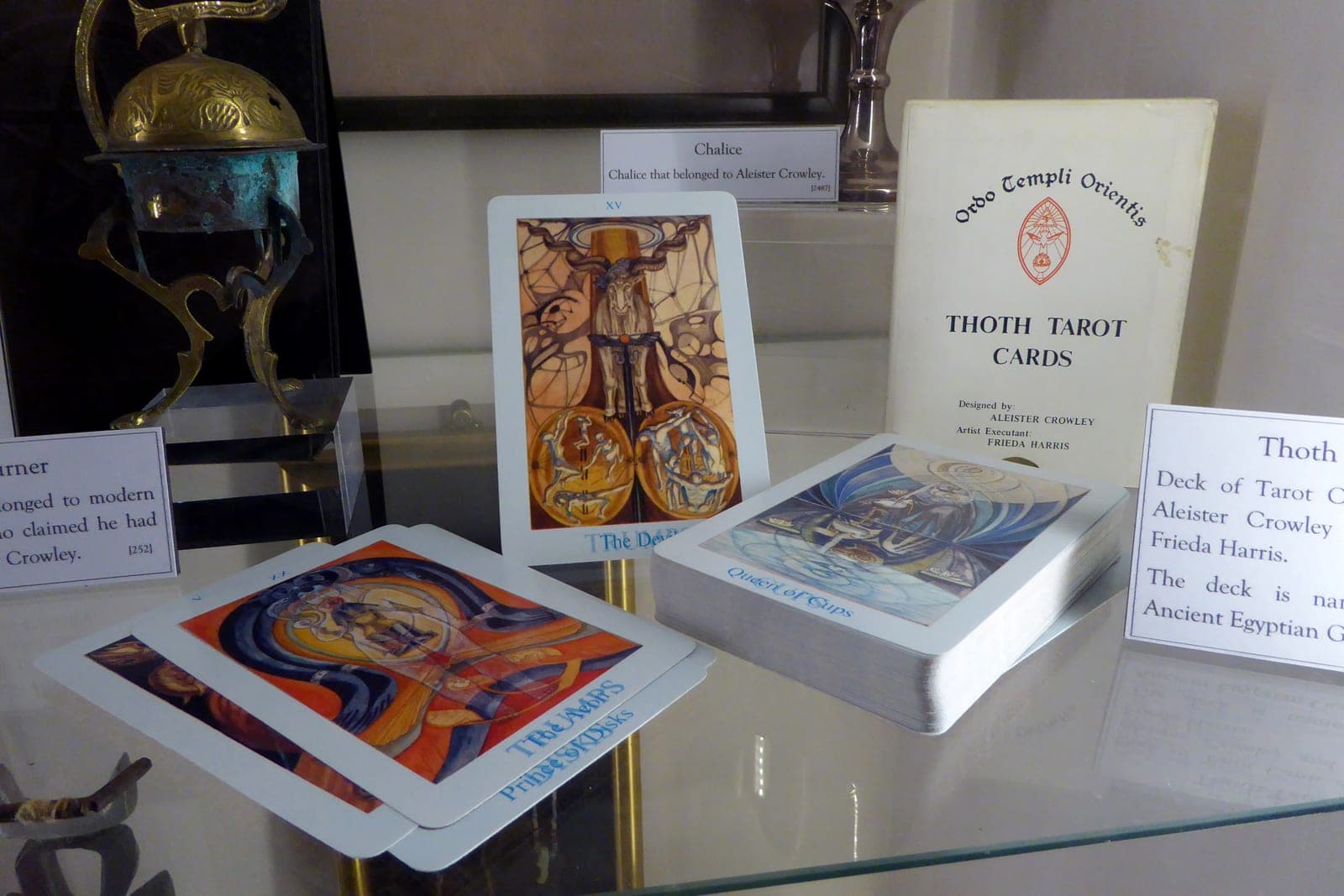
The court-card family. Instead of King, Queen, Knight, and Page, the Thoth Tarot has Knight, Queen, Prince, and Princess. Each figure represents an element within an element: the Knight represents Fire, the Queen Water, the Prince Air, and the Princess Earth. The Prince of Cups, for example, is “Air of Water.” In Golden Dawn terminology, the Princesses are called the “Thrones of the Aces”: they anchor the raw power of the Ace in the material world.
Tzaddi is not the Star. The Book of the Law contains the statement “Tzaddi is not the Star.” Crowley understood this to mean that the Hebrew letters assigned to The Emperor and The Star should be exchanged: The Emperor received Tzaddi, and The Star received Heh. The Golden Dawn had already exchanged the positions of Strength and Justice in the card sequence, and Crowley’s exchange formed a symmetrical “double loop” in the zodiac alongside that earlier switch.
Frieda Harris’s visual language. Harris colored the cards according to the color scales Crowley detailed in his book 777: four scales corresponding to the four worlds of Kabbalah. She also drew on projective geometry and anthroposophy, influences visible in the rays of light, spirals, and intersecting planes. Some editions include three versions of The Magician—called The Magus in this deck—from among the versions she painted during their work together.
Reading without reversed cards. Crowley did not use reversed cards. Instead, following the Golden Dawn method, the relationships among the elements are considered through Elemental Dignities: a card is strengthened by neighboring cards of a friendly element and weakened by cards of an opposing element, such as Fire beside Water. Interpretation is therefore shaped by the neighboring cards in the spread rather than by the card’s orientation.
Its place in tarot history. Alongside the Tarot de Marseille and the Rider–Waite–Smith deck, the Thoth Tarot is considered one of the three major traditions of modern tarot. Many subsequent decks have drawn on its structure, names, and correspondences.
How Does the Thoth Tarot Differ from Rider–Waite–Smith?
| Rider–Waite–Smith | Thoth Tarot | Crowley’s Emphasis |
|---|---|---|
| Strength | Lust | Vitality, desire, and embracing power |
| Justice | Adjustment | Dynamic balance and the laws of cause and effect |
| Temperance | Art | Alchemy and the union of opposites |
| Judgement | The Aeon | Awakening and a shift in consciousness |
| The World | The Universe | Cosmic completion |
| Wheel of Fortune | Fortune | Cycles and the movement of forces |
The changes go beyond names. Lust also concerns recognizing the power of instinct; Art explores the alchemical union of opposites; and Adjustment emphasizes ongoing fine-tuning rather than moral judgment alone. Both decks were influenced by the Golden Dawn, but Crowley and Harris developed a distinctive language.
Crowley, Kabbalah, and the Tree of Life
The Tree of Life originated in Jewish Kabbalah, but within Hermetic Qabalah it was integrated with astrology, alchemy, and tarot. These traditions should be distinguished: Jewish Kabbalah explores the relationships among the Divine, creation, and humanity, while Hermetic Qabalah developed a broad system of esoteric correspondences.
The Tree of Life has ten sephiroth (seh-fee-ROHT) and 22 paths. In the Golden Dawn system, the sephiroth correspond to the ten numbered cards in each suit, and the paths to the Major Arcana cards and the Hebrew letters. Chesed (KHEH-sed) can express abundance and generosity, Gevurah (geh-voo-RAH) boundaries and discernment, and Tiferet (tif-EH-ret) connection and harmony. These are not labels of good and evil, but forces that find expression in different ways.
The Four of Cups, for example, corresponds to Chesed and the element of Water. In the Thoth Tarot it is called Luxury: emotional abundance and comfort can also become overindulgence and stagnation. The Qabalistic correspondence adds a layer of meaning, but does not replace the context of the question and the spread.
The Paths and the Major Arcana
The Magician corresponds to the Hebrew letter Beth and to Mercury, expressing communication, skill, and the ability to bridge idea and action. The High Priestess corresponds to the letter Gimel and to the Moon, expressing mystery, receptivity, and inner knowing. The Empress corresponds to the letter Daleth and to Venus, representing love, fertility, and creativity.
Crowley did not invent these correspondences; he inherited many of them from the Golden Dawn, expanded on them, and changed some assignments, particularly those of The Emperor and The Star, in keeping with his understanding of The Book of the Law.
Archetypes, Mythology, and the Shadow
Archetypes are patterns that recur in myths, dreams, and stories: the mother, the father, the sage, the child, the rebel, and the magician. The concept is associated with Carl Gustav Jung, but Crowley’s system should not be equated with Jungian psychology. An archetypal reading is one possible modern lens through which to approach the Thoth Tarot, not an exact account of its origins.
The Fool may express beginnings, freedom, and innocence, but also a lack of discernment. The Magician represents creativity, language, and talent, but sometimes manipulation as well. The High Priestess symbolizes inner wisdom and mystery, while The Empress represents nurturing, love, and growth, but also attachment and overprotectiveness. The Emperor may represent responsibility and boundaries, or rigidity and control. The Hermit can symbolize reflection or withdrawal.
The Jungian concept of the “shadow” helps us ask what happens when a particular force goes unrecognized or falls out of balance. For Crowley, The Devil is not only about bondage; it is also connected to matter, fertility, and instinct. This does not erase the dangers of dependency and obsession.
Crowley and Harris incorporated imagery from Egyptian, Greek, and Christian mythologies. Within Thelema, Nuit is associated with infinite space, Horus with the new aeon, and Thoth with wisdom and writing. These are reinterpretations within Crowley’s system, not always the original meanings of these figures in ancient Egypt.
The Meaning of a Reading and Crowley’s Legacy
A multilayered reading does not have to pronounce a fixed destiny. Art can invite reflection on the union of opposites; Adjustment, on the relationship between choice and consequence; and Lust, on the meeting of desire and awareness. Sometimes a card describes the querent; at other times, another person, a relationship, or a temporary situation. No single meaning should be imposed.
Crowley died on December 1, 1947, in Hastings, England, at the age of 72. His legacy combines deeply influential esoteric work with a troubled and controversial life. The Thoth Tarot remains an invitation to see each card as a meeting place of psyche, myth, tradition, and life.