

The Knights in Tarot: Bringing Passion, Emotion, Thought, and Action to Life
A comprehensive guide to the four Knights in tarot: what drives them, how they express themselves in relationships, sexuality, family life, and work, and what their pace, symbols, and card combinations reveal about the path from potential to fulfillment.
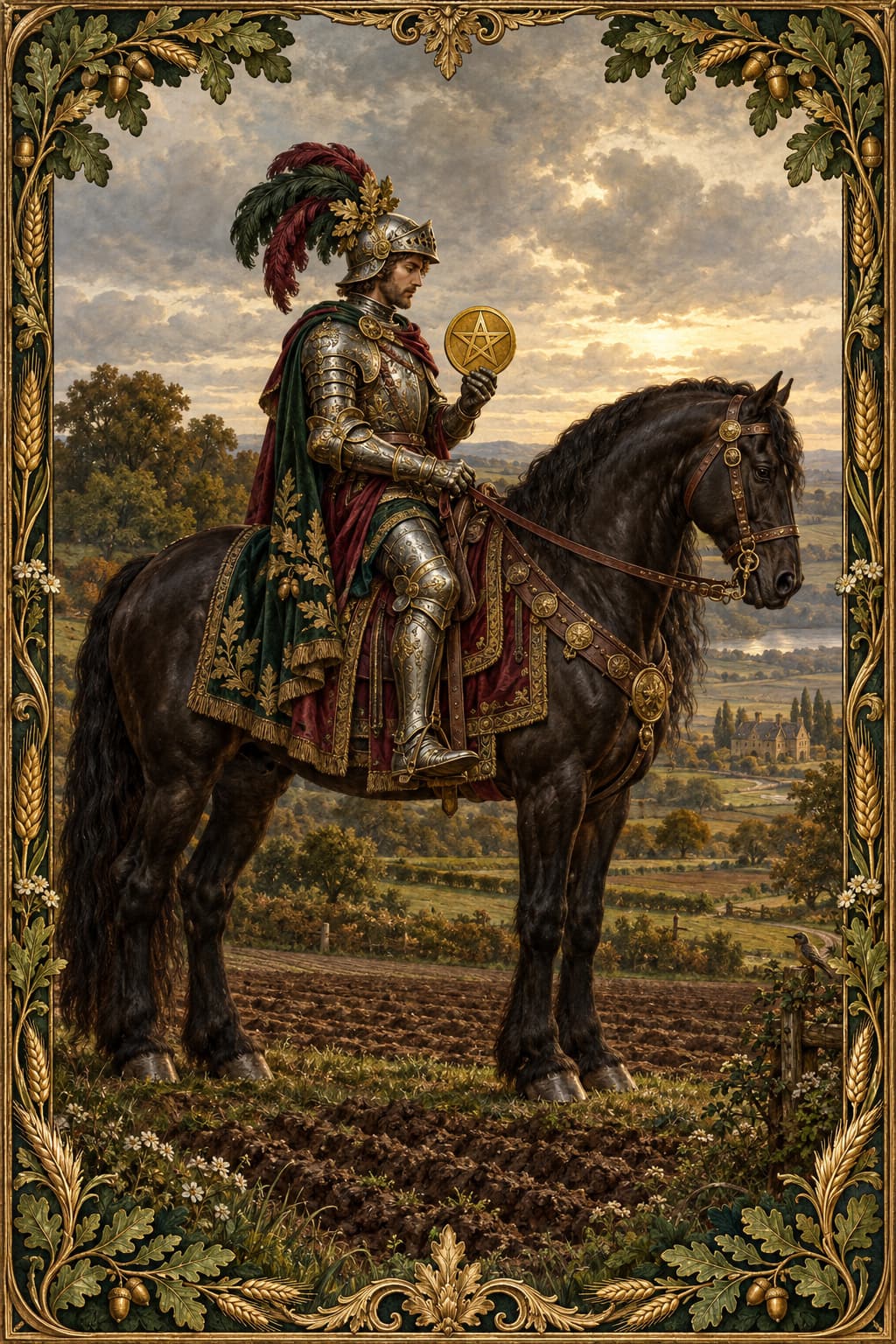
There comes a moment when an idea stops being a possibility and begins to move us. We reach out to someone, set off on a journey, make an offer, stand up for a position, or begin building something that matters to us. The four Knights in tarot describe this moment: a force already in motion that still needs to find direction, a pace, and a way to keep going.
The Knight of Wands moves through passion, the Knight of Cups through emotion, the Knight of Swords through thought, and the Knight of Pentacles through practical responsibility. Each brings a gift, and each can become so carried away by that gift that it turns into a limitation. Fire can kindle life or consume it; emotion can bring us closer or blur our perceptions; thought can clarify or wound; perseverance can build or keep us stuck.
The Knights do not promise success, nor do they necessarily indicate an inability to commit. They help us understand how something is progressing, what drives it, and what it needs to take a form we can sustain over time.
Who Are the Knights, and Where Do They Fit Among the Court Cards?
In the Rider–Waite–Smith deck, the four court ranks are Page, Knight, Queen, and King. The Knight is a mounted figure with a role and character of its own. It is not a Prince, and Prince should not be used as an alternative name. The translation of Page varies among decks; differences in translation do not change the Knight’s identity.
The court can be read as four ways of engaging with a suit’s element: curiosity and learning, experimentation and action, nurturing and emotional receptivity, and leadership and responsibility. This is a useful interpretive model, not a hierarchy that ranks people by their worth. The Queen is not a stage someone must pass through to become a King; the two figures offer different forms of maturity.
Likewise, the Knight does not necessarily represent someone young, male, or immature. People of any gender or age can act with a Knight’s energy. A highly responsible person may appear as a Knight when setting out on a new path, and that same person may express a different Knight at work, in love, and within the family.
In a reading, a Knight may represent a particular person, a temporary behavior, an inner force, or an event: an invitation, a trip, a move, a confrontation, or progress on a project. Before deciding who the Knight is, it helps to ask what role it plays in the question being explored.
For a deeper look at the fundamentals, the guide How to Read Tarot Cards explains how to connect the question, the image, and the context.
The Horse, the Armor, and the Object: How Does the Image Tell the Story?
The horse brings vitality, drive, and the capacity for movement into the image. The rider tries to direct that force, and the relationship between them raises a question: is the person guiding the impulse, or being carried along by it? The armor suggests protection and a readiness to meet difficulty, but it can also symbolize what makes it hard to be vulnerable and grow close to others.
For more on this visual language, read about Symbols, Mythology, and Archetypes in Tarot.
The object in the Knight’s hand shows what lies at the heart of the journey: the wand expresses will and vitality; the cup holds emotion and an offer; the sword embodies thought and decisive judgment; the pentacle focuses attention on value, material concerns, and responsibility. We can ask not only where the Knight is going, but also what the Knight is protecting along the way.
In Rider–Waite–Smith, the horses tell four different stories: the Knight of Wands conveys momentum and restlessness; the Knight of Cups, measured movement; the Knight of Swords, a charge; and the Knight of Pentacles, a steady stance. A standing horse does not mean that nothing is happening: sometimes movement takes place through preparation, observation, or repeated effort.
The direction of the Knight’s gaze and movement can enrich a visual reading if you work with that approach. A Knight facing another card may seem to be seeking its quality, while a Knight facing away from it may emphasize distance. This is an additional layer; the card’s position and the meaning of the question take precedence over any automatic visual rule.
The Four Knights at a Glance
| Knight | Motivation | Gift | Shadow | Question for Growth |
|---|---|---|---|---|
| Knight of Wands | Passion, freedom, experience | Courage, initiative, and vitality | Impulsiveness, scattered energy, and giving up when the excitement fades | How do we keep the fire burning beyond the beginning? |
| Knight of Cups | Emotion, beauty, connection, and meaning | Courtship, empathy, and inspiration | Idealization and promises without follow-through | How do we give emotion a sustainable form? |
| Knight of Swords | Truth, an idea, and a decisive answer | Clarity, determination, and directness | Pressure, rigidity, and hurtful words | How do we move forward without losing the ability to listen? |
| Knight of Pentacles | Security, responsibility, and tangible results | Reliability, patience, and perseverance | Stagnation, stubbornness, and work without vitality | How do we build stability that remains alive? |
Knight of Wands: The Courage to Set Out and the Capacity to Stay
The Knight of Wands is the impulse to dare. This Knight senses that something is possible and wants to encounter it physically and firsthand: to travel, create, start a business, approach someone attractive, or leave a situation that has become too confining. The Knight is willing to experiment before having complete certainty.
The foundation of this energy is explored in the article on The Suit of Wands—Fire, Will, and Creative Power.
In its light, this Knight shares vitality generously. It energizes people, brings confidence and boldness, and rekindles interest where things have grown dormant. In its shadow, the need for excitement can become an endless pursuit. Every beginning looks promising, but dealing with routine, limitations, and disappointments feels like losing freedom.
In Relationships and Sexuality
This is a Knight of attraction, initiative, and chemistry. It can describe enthusiastic courtship, a desire to meet, or the return of passion to a long-standing relationship. In sexuality, it may express playfulness, curiosity, intensity, and a desire for shared experience. Its presence does not prove an intention to pursue a casual relationship, infidelity, or an inability to commit.
The question is what happens when there is no longer anyone to win over. Does the person remain interested when the relationship calls for listening, responsibility, and consideration? Can passion respect a boundary without turning into pressure? Sometimes that same impatience also appears as anger: desire is strong, and the frustration of not having it met seeks an outlet.
The shadow can appear as hot-and-cold behavior or a quick commitment that the person cannot sustain. Still, behaviors such as sexual pressure, ignoring a refusal, or overwhelming someone with gestures need to be addressed as actions in their own right; a card is not a tool for diagnosing someone as manipulative.
At Work, with Money, and in Family Life
At work, this Knight is well suited to launches, entrepreneurship, marketing, leading change, and tasks that require courage. It also needs a framework that helps sustain momentum when it is time to address the details. With money, it may reflect spending driven by enthusiasm, a bold investment, or a desire to buy freedom and experience. The question is whether the available resources can support the pace.
In family life, it brings outings, laughter, and a willingness to try new things. In its shadow, plans that change with someone’s mood become hard to rely on. In a parenting role, it may encourage independence while needing greater consistency. During conflict, it tends to react quickly; in personal growth, it learns that the capacity to stay does not cancel out freedom.
Questions for Reflection: What truly lights me up? Am I moving toward something that matters to me, or running from boredom? What could help me keep going once the initial enthusiasm settles?
Knight of Cups: When the Heart Wants to Reach Out
The Knight of Cups carries something inward out into the world: love, a request for forgiveness, a creative work, a dream, or an offer. This Knight wants the encounter to be meaningful, and wants what is happening within to find an echo in another heart.
Explore the emotional world of this suit in the article on The Suit of Cups—Emotion, Love, and the Capacity to Receive.
In its light, this Knight is attentive, creative, and able to put feelings into words. In its shadow, it can fall in love with an image: a perfect relationship, the role of rescuer, or a version of itself that looks beautiful within the story. The emotion can be entirely sincere and still be insufficient to build a shared life.
In Relationships and Sexuality
The Knight of Cups can describe an invitation, courtship, growing closeness, or an attempt at reconciliation. It seeks connection through a gesture, a conversation, and an atmosphere of openness. This does not mean that the offer has been accepted or that the connection is mutual: an invitation and the response to it are two different things.
In sexuality, it emphasizes emotional closeness, tenderness, fantasy, and the experience of feeling desired and seen. Sometimes the imagined experience is more intense than the person’s ability to talk about actual desires and limits. This Knight’s growth includes curiosity about the real person, even when they do not match the romantic image.
This Knight can be devoted and faithful. The shadow is not romance itself, but the gap between what someone feels and promises and what they follow through on. In an existing relationship, it may restore tenderness and a language of love; during difficulty, it may try to soften everything with a gesture rather than discuss the painful issue.
At Work, with Money, and in Family Life
At work, this Knight brings inspiration, diplomacy, creativity, and an ability to understand people. It may describe an appealing offer, artistic work, or a need to find meaning in what one does. The challenge is to connect a vision with a timeline, boundaries, and a clear agreement.
With money, choices may be influenced by beauty, generosity, nostalgia, or a desire to bring someone joy. In family life, this Knight may be the one who makes peace, remembers important moments, and senses the mood in the room. In its shadow, it struggles to say no, promises more than it can deliver, or expects others to understand feelings that remain unspoken.
In spirituality, it seeks an experience of connection and meaning. Its growth lies in the ability to embrace ordinary reality, too, where there is no special excitement and yet love is still present.
Questions for Reflection: Am I meeting the person in front of me, or the hope they awaken in me? What part of my gesture can I sustain tomorrow? Can I speak an uncomfortable truth without giving up tenderness?
Knight of Swords: Moving Quickly While Remembering the People Along the Way
The Knight of Swords is driven by a sense that something must be understood, decided, or acted on now. This Knight sees a goal, spots a contradiction, and wants to get to the heart of the matter. It may appear when there is a need to speak openly, defend a position, break through hesitation, or respond to an urgent situation.
To understand the power and complexity of thought, see The Suit of Swords—Thought as a Sword.
In its light, this Knight is brave, sharp, and determined. In its shadow, it confuses urgency with importance and confidence with being right. It can be so certain of its direction that it does not hear the information that would require a change of course.
In Relationships and Sexuality
In relationships, this Knight may express a direct approach, an attraction to someone’s mind and intellect, an incisive conversation, or a quick decision. Emotion may emerge through efforts to solve, plan, and protect. Someone can care deeply and still sound as though they are conducting a debate.
The difficulty arises when conversation becomes a battle that must have a winner. Directness helps when it leaves room for a response; it hurts when it allows the other person no room for their own pace, uncertainty, or boundaries. In sexuality, the card may describe mental stimulation, initiative, and intensity, but on its own it does not indicate a particular sexual preference or violence.
Anger, too, can drive the charge. In a reading, we can gently ask whether words are being spoken too quickly, or whether feelings are being expressed only as arguments. The Knight is not heartless; sometimes it needs time to recognize what lies behind its position.
At Work, with Money, and in Family Life
At work, this Knight is suited to troubleshooting, negotiation, research, crisis management, and moving a stalled decision forward. Speed can be an asset when the situation genuinely calls for it. It becomes a liability when it means skipping checks, coordination, or consideration of consequences.
With money, it may reflect a decisive choice or a desire to end a period of indecision. In family life, this Knight may rush to solve a problem and protect others, while struggling to hear that someone needs presence more than a solution. In personal growth, it learns to separate a position from an identity: changing one’s mind is not defeat.
Questions for Reflection: What is truly urgent here? What do I still not know? Do I want to understand, influence, or win? What does the same truth sound like when it also leaves room for another person?
Knight of Pentacles: The Responsibility That Sustains Things
The Knight of Pentacles asks what is needed for something to last. This Knight considers resources, habits, quality, and details. It is willing to do work that may not look impressive from the outside, understanding that many things are built through repetition.
For more on value, material life, and stability, see The Suit of Pentacles—Earth and the Capacity to Build a Tangible Reality.
In its light, this Knight is steady, reliable, and devoted. In its shadow, caution can become endless postponement, and commitment to a method can come at the expense of the goal. It may wait until everything is certain, or continue down a path that no longer fits simply because so much has already been invested in it.
In Relationships and Sexuality
This Knight’s love is visible in actions: being there, remembering, helping, and building trust. It may move slowly because it takes the relationship seriously. Still, slowness alone is not evidence of serious intent. To distinguish building a relationship from avoiding one, look for progress, availability, and a willingness to discuss both people’s needs.
In sexuality, it may emphasize physical sensuality, patience, and a sense of safety that makes it possible to open up. Stability does not have to be boring; sometimes it is the foundation for depth. The shadow appears when habit replaces genuine connection, or when practical action consistently substitutes for emotional expression.
At Work, with Money, and in Family Life
At work, this Knight expresses professionalism, practice, maintenance, and consistent follow-through. It is important in projects that require reliability over time. The challenge is to recognize when quality has become perfectionism, and when a method needs to change rather than simply working harder.
With money, it emphasizes budgeting, conserving resources, and planning. This is not a promise of profit. In family life, it may carry substantial responsibility and express care by taking care of things; in its shadow, it struggles to ask for help or feels that its worth depends on being needed.
In spirituality, it reminds us of the power of regular practice and the possibility of finding meaning within ordinary life. Its growth includes flexibility, enjoyment, and a willingness to be seen even when it is not being useful.
Questions for Reflection: Is something truly being built here? What does my routine make possible, and what does it conceal? Am I staying by choice, or out of fear of change?
The Knights in Family Life, Friendship, and Communication
In friendship, the Knight of Wands invites adventure; the Knight of Cups offers a listening ear and a thoughtful gesture; the Knight of Swords steps forward to speak and act; the Knight of Pentacles shows up and keeps helping over time. Each form can be loving, and each has a point where it misses a different need.
Within a family, differences between the Knights can sometimes look like differences in how much people care. One person wants to act immediately, another needs to talk about feelings, a third wants to understand, and a fourth checks what can actually be done. Instead of deciding who loves more, we can explore the language each person uses to express commitment.
In a reading about parenting or siblings, family members should not be locked into fixed roles. An enthusiastic child is not always the Knight of Wands, and a responsible parent is not always the Knight of Pentacles. The cards can describe the dynamic at a particular moment and the quality it currently lacks.
Body, Emotion, and Spirit: How Do We Use the Energy?
The Knights can be read as a symbolic language of effort and attention: Wands describes physical momentum; Cups, the space given to emotion; Swords, mental activity and urgency; and Pentacles, habits, pace, and maintenance. This is a reflection on experience, not a diagnosis of a medical or mental health condition.
Psychologically, each Knight can rely too heavily on its strongest tool. The Knight of Wands adds activity when feeling is needed; the Knight of Cups adds a story when something needs to be checked; the Knight of Swords adds an explanation when listening is needed; the Knight of Pentacles adds work when it is time to rest or change direction.
As interpretive archetypes, they can be seen as the adventurer, the suitor, the champion of an idea, and the builder. Stories of journeys and chivalry, including the quest for the Holy Grail, can enrich reflection on intention, service, and tests of character. These are symbolic parallels, not proof of a particular historical origin for the cards.
Their shared spiritual question is what the movement is devoted to: excitement, recognition, certainty, security, or something truly worthy of dedication. Sometimes growth begins precisely when the Knight can dismount and be present in the place they have reached.
A Reversed Card: Blockage, Excess, or an Inward Turn
There is no single, universally agreed-upon meaning for a reversed card. It may describe a quality that is blocked, exaggerated, unconscious, or directed inward. Even in a reading without reversals, the shadow side can be recognized through the question, the position, and the neighboring cards.
The distinction between a helpful quality and a burdensome expression is explored in the guide Light, Shadow, Lesson, and Context in Reading a Card.
| Knight | When Movement Is Blocked | When It Becomes Excessive |
|---|---|---|
| Knight of Wands | Loss of enthusiasm, fear of setting out | Impulsiveness, scattered energy, reactivity |
| Knight of Cups | Emotion that cannot find expression | Idealization, emotional overwhelm, grand promises |
| Knight of Swords | Difficulty deciding or saying something clearly | Pressure, charging ahead, and verbal conflict |
| Knight of Pentacles | Procrastination or difficulty persevering | Rigidity, perfectionism, and overwork |
A reversed Knight is not a verdict on someone’s character. It can point to a pattern that can be recognized and understood, and sometimes to external conditions that prevent progress.
Timing, Elements, and Astrology: Distinguishing Among Systems
In most visual readings, the Knight of Swords suggests acceleration; the Knight of Wands, momentum; the Knight of Cups, a pace shaped by emotional openness; and the Knight of Pentacles, gradual development. These are qualities of time, not a precise schedule. Fast movement might mean an immediate message without the entire matter being resolved right away.
For more on the difference between pace, a time window, and a prerequisite, see Time, Timing, and Movement in Tarot.
Different teaching materials assign different correspondences to the rank of Knight: Fire in one system, Air in another. Some of the confusion comes from differences in names and structure among Rider–Waite–Smith, Golden Dawn traditions, and Thoth. The Thoth deck has separate Knight and Prince ranks; they should not be used interchangeably simply because a source draws a correspondence between systems.
For background on the deck and its distinct tradition, read about Aleister Crowley and the Thoth Tarot.
The suit elements provide a consistent foundation for this article: Wands–Fire, Cups–Water, Swords–Air, and Pentacles–Earth. Any additional correspondence involving a rank’s element, a zodiac sign, decans, or a season requires naming the system and deck being used. For that reason, this article does not offer a table of dates presented as a universal truth for all the Knights.
When using astrology in a reading, it helps to ask whether it adds information relevant to the question or merely a label. A card can echo a quality associated with a zodiac sign without establishing that it is the person’s sign. Likewise, the technical numbering of a Knight as 12 in a deck or information system does not prove that 12 has a universal numerological meaning for the card.
The Knight’s Meaning by Position in a Spread
| Position | What to Explore |
|---|---|
| Current situation | What force is already driving the situation, and at what pace? |
| Feelings | How is emotion experienced and expressed: as passion, a gesture, thought, or action? |
| Intentions | Where does the person want to go? An intention is not a commitment to follow through. |
| Obstacle | Is there excessive speed, idealization, rigidity, or delay? |
| Advice | Which quality of the Knight might help, and in what measure? |
| Possible next developments | What pattern may continue if conditions remain similar? |
In an outcome position, a Knight may suggest that the process is still moving and has not yet fully settled. It does not dictate a yes-or-no answer. In a question about commitment, for example, it is important to distinguish among a desire to grow closer, concrete action, and the ongoing mutual consent of two people.
Card Combinations: What Accelerates, Slows, or Changes the Movement?
The following combinations offer possible interpretations, not predictive formulas. The same pair of cards may describe an opportunity, a difficulty, or two complementary qualities, depending on the question and their positions.
Before working with combinations, it helps to explore the guide How to Read a Full Spread: Relationships Between Cards, Elements, and Arcana.
Knight of Wands with Other Cards
- Eight of Wands: Acceleration, messages, and a desire to meet or move forward quickly. It is worth checking whether there is also coordination.
- The Hanged Man: A strong impulse meets a period of waiting. The question is how to bear frustration without forcing movement.
- Temperance: An opportunity to give passion a sustainable pace.
- The Devil: Intense attraction may become entangled with dependency, compulsion, or a need for intensity. This is not proof of infidelity.
- Seven of Pentacles: Tension between wanting an immediate result and a process that needs time.
- Ten of Wands: Multiple initiatives or enthusiastic effort that have become a burden.
Knight of Cups with Other Cards
- Two of Cups: The possibility that an emotional invitation will be met with openness to connection; reciprocity needs to be checked in real life.
- The Lovers: Feeling that calls for a choice and shared values, not just excitement.
- Four of Cups: An offer met with withdrawal, lack of interest, or difficulty receiving it.
- Seven of Cups or The Moon: Imagination, longing, and projection; what was actually said needs to be distinguished from what was merely assumed.
- The Hierophant: An opportunity to give a relationship a mutually agreed-upon structure, or tension between feelings and the expectations that structure carries.
- Nine of Swords: Longing or hope entangled with worry and overthinking.
Knight of Swords with Other Cards
- Ace of Swords: Clarity and a willingness to speak pointedly, with a need to consider timing and wording.
- Two of Swords: Pressure to decide meets defensiveness or uncertainty.
- Three of Swords: A painful truth, words that wound, or a swift reaction to pain. The combination alone cannot establish who is causing the hurt.
- Four of Swords: Tension between urgency and the need to pause and rest.
- Queen of Cups: An opportunity to bring directness together with emotional listening, or a gap between two communication styles.
- Death: A decision, a clean break, or a response to profound change; not every such change is a breakup.
Knight of Pentacles with Other Cards
- Eight of Pentacles: Practice, skill, and steady development.
- Ten of Pentacles: Effort directed toward long-term security, a home, or a legacy.
- Four of Pentacles: Caution that may offer protection or restrict change and generosity.
- The Devil: Responsibility that may turn into bondage to work, material concerns, or habit.
- Wheel of Fortune: Stability meets changing circumstances and is called upon to become more flexible.
- The World: An opportunity to explore the completion and maturation of a long process, without assuming guaranteed success.
Multiple Knights in One Spread
Several Knights may emphasize a period of movement, quick reactions, transitions, or competing directions. They can represent several people, but also different aspects of the same person. Their presence does not automatically indicate multiple romantic interests or the involvement of a third party.
| Pair of Knights | Shared Potential | Possible Tension |
|---|---|---|
| Wands and Cups | Passion finding emotional expression | A desire for experience versus a need for closeness |
| Wands and Swords | Courage and determination driving action | Escalation, competition, and acceleration without checking first |
| Wands and Pentacles | A vision given practical structure | Freedom versus caution, and differences in pace |
| Cups and Swords | Feelings that can be discussed clearly | A need for empathy versus a need for a decision |
| Cups and Pentacles | Care expressed through action | Romantic language versus practical language |
| Swords and Pentacles | A clear-cut decision and methodical follow-through | Urgency versus careful assessment and patience |
When a Queen or King appears beside a Knight, consider whether they offer emotional steadiness, a broader perspective, or responsibility that the movement lacks. They may also represent a separate person or a different tension. Their presence does not guarantee that the Knight will mature or that the relationship will become committed.
Examples of Readings That Bring the Cards Together
Knight of Wands, The Hanged Man, and Two of Cups: Attraction Meets a Different Pace
In a situation–challenge–possibility spread, there is initiative and passion, but the challenge is to tolerate a pause. Two of Cups invites consideration of a mutual connection, provided there is a willingness to respect both people’s pace. One way to phrase this is: “There may be attraction here, but also a difference in pace. Is there room to get to know each other without pressuring the relationship to take shape too quickly?”
Knight of Cups, Seven of Cups, and King of Cups: From Dreaming to Emotional Capacity
Courtship meets a range of possibilities, expectations, or imaginings. King of Cups can offer a quality of emotional regulation and responsibility. This is a possibility for maturation, not a promise that a particular person will change. The question is what makes it possible to see the relationship as it is.
Knight of Swords, Two of Swords, and Queen of Cups: Speaking Without Breaking Through Someone’s Defenses
Someone wants to reach a decision, while there is also difficulty opening up or choosing. Queen of Cups suggests exploring the feelings beneath the defenses. The path to a clear conversation may lie in easing the pressure rather than adding more arguments.
Knight of Pentacles, Eight of Wands, and Ten of Pentacles: When the Pace Changes
Steady effort meets acceleration or a flow of information. Ten of Pentacles raises the question of a long-term foundation: how can this momentum be used without losing what has been built? In a work spread, this may suggest preparedness meeting opportunity, rather than a prediction of certain profit.
A Suggested Spread: From Potential to Purposeful Movement
You can choose a Knight that describes the subject, or shuffle the four Knights and draw one for reflection. Then lay out five cards from the deck, leaving out the chosen Knight:
To give the spread a clear focus, you can turn to the article How to Ask a Tarot Question.
- The Motivation: What is driving the movement?
- The Defense: What am I trying to protect?
- The Pace: What is accelerating or slowing the process?
- The Missing Resource: What quality could open up the path?
- The Possibility: What might develop if I make room for that quality?
This is a spread for reflection, not a test of whether another person’s feelings are genuine. You can use it to explore a relationship, work, creativity, or a personal decision, comparing the story the cards evoke with what is actually known.
Read the Movement, Leave Room for the Person
The Knights offer a rich language for understanding how we desire, feel, think, and build. None of them is good or bad, and none is enough for every situation. There are moments that call for the courage of Wands, moments that need the tenderness of Cups, moments that demand the clarity of Swords, and moments when only the perseverance of Pentacles allows us to move forward.
A reading deepens when we stop asking only, “Who is this Knight?” and begin asking, “What is moving here, where is it headed, and at what cost?” Then we can see both the gift and the need: passion that needs continuity, feeling that needs reality, thought that needs listening, and commitment that needs room for life.